จุดจบของรหัส SWIFT แบบดั้งเดิมมีความหมายอย่างไรต่อสกุลเงินดิจิทัล? หลักฐานจาก Ripple
คำสำคัญ:
สกุลเงินดิจิทัล, การศึกษาเหตุการณ์, ผลตอบแทนผิดปกติ, กฎระเบียบ, ประสิทธิภาพของตลาด, ปฏิกิริยาของตลาด, Ripple, SWIFT, ปฏิกิริยาด้านราคา, นักลงทุนสถาบันบทคัดย่อ
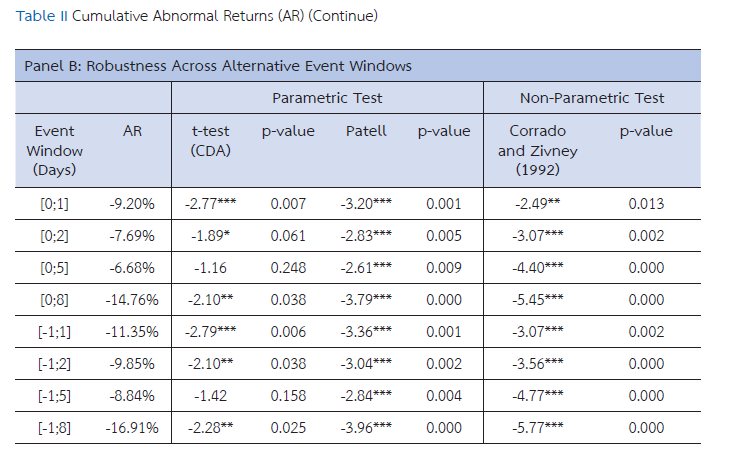
การประกาศอย่างเป็นทางการของ Ripple ในการสนับสนุนมาตรฐาน ISO 20022 ถือเป็นกรณีศึกษาที่น่าสนใจสำหรับการตรวจสอบผลกระทบด้านราคาภายหลังการประกาศในตลาดสกุลเงินดิจิทัล บทความนี้เป็นงานวิจัยชิ้นแรกที่ศึกษาปฏิกิริยาของราคาต่อการนำมาตรฐาน ISO 20022 มาใช้ในบริบทของตลาดคริปโทเคอร์เรนซี ผ่านระเบียบวิธีการศึกษาเหตุการณ์ (event study methodology) ผลการศึกษาพบว่าภายหลังการประกาศสนับสนุนมาตรฐานดังกล่าวราคาของสินทรัพย์ปรับตัวลดลงอย่างมีนัยสำคัญในช่วงไม่กี่วันรอบวันประกาศ แม้ว่าโดยธรรมชาติแล้วข่าวนี้จะถือเป็นข่าวเชิงบวกก็ตาม ความผิดปกติของตลาดในลักษณะนี้สอดคล้องกับพฤติกรรมราคาหุ้นที่ทฤษฎีการถือครองโดยการถือครองแบบกระจุกตัวในตลาดหุ้น ซึ่งเป็นปรากฏการณ์ที่ได้รับการบันทึกและศึกษาอย่างกว้างขวางในวรรณกรรมด้านตลาดหุ้น
เอกสารอ้างอิง
Algieri, B., Lawuobahsumo, K. K., Leccadito, A., & Zahid, I. (2025). Calendar effects on returns, volatility and higher moments: Evidence from crypto markets. The North American Journal of Economics and Finance, 79, Article 102441. https://doi.org/10.1016/j.najef.2025.102441
Antoniadis, I., Gkasis, C., & Kontsas, S. (2019). The Relationship of Insider Trading Announcements, Ownership Structure and Corporate Governance: An Event Study Analysis of Athens Stock Exchange Market Technology Firms. International Journal of Economics and Finance, 11(7), 13–27. https://doi.org/10.5539/ijef.v11n7p13
Bartos, J. (2015). Does Bitcoin follow the hypothesis of efficient market? International Journal of Economic Sciences, 4(2), 10–23. https://doi.org/10.20472/ES.2015.4.2.002
Bouoiyour, J., & Selmi, R. (2019). How do futures contracts affect Bitcoin prices? Economics Bulletin, 39(2), 1127–1134.
Brown, S. J., & Warner, J. B. (1980). Measuring security price performance. Journal of Financial Economics, 8(3), 205–258. https://doi.org/10.1016/0304-405X(80)90002-1
Brown, S. J., & Warner, J. B. (1985). Using daily stock returns. Journal of Financial Economics, 14(1), 3–31. https://doi.org/10.1016/0304-405X(85)90042-X
Byun, H.-Y., Hwang, L.-S., & Lee, W.-J. (2011). How does ownership concentration exacerbate information asymmetry among equity investors? Pacific-Basin Finance Journal, 19(5), 511–534. https://doi.org/10.1016/j.pacfin.2011.06.002
Carhart, M. M. (1997). On persistence in mutual fund performance. The Journal of Finance, 52(1), 57–82. https://doi.org/10.1111/j.1540-6261.1997.tb03808.x
Chen, H., Noronha, G., & Singal, V. (2004). The Price Response to S&P 500 Index Additions and Deletions: Evidence of Asymmetry and a New Explanation. The Journal of Finance, 59(4), 1901–1930. https://doi.org/10.1111/j.1540-6261.2004.00683.x
Chen, H.-L., Shiu, C.-Y., & Wei, H.-S. (2019). Price effect and investor awareness: Evidence from MSCI Standard Index reconstitutions. Journal of Empirical Finance, 50, 93–112. https://doi.org/10.1016/j.jempfin.2019.01.002
Chokor, A., & Alfieri, E. (2021). Long and short-term impacts of regulation in the cryptocurrency market. The Quarterly Review of Economics and Finance, 81, 157–173. https://doi.org/10.1016/j.qref.2021.05.005
Ciaian, P., Rajcaniova, M., & Kancs, d’Artis. (2016). The economics of Bitcoin price formation. Applied Economics, 48(19), 1799–1815. https://doi.org/10.1080/00036846.2015.1109038
Cipriani, M., Goldberg, L. S., & La Spada, G. (2023). Financial sanctions, SWIFT, and the architecture of the international payment system. Journal of Economic Perspectives, 37(1), 31–52. https://doi.org/10.1257/jep.37.1.31
CoinMarketCap. (2025, September 5). Today’s cryptocurrency prices by market cap. https://Coinmarketcap.com
Corrado, C. J. (1989). A nonparametric test for abnormal security-price performance in event studies. Journal of Financial Economics, 23(2), 385–395. https://doi.org/10.1016/0304-405X(89)90064-0
Corrado, C. J., & Zivney, T. L. (1992). The specification and power of the sign test in event study hypothesis tests using daily stock returns. The Journal of Financial and Quantitative Analysis, 27(3), 465. https://doi.org/10.2307/2331331
Cowan, A. R. (1992). Nonparametric event study tests. Review of Quantitative Finance and Accounting, 2(4), 343–358. https://doi.org/10.1007/BF00939016
Cowan, A. R., & Sergeant, A. M. A. (2001). Interacting biases, non-normal return distributions and the performance of tests for long-horizon event studies. Journal of Banking & Finance, 25(4), 741–765. https://doi.org/10.1016/S0378-4266(00)00094-7
Crane, A. D., Michenaud, S., & Weston, J. P. (2016). The effect of institutional ownership on payout policy: Evidence from index thresholds. Review of Financial Studies, 29(6), 1377–1408. https://doi.org/10.1093/rfs/hhw012
Dumrongwong, K. (2021). Calendar effects on cryptocurrencies: Not so straightforward. Southeast Asian Journal of Economics, 9(1), 1–26.
Dumrongwong, K. (2024). The exchange inclusion effect in the cryptocurrency market. The Journal of Investing, 33(3), 56–71. https://doi.org/10.3905/joi.2024.1.300
Fama, E. F., & French, K. R. (1993). Common risk factors in the returns on stocks and bonds. Journal of Financial Economics, 33(1), 3–56. https://doi.org/10.1016/0304-405X(93)90023-5
Fama, E. F., & French, K. R. (2015). A five-factor asset pricing model. Journal of Financial Economics, 116(1), 1–22. https://doi.org/10.1016/j.jfineco.2014.10.010
Gimenes, A. D., Colombo, J. A., & Yousaf, I. (2023). Store of value or speculative investment? Market reaction to corporate announcements of cryptocurrency acquisition. Financial Innovation, 9(1), 123. https://doi.org/10.1186/s40854-023-00539-6
Hrazdil, K. (2010). S&P 500 index inclusion announcements: Does the S&P committee tell us something new? Managerial Finance, 36(5), 368–393. https://doi.org/10.1108/03074351011039418
Huffman, E. (2025, September 5). ISO 20022 crypto: Top list of compliant coins in 2025. https://cryptonews.com/cryptocurrency/iso-20022-crypto
Jain, P. C. (1987). The effect on stock price of inclusion in or exclusion from the S&P 500. Financial Analysts Journal, 43(1), 58–65. https://doi.org/10.2469/faj.v43.n1.58
Jiang, H., Habib, A., & Hu, B. (2011). Ownership concentration, voluntary disclosures and information asymmetry in New Zealand. The British Accounting Review, 43(1), 39–53. https://doi.org/10.1016/j.bar.2010.10.005
Joo, M. H., Nishikawa, Y., & Dandapani, K. (2020). Announcement effects in the cryptocurrency market. Applied Economics, 52(44), 4794–4808. https://doi.org/10.1080/00036846.2020.1745747
Kamal, M. R., & Wahlstrøm, R. R. (2023). Cryptocurrencies and the threat versus the act event of geopolitical risk. Finance Research Letters, 57, Article 104224. https://doi.org/10.1016/j.frl.2023.104224
Kinateder, H., & Papavassiliou, V. G. (2021). Calendar effects in Bitcoin returns and volatility. Finance Research Letters, 38, Article 101420. https://doi.org/10.1016/j.frl.2019.101420
Kolari, J. W., & Pynnönen, S. (2010). Event study testing with cross-sectional correlation of abnormal returns. Review of Financial Studies, 23(11), 3996–4025. https://doi.org/10.1093/rfs/hhq072
Kolari, J. W., & Pynnönen, S. (2011). Nonparametric rank tests for event studies. Journal of Empirical Finance, 18(5), 953–971. https://doi.org/10.1016/j.jempfin.2011.08.003
Köppel, J. (2011). The SWIFT affair: Swiss banking secrecy and the fight against terrorist financing. Graduate Institute Publications. https://doi.org/10.4000/books.iheid.225
Li, S., Xiang, S., & Cui, X. (2025). The booster of long-termism or the tool for major shareholders’ entrenchment? Evidence from staggered boards in emerging markets. Journal of Accounting Literature. https://doi.org/10.1108/JAL-09-2024-0249
Liu, A., Jahanshahloo, H., Chen, J., & Eshraghi, A. (2023). Trading patterns in the Bitcoin market. The European Journal of Finance, 1–18. https://doi.org/10.1080/1351847X.2023.2241883
MacKinlay, A. C. (1997). Event studies in economics and finance. Journal of Economic Literature, 35(1), 13–39. https://www.jstor.org/stable/2729691
Madhavan, A. (2003). The Russell reconstitution effect. Financial Analysts Journal, 59(4), 51–64. https://doi.org/10.2469/faj.v59.n4.2545
Martin, J. (2020, May 6). Ripple joins ISO global standards body on cross-border payments. https://cointelegraph.com/news/ripple-joins-iso-global-standards-body-on-cross-border-payments
Patell, J. M. (1976). Corporate forecasts of earnings per share and stock price behavior: empirical test. Journal of Accounting Research, 14(2), 246–276. https://doi.org/10.2307/2490543
Pynnonen, S. (2022). Non-parametric statistic for testing cumulative abnormal stock returns. Journal of Risk and Financial Management, 15(4), 149. https://doi.org/10.3390/jrfm15040149
Qiu, T., Zhang, R., & Gao, Y. (2019). Ripple vs. SWIFT: Transforming cross border remittance using blockchain technology. Procedia Computer Science, 147, 428–434. https://doi.org/10.1016/j.procs.2019.01.260
Razali, N. M., & Wah, Y. B. (2011). Power comparisons of Shapiro-Wilk, Kolmogorov-Smirnov, Lilliefors and Anderson-Darling tests. Journal of Statistical Modeling and Analytics, 2(1), 21–33.
Ripple. (2020). Q2 2020 XRP markets report. Ripple Insights. https://ripple.com/insights/q2-2020-xrp-markets-report/
SWIFT. (2025a). Why ISO 20022? https://www.swift.com/standards/iso-20022/supercharge-your-payments-business/chapter-2
SWIFT. (2025b, September 5). Who we are. https://www.swift.com/about-us/who-we-are
Vidal-Tomás, D., & Ibañez, A. (2018). Semi-strong efficiency of Bitcoin. Finance Research Letters, 27, 259–265. https://doi.org/10.1016/j.frl.2018.03.013
Wilcoxon, F. (1945). Individual comparisons by ranking methods. Biometrics Bulletin, 1(6), 80–83. https://doi.org/10.2307/3001968
XRPScan. (2025, September 6). Top accounts by XRP balance. https://xrpscan.com/balances
Yaseen, H., & Trifan, R. (2019). The Impact of dividend events on stock returns: findings on companies listed on the Bucharest Stock Exchange. The Review of Finance and Banking, 11(2), 59–78.
Ye, W., & Li, Y. (2025). Ownership structure and firm profitability: Impact of major shareholder gender. Finance Research Letters, 84, 107221. https://doi.org/10.1016/j.frl.2025.107221
Yue, W., Zhang, S., & Zhang, Q. (2021). Asymmetric news effects on cryptocurrency liquidity: an event study perspective. Finance Research Letters, 41, Article 101799. https://doi.org/10.1016/j.frl.2020.101799
Zhou, F. (2025). Application of event study methodology in the analysis of cryptocurrency returns. Emerging Markets Finance and Trade, 61(4), 989–1009. https://doi.org/10.1080/1540496X.2024.2404173
ดาวน์โหลด
เผยแพร่แล้ว
รูปแบบการอ้างอิง
ฉบับ
ประเภทบทความ
สัญญาอนุญาต
ลิขสิทธิ์ (c) 2026 คณะบริหารธุรกิจ สถาบันบัณฑิตพัฒนบริหารศาสตร์

อนุญาตภายใต้เงื่อนไข Creative Commons Attribution-NonCommercial-NoDerivatives 4.0 International License.