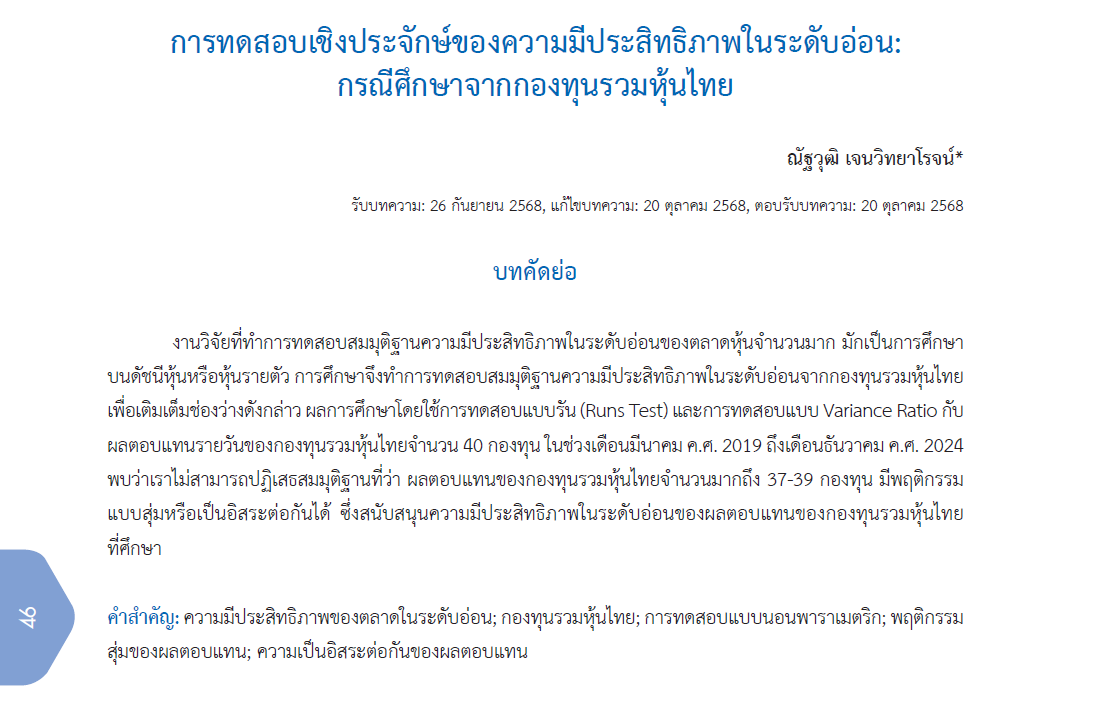
An Empirical Test of the Weak-Form Efficiency: the Case of Thai Equity Mutual Funds
Keywords:
Weak-Form Market Efficiency, Thai Equity Mutual Funds, Non-Parametric Tests, Return Randomness, Return IndependenceAbstract
Most studies on weak-form efficient market hypothesis (Fama, 1970) were done on stock indices or individual stocks. To fill such gap, this study rather tests weak-form market efficiency on Thai equity mutual funds. The results from both runs tests and variance ratio tests on 40 Thai equity mutual funds’ daily returns from March 2019 to December 2024 indicate that we cannot reject the null hypothesis that the daily returns of up to 37 to 39 funds are random or independent, supporting the weak-form efficiency of the returns of the funds under study.
References
Abraham, A., F. J. Seyyed, & S. A. Alsakran. (2002). Testing the random walk behavior and efficiency of the Gulf stock markets. Financial Review, 37(3), 469-480. https://doi.org/10.1111/0732-8516.00008
Banchuenvijit, W., & Choochuen, S. (2013). Market efficiency of the Stock Exchange of Thailand. University of the Thai Chamber of Commerce Journal Humanities and Social Sciences, 33(1), 68-80.
Fama, E. F. (1965). The behavior of stock-market prices. The Journal of Business, 38(1), 34-105. http://www.jstor.org/stable/2350752
Fama, E. F. (1970). Efficient capital markets: A review of theory and empirical work. The Journal of Finance, 25(2), 383-417. https://doi.org/10.2307/2325486
Fama, E. F. (1991). Efficient capital markets: II. The Journal of Finance, 46(5), 1575-1617. https://doi.org/10.1111/j.1540-6261.1991.tb04636.x
Getmansky, M., Lo, A. W., & Makarov, I. (2004). An econometric model of serial correlation and illiquidity in hedge fund returns. Journal of Financial Economics, 74(3), 529-609. https://doi.org/10.1016/j.jfineco.2004.04.001
Jenwittayaroje, N. (2020). Return behavior of the individual stocks: An empirical test on the weak form efficiency of SET50 and SET100 stocks on the Stock Exchange of Thailand. Kasetsart Applied Business Journal, 14(20), 78-96.
Jenwittayaroje, N. (2021). Testing weak-form market efficiency in the Stock Exchange of Thailand. Global Business and Economics Review, 24(3), 211-224. https://doi.org/10.1504/GBER.2021.114657
Jenwittayaroje, N. (2022). The study of the return behavior of the big-cap stocks on the Stock Exchange of Thailand: Evidence from pre-, during, and post-Covid-19. NIDA Business Journal, (31), 96-112. https://so10.tci-thaijo.org/index.php/NIDABJ/article/view/93
Jenwittayaroje, N. (2024). Testing weak-form efficiency of commodities open-ended funds in Thailand. NIDA Business Journal, (34), 74-85. https://so10.tci-thaijo.org/index.php/NIDABJ/article/view/1195
Kenourgios, D., & Y. Samios. (2021). Halloween effect and active fund management. Quarterly Review of Economics and Finance, 80, 534-544. https://doi.org/10.1016/j.qref.2021.04.006
Lo, A. W., & MacKinlay, A. C. (1988). Stock market prices do not follow random walks: Evidence from a simple specification test. The Review of Financial Studies, 1(1), 41-66. http://www.jstor.org/stable/2962126
Downloads
Published
How to Cite
Issue
Section
License
Copyright (c) 2025 NIDA Business School, National Institute of Development Administration

This work is licensed under a Creative Commons Attribution-NonCommercial-NoDerivatives 4.0 International License.