An Empirical Investigation of the Random-Walk Behavior of Various Stock Indices in the Stock Exchange of Thailand
Keywords:
Random-Walk Behavior, Weak-Form Market Efficiency, Stock Indices, Non-Parametric TestsAbstract
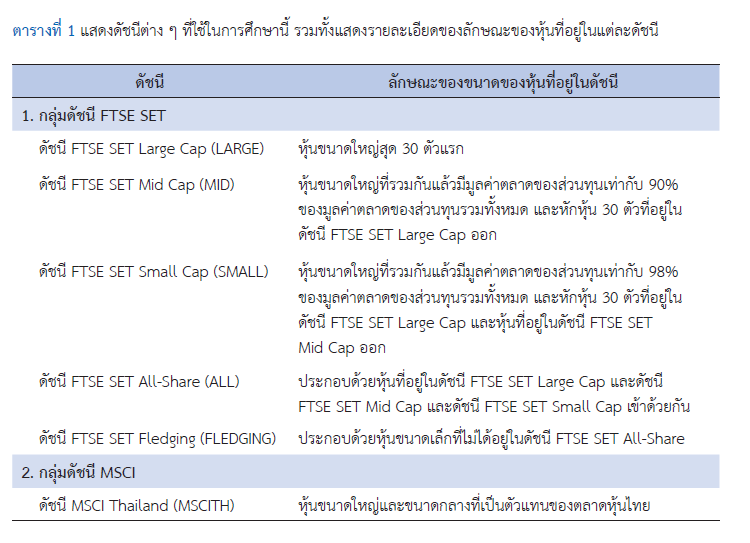
This study examines the random-walk behavior of the daily returns of 15 stock indices in the Stock Exchange of Thailand over the period from May 2020 to December 2025, including several indices that have not been analyzed in this context. The results from both parametric and non-parametric tests indicate that random-walk behavior, or weak-form efficiency, is related to the size of stocks in an index, and not to the index’s investment theme. Specifically, large-cap indices exhibit random-walk behavior, whereas small-cap indices do not and instead display positively autocorrelated returns. Compared with previous studies on the Thai stock market, the evidence shows that large-cap stocks are weak-form efficient both before and after the Covid-19 crisis, while small-cap stocks remain weak-form inefficient in both periods. The inefficiency of small-cap stocks may stem from an insufficiently effective price discovery process for these stocks, which has important implications for policy design aimed at improving price discovery process in the small-cap groups.
References
Aumeboonsuke, V., & Dryver, A. L. (2014). The importance of using a test of weak-form market efficiency that does not require investigating the data first. International Review of Economics & Finance, 33, 350-357. https://doi.org/10.1016/j.iref.2014.02.009
Fama, E. F. (1965). The behavior of stock-market prices. Journal of Business, 38(1), 34-105. https://doi.org/10.1086/294743
Fama, E. F. (1970). Efficient capital markets: A review of theory and empirical work. Journal of Finance, 25(2), 383-417. https://doi.org/10.2307/2325486
Hoque, H. A. A. B., Kim, J. H., & Pyun, C. S. (2007). A comparison of variance ratio tests of random walk: A case of Asian emerging stock markets. International Review of Economics & Finance, 16(4), 488-502. https://doi.org/10.1016/j.iref.2006.06.002
Huang, B. N. (1995). Do Asian stock market prices follow random walks? Evidence from the variance ratio test. Applied Financial Economics, 5(4), 251-256. https://doi.org/10.1080/758536875
Jenwittayaroje, N. (2021). Testing weak-form market efficiency in the stock exchange of Thailand. Global Business and Economics Review, 24(3), 211-224. https://doi.org/10.1504/GBER.2021.114657
Jenwittayaroje, N. (2022). The study of the return behavior of the big-cap stocks on the Stock Exchange of Thailand: Evidence from pre-, during, and post-Covid-19. NIDA Business Journal, 31, 96-112. https://so10.tci-thaijo.org/index.php/NIDABJ/article/view/93
Jiranyakul, K. (2007). Behavior of stock market index in the stock exchange of Thailand. NIDA Economic Review, 2(2), 47-57. https://doi.org/10.14456/der.2008.4
Lo, A. W. (2004). The adaptive markets hypothesis: Market efficiency from an evolutionary perspective. The Journal of Portfolio Management, 30(5), 15-29. https://doi.org/10.3905/jpm.2004.442611
Lo, A. W., & MacKinlay, A. C. (1988). Stock market prices do not follow random walks: Evidence from a simple specification test. The Review of Financial Studies, 1(1), 41-66. https://doi.org/10.1093/rfs/1.1.41
Lo, A. W., & MacKinlay, A. C. (1990). An econometric analysis of nonsynchronous trading. Journal of Econometrics, 45(1-2), 181-211. https://doi.org/10.1016/0304-4076(90)90098-E
Morgan Stanley Capital International (2026). MSCI Thailand Index. MSCI Inc. https://www.msci.com/indexes/index/105769
Smith, G. (2012). The changing and relative efficiency of European emerging stock markets. The European Journal of Finance, 18(8), 689-708. https://doi.org/10.1080/1351847 X.2011.628682
Wright, J. H. (2000). Alternative variance-ratio tests using ranks and signs. Journal of Business & Economic Statistics, 18(1), 1-9. https://doi.org/10.1080/07350015.2000.10524842
Downloads
Published
How to Cite
Issue
Section
License
Copyright (c) 2026 NIDA Business School, National Institute of Development Administration

This work is licensed under a Creative Commons Attribution-NonCommercial-NoDerivatives 4.0 International License.