AI-Enabled Customer Engagement, Online Brand Trust, and Sustainable Brand Equity in Platform-Based E-Commerce Distribution: A Conceptual Framework
Keywords:
Artificial Intelligence, Customer Engagement, Online Brand Trust, Sustainable Brand Equity, E-Commerce, Thailand, Perceived RiskAbstract
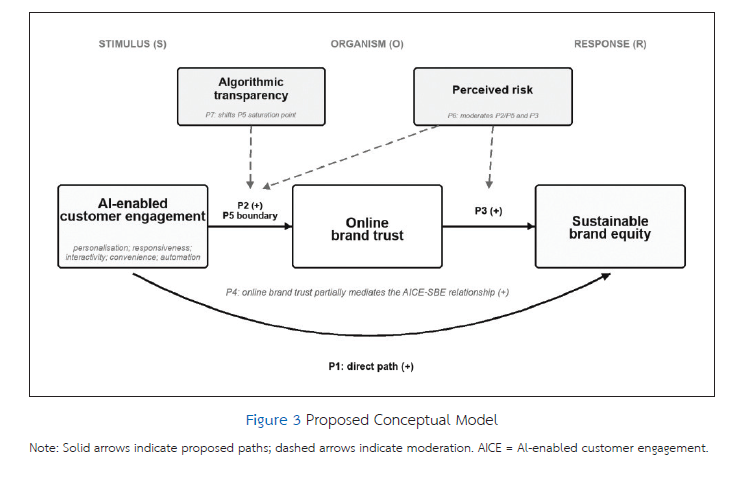
Artificial Intelligence (AI) has significantly influenced interactions between e-commerce businesses and their customers on a day-to-day basis today. Recommendation engines, chatbots, automated service replies, and customer analytics can improve the frequency and efficacy of a brand's interactions with customers. However, increasing contact does not necessarily add value to a brand. This is a conceptual framework paper that presents a theoretical model that describes the impact of AI-Enabled Customer Engagement (AICE) on Sustainable Brand Equity (SBE) via online brand trust. This paper does not seek to make an environmental or social sustainability claim, but rather a claim that SBE is an attribute of customer-based brand value in the long term. The model is grounded in customer engagement theory, online trust research, the customer-based brand equity tradition, and the Stimulus-Organism-Response (SOR) framework. It proposes four core relationships: AICE is proposed to influence SBE, AICE is proposed to influence online brand trust, online brand trust is proposed to influence SBE, and online brand trust is proposed to partially mediate the AICE-SBE relationship. Three new boundary conditions are formulated to extend this framework: non-linear (inverted-U) engagement-trust linkage, the role of perceived risk as a moderator, and the importance of algorithmic transparency as a condition that shifts the saturation point. The Thai e-commerce environment is chosen because official market statistics show that e-marketplaces and social commerce play significant roles as sales channels where AI-mediated engagement can be observed in customer journeys. As a conceptual contribution, this work presents a theory-building framework as opposed to empirical results in a platform-based and social-commerce distribution channels setting. Its main contribution is the introduction of the AI Engagement Saturation Model (AIESM), which postulates an inverted-U saturation effect of AICE on online brand trust until a certain saturation point, after which additional AI engagement deteriorates online brand trust.
References
Aaker, D. A. (1991). Managing brand equity: Capitalizing on the value of a brand name. The Free Press.
Adam, M., Wessel, M., & Benlian, A. (2021). AI-based chatbots in customer service and their effects on user compliance. Electronic Markets, 31(2), 427-445. https://doi.org/10.1007/s12525-020-00414-7
Aguirre, E., Mahr, D., Grewal, D., de Ruyter, K., & Wetzels, M. (2015). Unraveling the personalization paradox: The effect of information collection and trust-building strategies on online advertisement effectiveness. Journal of Retailing, 91(1), 34-49. https://doi.org/10.1016/j.jretai.2014.09.005
Akhtar, N., Gupta, P., Taheri, B., & Alghafes, R. (2026). Unveiling the role of chatbot conversational attributes of hospitality booking platforms in developing users' creepiness and paradoxical behaviors. International Journal of Hospitality Management, 133, 104428. https://doi.org/10.1016/j.ijhm.2025.104428
Aydin, S. (2026). Brand trust in AI-driven e-commerce personalization: The well-being-privacy trade-off. Sustainability, 18(2), 1073. https://doi.org/10.3390/su18021073
Baalbaki, S., & Guzman, F. (2016). A consumer-perceived consumer-based brand equity scale. Journal of Brand Management, 23(3), 229-251. https://doi.org/10.1057/bm.2016.11
Bilal, M., Zhang, Y., Cai, S., Akram, U., & Halibas, A. (2024). Artificial intelligence is the magic wand making customer-centric a reality! An investigation into the relationship between consumer purchase intention and consumer engagement through affective attachment. Journal of Retailing and Consumer Services, 77, 103674. https://doi.org/10.1016/j.jretconser.2023.103674
Brodie, R. J., Hollebeek, L. D., Jurić, B., & Ilić, A. (2011). Customer engagement: Conceptual domain, fundamental propositions, and implications for research. Journal of Service Research, 14(3), 252-271. https://doi.org/10.1177/1094670511411703
Cai, N., Gao, S., & Yan, J. (2024). How the communication style of chatbots influences consumers' satisfaction, trust, and engagement in the context of service failure. Humanities and Social Sciences Communications, 11, 687. https://doi.org/10.1057/s41599-024-03212-0
Chaudhuri, A., & Holbrook, M. B. (2001). The chain of effects from brand trust and brand affect to brand performance: The role of brand loyalty. Journal of Marketing, 65(2), 81-93. https://doi.org/10.1509/jmkg.65.2.81.18255
Cloarec, J., Meyer-Waarden, L., & Munzel, A. (2024). Transformative privacy calculus: Conceptualizing the personalization-privacy paradox on social media. Psychology & Marketing, 41(7), 1574-1596. https://doi.org/10.1002/mar.21998
Dananjoyo, R., & Udin, U. (2023). The effect of sustainable brand equity on customer satisfaction and customer loyalty using customer trust as mediation variable. International Journal of Sustainable Development and Planning, 18(7), 2281-2291. https://doi.org/10.18280/ijsdp.180733
Davenport, T., Guha, A., Grewal, D., & Bressgott, T. (2020). How artificial intelligence will change the future of marketing. Journal of the Academy of Marketing Science, 48(1), 24-42. https://doi.org/10.1007/s11747-019-00696-0
Electronic Transactions Development Agency. (2024, May 31). ETDA reveals Thailand's e-commerce value in 2023 is expected to reach THB 5.96 trillion [Press release]. https://www.etda.or.th/th/pr-news/Dgt_ecom_survey2024.aspx
Featherman, M. S., & Pavlou, P. A. (2003). Predicting e-services adoption: A perceived risk facets perspective. International Journal of Human-Computer Studies, 59(4), 451-474. https://doi.org/10.1016/S1071-5819(03)00111-3
Hassan, N., Abdelraouf, M., & El-Shihy, D. (2025). The moderating role of personalized recommendations in the trust-satisfaction-loyalty relationship: An empirical study of AI-driven e-commerce. Future Business Journal, 11(1), 66. https://doi.org/10.1186/s43093-025-00476-z
Hollebeek, L. D., Glynn, M. S., & Brodie, R. J. (2014). Consumer brand engagement in social media: Conceptualization, scale development and validation. Journal of Interactive Marketing, 28(2), 149-165. https://doi.org/10.1016/j.intmar.2013.12.002
Huang, M.-H., & Rust, R. T. (2018). Artificial intelligence in service. Journal of Service Research, 21(2), 155-172. https://doi.org/10.1177/1094670517752459
Ishaq, M. I., & Di Maria, E. (2020). Sustainability countenance in brand equity: A critical review and future research directions. Journal of Brand Management, 27(1), 15-34. https://doi.org/10.1057/s41262-019-00167-5
Jaakkola, E. (2020). Designing conceptual articles: Four approaches. AMS Review, 10(1-2), 18-26. https://doi.org/10.1007/s13162-020-00161-0
Jacoby, J. (2002). Stimulus-organism-response reconsidered: An evolutionary step in modeling (consumer) behavior. Journal of Consumer Psychology, 12(1), 51-57. https://doi.org/10.1207/S15327663JCP1201_05
Keller, K. L. (1993). Conceptualizing, measuring, and managing customer-based brand equity. Journal of Marketing, 57(1), 1-22. https://doi.org/10.1177/002224299305700101
Lemon, K. N., & Verhoef, P. C. (2016). Understanding customer experience throughout the customer journey. Journal of Marketing, 80(6), 69-96. https://doi.org/10.1509/jm.15.0420
MacInnis, D. J. (2011). A framework for conceptual contributions in marketing. Journal of Marketing, 75(4), 136-154. https://doi.org/10.1509/jmkg.75.4.136
Martin, K. D., Borah, A., & Palmatier, R. W. (2017). Data privacy: Effects on customer and firm performance. Journal of Marketing, 81(1), 36-58. https://doi.org/10.1509/jm.15.0497
Mehrabian, A., & Russell, J. A. (1974). An approach to environmental psychology. MIT Press.
Morgan, R. M., & Hunt, S. D. (1994). The commitment-trust theory of relationship marketing. Journal of Marketing, 58(3), 20-38. https://doi.org/10.1177/002224299405800302
Mostafa, R. B., & Kasamani, T. (2022). Antecedents and consequences of chatbot initial trust. European Journal of Marketing, 56(6), 1748-1771. https://doi.org/10.1108/EJM-02-2020-0084
Nikolov, A., Iyer, P., Rokonuzzaman, M., Batra, G., Eskridge, B., & Sen, S. (2025). The AI chatbot anthropomorphism dilemma. Marketing Intelligence & Planning, 44(3), 500-523. https://doi.org/10.1108/MIP-09-2024-0623
Park, K., & Yoon, H. (2024). Beyond the code: The impact of AI algorithm transparency signaling on user trust and relational satisfaction. Public Relations Review, 50(5), 102507. https://doi.org/10.1016/j.pubrev.2024.102507
Park, Y., & Gong, T. (2023). Curvilinear relationship between customer engagement and responses to service failures. The Service Industries Journal, 45(1), 54-80. https://doi.org/10.1080/02642069.2022.2164273
Pavlou, P. A. (2003). Consumer acceptance of electronic commerce: Integrating trust and risk with the technology acceptance model. International Journal of Electronic Commerce, 7(3), 101-134. https://doi.org/10.1080/10864415.2003.11044275
Perez-Vega, R., Kaartemo, V., Lages, C. R., Borghei Razavi, N., & Männistö, J. (2021). Reshaping the contexts of online customer engagement behavior via artificial intelligence: A conceptual framework. Journal of Business Research, 129, 902-910. https://doi.org/10.1016/j.jbusres.2020.11.002
Puntoni, S., Reczek, R. W., Giesler, M., & Botti, S. (2021). Consumers and artificial intelligence: An experiential perspective. Journal of Marketing, 85(1), 131-151. https://doi.org/10.1177/0022242920953847
Rahman, M. S., Bag, S., Hossain, M. A., Abdel Fattah, F. A. M., Gani, M. O., & Rana, N. P. (2023). The new wave of AI-powered luxury brands online shopping experience: The role of digital multisensory cues and customers' engagement. Journal of Retailing and Consumer Services, 72, 103273. https://doi.org/10.1016/j.jretconser.2023.103273
Shabankareh, M., Kalantari Daronkola, H., Sarhadi, A., Thaichon, P., & Nazarian, A. (2025). The influence of artificial intelligence quality on business-to-business relationships on e-commerce platforms: Unveiling the nexus. International Journal of Advertising, 44(8), 1483-1522. https://doi.org/10.1080/02650487.2025.2557053
Song, S., & Shin, M. (2022). Uncanny valley effects on chatbot trust, purchase intention, and adoption intention in the context of e-commerce: The moderating role of avatar familiarity. International Journal of Human-Computer Interaction, 40(2), 441-456. https://doi.org/10.1080/10447318.2022.2121038
Sun, H., Xie, P., & Sun, Y. (2025). The inverted U-shaped effect of personalization on consumer attitudes in AI-generated ads: Striking the right balance between utility and threat. Journal of Advertising Research, 65(2), 237-258. https://doi.org/10.1080/00218499.2025.2462405
Suraña-Sánchez, C., & Aramendia-Muneta, M. E. (2024). Impact of artificial intelligence on customer engagement and advertising engagement: A review and future research agenda. International Journal of Consumer Studies, 48(2), e13027. https://doi.org/10.1111/ijcs.13027
Teepapal, T. (2025). AI-driven personalization: Unraveling consumer perceptions in social media engagement. Computers in Human Behavior, 165, 108549. https://doi.org/10.1016/j.chb.2024.108549
Van Doorn, J., Lemon, K. N., Mittal, V., Nass, S., Pick, D., Pirner, P., & Verhoef, P. C. (2010). Customer engagement behavior: Theoretical foundations and research directions. Journal of Service Research, 13(3), 253-266. https://doi.org/10.1177/1094670510375599
Yoo, B., & Donthu, N. (2001). Developing and validating a multidimensional consumer-based brand equity scale. Journal of Business Research, 52(1), 1-14. https://doi.org/10.1016/S0148-2963(99)00098-3
Downloads
Published
How to Cite
Issue
Section
License
Copyright (c) 2026 NIDA Business School, National Institute of Development Administration

This work is licensed under a Creative Commons Attribution-NonCommercial-NoDerivatives 4.0 International License.