การมีส่วนร่วมของลูกค้าที่ขับเคลื่อนด้วยปัญญาประดิษฐ์ ความไว้วางใจในตราสินค้าออนไลน์และคุณค่าตราสินค้าที่ยั่งยืนในการกระจายสินค้า อีคอมเมิร์ซบนแพลตฟอร์ม: กรอบแนวคิดเชิงทฤษฎี
คำสำคัญ:
ปัญญาประดิษฐ์, การมีส่วนร่วมของลูกค้า, ความไว้วางใจในตราสินค้าออนไลน์, คุณค่าตราสินค้าที่ยั่งยืน, อีคอมเมิร์ซ, การรับรู้ความเสี่ยง, ประเทศไทยบทคัดย่อ
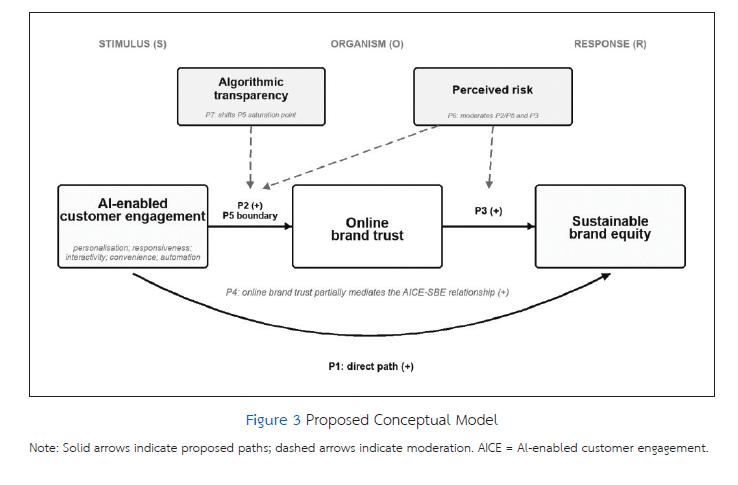
ปัจจุบันปัญญาประดิษฐ์ (AI) มีอิทธิพลอย่างมากต่อปฏิสัมพันธ์ระหว่างธุรกิจอีคอมเมิร์ซกับลูกค้าในชีวิตประจำวัน ระบบแนะนำสินค้า แชตบอต การตอบกลับบริการอัตโนมัติ และการวิเคราะห์ข้อมูลลูกค้า สามารถเพิ่มความถี่และประสิทธิผลของการปฏิสัมพันธ์ระหว่างตราสินค้ากับลูกค้าได้ อย่างไรก็ตาม การมีปฏิสัมพันธ์กับลูกค้าที่มากขึ้นไม่จำเป็นต้องเพิ่มคุณค่าให้แก่ตราสินค้าเสมอไป บทความนี้เป็นบทความเชิงแนวคิดที่นำเสนอแบบจำลองเชิงทฤษฎีซึ่งอธิบายผลกระทบของการมีส่วนร่วมของลูกค้าที่ขับเคลื่อนด้วยปัญญาประดิษฐ์ (AICE) ต่อคุณค่าตราสินค้าที่ยั่งยืน (SBE) ผ่านความไว้วางใจในตราสินค้าออนไลน์ ทั้งนี้บทความมิได้มุ่งอ้างความยั่งยืนด้านสิ่งแวดล้อมหรือสังคม แต่หมายถึง SBE ในฐานะคุณค่าตราสินค้าที่อิงกับลูกค้าในระยะยาว แบบจำลองนี้ตั้งอยู่บนทฤษฎีการมีส่วนร่วมของลูกค้า งานวิจัยด้านความไว้วางใจออนไลน์ แนวคิดคุณค่าตราสินค้าที่อิงกับลูกค้า และกรอบสิ่งเร้า-สภาวะภายใน-การตอบสนอง (SOR) โดยเสนอความสัมพันธ์หลักสี่ประการ ได้แก่ AICE ส่งผลต่อ SBE, AICE ส่งผลต่อความไว้วางใจในตราสินค้าออนไลน์, ความไว้วางใจในตราสินค้าออนไลน์ส่งผลต่อ SBE และความไว้วางใจในตราสินค้าออนไลน์เป็นตัวแปรส่งผ่านบางส่วนของความสัมพันธ์ระหว่าง AICE กับ SBE จากนั้นขยายกรอบด้วยข้อเสนอเชิงขอบเขตสามประการ คือ ขีดจำกัดความสัมพันธ์ไม่เป็นเชิงเส้นแบบรูปตัวยูคว่ำ (inverted-U) ระหว่างการมีส่วนร่วมกับความไว้วางใจ การรับรู้ความเสี่ยงในฐานะตัวแปรกำกับ และความโปร่งใสของอัลกอริทึมในฐานะเงื่อนไขที่เลื่อนจุดอิ่มตัว บริบทอีคอมเมิร์ซไทยถูกเลือกเนื่องจากหลักฐานเชิงตลาดอย่างเป็นทางการบ่งชี้ว่าตลาดกลางออนไลน์และโซเชียลคอมเมิร์ซเป็นช่องทางการขายหลักที่การมีส่วนร่วมผ่าน AI ปรากฏชัดในเส้นทางของลูกค้าประจำวัน ในฐานะบทความเชิงแนวคิด บทความนี้นำเสนอกรอบสำหรับการสร้างทฤษฎีมากกว่าการรายงานผลการวิจัย โดยวางอยู่ในบริบทช่องทางการกระจายสินค้าแบบแพลตฟอร์มและโซเชียลคอมเมิร์ซ ข้อเสนอหลักของบทความคือแบบจำลองภาวะอิ่มตัวของการมีส่วนร่วมผ่าน AI (AIESM) ซึ่งอธิบายผลของภาวะอิ่มตัวแบบรูปตัวยูคว่ำ กล่าวคือ AI สร้างความไว้วางใจในตราสินค้าออนไลน์ได้เพียงจนถึงจุดอิ่มตัวที่ขึ้นกับความโปร่งใสและความเสี่ยง หลังจากนั้นการมีส่วนร่วมที่เพิ่มขึ้นจะบั่นทอนความไว้วางใจ
เอกสารอ้างอิง
Aaker, D. A. (1991). Managing brand equity: Capitalizing on the value of a brand name. The Free Press.
Adam, M., Wessel, M., & Benlian, A. (2021). AI-based chatbots in customer service and their effects on user compliance. Electronic Markets, 31(2), 427-445. https://doi.org/10.1007/s12525-020-00414-7
Aguirre, E., Mahr, D., Grewal, D., de Ruyter, K., & Wetzels, M. (2015). Unraveling the personalization paradox: The effect of information collection and trust-building strategies on online advertisement effectiveness. Journal of Retailing, 91(1), 34-49. https://doi.org/10.1016/j.jretai.2014.09.005
Akhtar, N., Gupta, P., Taheri, B., & Alghafes, R. (2026). Unveiling the role of chatbot conversational attributes of hospitality booking platforms in developing users' creepiness and paradoxical behaviors. International Journal of Hospitality Management, 133, 104428. https://doi.org/10.1016/j.ijhm.2025.104428
Aydin, S. (2026). Brand trust in AI-driven e-commerce personalization: The well-being-privacy trade-off. Sustainability, 18(2), 1073. https://doi.org/10.3390/su18021073
Baalbaki, S., & Guzman, F. (2016). A consumer-perceived consumer-based brand equity scale. Journal of Brand Management, 23(3), 229-251. https://doi.org/10.1057/bm.2016.11
Bilal, M., Zhang, Y., Cai, S., Akram, U., & Halibas, A. (2024). Artificial intelligence is the magic wand making customer-centric a reality! An investigation into the relationship between consumer purchase intention and consumer engagement through affective attachment. Journal of Retailing and Consumer Services, 77, 103674. https://doi.org/10.1016/j.jretconser.2023.103674
Brodie, R. J., Hollebeek, L. D., Jurić, B., & Ilić, A. (2011). Customer engagement: Conceptual domain, fundamental propositions, and implications for research. Journal of Service Research, 14(3), 252-271. https://doi.org/10.1177/1094670511411703
Cai, N., Gao, S., & Yan, J. (2024). How the communication style of chatbots influences consumers' satisfaction, trust, and engagement in the context of service failure. Humanities and Social Sciences Communications, 11, 687. https://doi.org/10.1057/s41599-024-03212-0
Chaudhuri, A., & Holbrook, M. B. (2001). The chain of effects from brand trust and brand affect to brand performance: The role of brand loyalty. Journal of Marketing, 65(2), 81-93. https://doi.org/10.1509/jmkg.65.2.81.18255
Cloarec, J., Meyer-Waarden, L., & Munzel, A. (2024). Transformative privacy calculus: Conceptualizing the personalization-privacy paradox on social media. Psychology & Marketing, 41(7), 1574-1596. https://doi.org/10.1002/mar.21998
Dananjoyo, R., & Udin, U. (2023). The effect of sustainable brand equity on customer satisfaction and customer loyalty using customer trust as mediation variable. International Journal of Sustainable Development and Planning, 18(7), 2281-2291. https://doi.org/10.18280/ijsdp.180733
Davenport, T., Guha, A., Grewal, D., & Bressgott, T. (2020). How artificial intelligence will change the future of marketing. Journal of the Academy of Marketing Science, 48(1), 24-42. https://doi.org/10.1007/s11747-019-00696-0
Electronic Transactions Development Agency. (2024, May 31). ETDA reveals Thailand's e-commerce value in 2023 is expected to reach THB 5.96 trillion [Press release]. https://www.etda.or.th/th/pr-news/Dgt_ecom_survey2024.aspx
Featherman, M. S., & Pavlou, P. A. (2003). Predicting e-services adoption: A perceived risk facets perspective. International Journal of Human-Computer Studies, 59(4), 451-474. https://doi.org/10.1016/S1071-5819(03)00111-3
Hassan, N., Abdelraouf, M., & El-Shihy, D. (2025). The moderating role of personalized recommendations in the trust-satisfaction-loyalty relationship: An empirical study of AI-driven e-commerce. Future Business Journal, 11(1), 66. https://doi.org/10.1186/s43093-025-00476-z
Hollebeek, L. D., Glynn, M. S., & Brodie, R. J. (2014). Consumer brand engagement in social media: Conceptualization, scale development and validation. Journal of Interactive Marketing, 28(2), 149-165. https://doi.org/10.1016/j.intmar.2013.12.002
Huang, M.-H., & Rust, R. T. (2018). Artificial intelligence in service. Journal of Service Research, 21(2), 155-172. https://doi.org/10.1177/1094670517752459
Ishaq, M. I., & Di Maria, E. (2020). Sustainability countenance in brand equity: A critical review and future research directions. Journal of Brand Management, 27(1), 15-34. https://doi.org/10.1057/s41262-019-00167-5
Jaakkola, E. (2020). Designing conceptual articles: Four approaches. AMS Review, 10(1-2), 18-26. https://doi.org/10.1007/s13162-020-00161-0
Jacoby, J. (2002). Stimulus-organism-response reconsidered: An evolutionary step in modeling (consumer) behavior. Journal of Consumer Psychology, 12(1), 51-57. https://doi.org/10.1207/S15327663JCP1201_05
Keller, K. L. (1993). Conceptualizing, measuring, and managing customer-based brand equity. Journal of Marketing, 57(1), 1-22. https://doi.org/10.1177/002224299305700101
Lemon, K. N., & Verhoef, P. C. (2016). Understanding customer experience throughout the customer journey. Journal of Marketing, 80(6), 69-96. https://doi.org/10.1509/jm.15.0420
MacInnis, D. J. (2011). A framework for conceptual contributions in marketing. Journal of Marketing, 75(4), 136-154. https://doi.org/10.1509/jmkg.75.4.136
Martin, K. D., Borah, A., & Palmatier, R. W. (2017). Data privacy: Effects on customer and firm performance. Journal of Marketing, 81(1), 36-58. https://doi.org/10.1509/jm.15.0497
Mehrabian, A., & Russell, J. A. (1974). An approach to environmental psychology. MIT Press.
Morgan, R. M., & Hunt, S. D. (1994). The commitment-trust theory of relationship marketing. Journal of Marketing, 58(3), 20-38. https://doi.org/10.1177/002224299405800302
Mostafa, R. B., & Kasamani, T. (2022). Antecedents and consequences of chatbot initial trust. European Journal of Marketing, 56(6), 1748-1771. https://doi.org/10.1108/EJM-02-2020-0084
Nikolov, A., Iyer, P., Rokonuzzaman, M., Batra, G., Eskridge, B., & Sen, S. (2025). The AI chatbot anthropomorphism dilemma. Marketing Intelligence & Planning, 44(3), 500-523. https://doi.org/10.1108/MIP-09-2024-0623
Park, K., & Yoon, H. (2024). Beyond the code: The impact of AI algorithm transparency signaling on user trust and relational satisfaction. Public Relations Review, 50(5), 102507. https://doi.org/10.1016/j.pubrev.2024.102507
Park, Y., & Gong, T. (2023). Curvilinear relationship between customer engagement and responses to service failures. The Service Industries Journal, 45(1), 54-80. https://doi.org/10.1080/02642069.2022.2164273
Pavlou, P. A. (2003). Consumer acceptance of electronic commerce: Integrating trust and risk with the technology acceptance model. International Journal of Electronic Commerce, 7(3), 101-134. https://doi.org/10.1080/10864415.2003.11044275
Perez-Vega, R., Kaartemo, V., Lages, C. R., Borghei Razavi, N., & Männistö, J. (2021). Reshaping the contexts of online customer engagement behavior via artificial intelligence: A conceptual framework. Journal of Business Research, 129, 902-910. https://doi.org/10.1016/j.jbusres.2020.11.002
Puntoni, S., Reczek, R. W., Giesler, M., & Botti, S. (2021). Consumers and artificial intelligence: An experiential perspective. Journal of Marketing, 85(1), 131-151. https://doi.org/10.1177/0022242920953847
Rahman, M. S., Bag, S., Hossain, M. A., Abdel Fattah, F. A. M., Gani, M. O., & Rana, N. P. (2023). The new wave of AI-powered luxury brands online shopping experience: The role of digital multisensory cues and customers' engagement. Journal of Retailing and Consumer Services, 72, 103273. https://doi.org/10.1016/j.jretconser.2023.103273
Shabankareh, M., Kalantari Daronkola, H., Sarhadi, A., Thaichon, P., & Nazarian, A. (2025). The influence of artificial intelligence quality on business-to-business relationships on e-commerce platforms: Unveiling the nexus. International Journal of Advertising, 44(8), 1483-1522. https://doi.org/10.1080/02650487.2025.2557053
Song, S., & Shin, M. (2022). Uncanny valley effects on chatbot trust, purchase intention, and adoption intention in the context of e-commerce: The moderating role of avatar familiarity. International Journal of Human-Computer Interaction, 40(2), 441-456. https://doi.org/10.1080/10447318.2022.2121038
Sun, H., Xie, P., & Sun, Y. (2025). The inverted U-shaped effect of personalization on consumer attitudes in AI-generated ads: Striking the right balance between utility and threat. Journal of Advertising Research, 65(2), 237-258. https://doi.org/10.1080/00218499.2025.2462405
Suraña-Sánchez, C., & Aramendia-Muneta, M. E. (2024). Impact of artificial intelligence on customer engagement and advertising engagement: A review and future research agenda. International Journal of Consumer Studies, 48(2), e13027. https://doi.org/10.1111/ijcs.13027
Teepapal, T. (2025). AI-driven personalization: Unraveling consumer perceptions in social media engagement. Computers in Human Behavior, 165, 108549. https://doi.org/10.1016/j.chb.2024.108549
Van Doorn, J., Lemon, K. N., Mittal, V., Nass, S., Pick, D., Pirner, P., & Verhoef, P. C. (2010). Customer engagement behavior: Theoretical foundations and research directions. Journal of Service Research, 13(3), 253-266. https://doi.org/10.1177/1094670510375599
Yoo, B., & Donthu, N. (2001). Developing and validating a multidimensional consumer-based brand equity scale. Journal of Business Research, 52(1), 1-14. https://doi.org/10.1016/S0148-2963(99)00098-3
ดาวน์โหลด
เผยแพร่แล้ว
รูปแบบการอ้างอิง
ฉบับ
ประเภทบทความ
สัญญาอนุญาต
ลิขสิทธิ์ (c) 2026 คณะบริหารธุรกิจ สถาบันบัณฑิตพัฒนบริหารศาสตร์

อนุญาตภายใต้เงื่อนไข Creative Commons Attribution-NonCommercial-NoDerivatives 4.0 International License.