Applying Artificial Intelligence for Developing Customer Experiences in Banking Services
Keywords:
Artificial Intelligence, Customer ExperienceAbstract
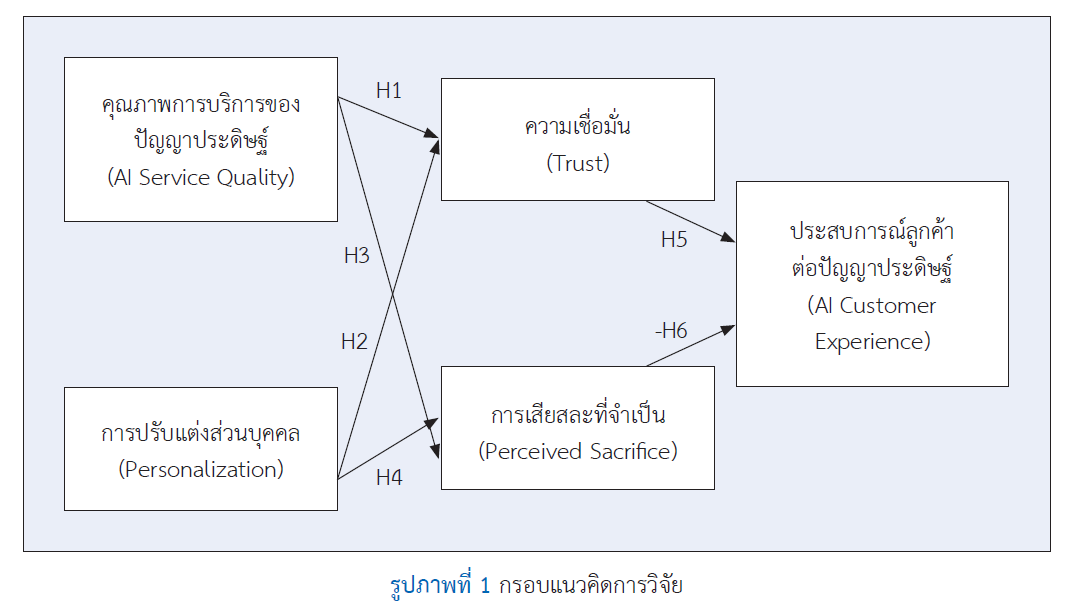
This study investigated the application of artificial intelligence (AI) technology to enhance customer experience within the banking service industry. The objectives of the research were to analyze a conceptual model of customer experience using AI technology and to identify the factors that constitute and influence customer experience in service businesses. Data were collected from a sample of 400 banking service customers residing in Bangkok and its metropolitan area, utilizing a structured questionnaire. The data were analyzed using descriptive statistics, including mean and standard deviation, and inferential statistics, specifically Structural Equation Modeling (SEM) for hypothesis testing.
The findings indicate that the adoption of AI technology in banking services is significantly influenced by service quality, trust, and personalization, all of which play a crucial role in enhancing customer experience. Conversely, the study found that customer sacrifices required for adapting to AI technology had no significant effect on the development of customer experience.
This research highlights that the integration of AI in the banking sector is essential for improving customer experience. To achieve this, AI applications for customer experience should incorporate elements of trust, convenience, and satisfaction with AI capabilities, as well as personalized service adjustments tailored to each customer. By focusing on these elements, banks can create superior customer experiences, ultimately gaining a competitive advantage in the digital era.
References
Ainur, A. K., Sayang, M. D., Jannoo, Z., & Yap, B. W. (2017). Sample size and non-normality effects on goodness of fit measures in structural equation models. Pertanika Journal of Science & Technology, 25(2), 575–586.
Al-Sabawi, R., & Al-Qudah, A. (2022). The moderating role of cost and convenience on the relationship in the UTAUT model to adopt e-payment services. International Journal of E-Payment Services, 32(1), Article 14.
Bendapudi, N., & Leone, R. P. (2003). Psychological implications of customer participation in co-production. Journal of Marketing, 67(1), 14–28. https://doi.org/10.1509/jmkg.67.1.14.18585
Bhalodia, G., Gediya, P., & Kher, V. (2024). Awareness and usage of digital payment modes among people of Rajkot city. In Digital Transformation and Consumer (Vol. 1, p. 4). https://doi.org/10.1201/9781003606185-154
Bienstock, C. C., Mentzer, J. T., & Bird, M. M. (1997). Measuring physical distribution service quality. Journal of the Academy of Marketing Science, 18(1), 31–44. https://doi.org/10.1007/BF02894507
Chang, V., Sivakulasingam, S., Wang, H., Wong, S. T., Ganatra, M. A., & Luo, J. (2024). Credit risk prediction using machine learning and deep learning: A study on credit card customers. Risks, 12, Article 174. https://doi.org/10.3390/risks12110174
Collier, J. E., & Bienstock, C. C. (2006). Measuring service quality in e-retailing. Journal of Service Research, 8(3), 260–275. https://doi.org/10.1177/1094670505278867
Comfere, C. L., Kascher, B., & Wiedenbeck, S. (2003). Trust and risk in e-commerce: A review. Information Systems Journal, 50(6), 737–758.
Corritore, C. L., Kracher, B., & Wiedenbeck, S. (2003). On-line trust: Concepts, evolving themes, a model. International Journal of Human-Computer Studies, 58(6), 737–758. https://doi.org/10.1016/S1071-5819(03)00041-7
Davis, F. D., Bagozzi, R. P., & Warshaw, P. R. (1989). User acceptance of computer technology: A comparison of two theoretical models. Management Science, 35(8), 982–1003. https://doi.org/10.1287/mnsc.35.8.982
De Winter, J., Dodou, D., & Eisma, Y. B. (2024). Personality and acceptance as predictors of ChatGPT use. Discover Psychology, 4, Article 57. https://doi.org/10.1007/s44202-024-00161-2
Guo, X., Zhang, X., & Sun, Y. (2016). The privacy–personalization paradox in mHealth services acceptance of different age groups. Information & Management, 53(2), 215–226. https://doi.org/10.1016/j.im.2015.09.010
Gupta, G., Bhatia, R., Singla, V., Joshi, M. C., & Rani, M. (2024). Study of chatbot in customer service at banking. In IEEE International Conference on Contemporary Computing and Informatics (Vol. 6, pp. 1–6). https://doi.org/10.1109/IC3I59117.2023.10397723
Kumar, N., Sharma, N. K., & Kumar, S. (2023). WSOmark: An adaptive dual-purpose color image watermarking using white shark optimizer and Levenberg–Marquardt BPNN. Expert Systems with Applications, 72, Article 120137. https://doi.org/10.1016/j.eswa.2023.120137
Lin, C.-H., Sher, P. J., & Shih, H.-Y. (2005). Past–present–future of ERP research: A review of the empirical literature. International Journal of Management Science, 16(4), 318–338. https://doi.org/10.1108/09564230510613988
Mick, D. G., & Fournier, S. (1998). Paradoxes of technology: Consumer cognizance, emotions, and coping strategies. Journal of Consumer Research, 25(2), 123–143. https://doi.org/10.1086/209531
Morgan, R. M., & Hunt, S. D. (1994). The commitment-trust theory of relationship marketing. Journal of Marketing, 58(3), 20–38. https://doi.org/10.1177/002224299405800302
Parasuraman, A., Zeithaml, V. A., & Berry, L. L. (1985). A conceptual model of service quality and its implications for future research. Journal of Marketing, 49(4), 41–50. https://doi.org/10.1177/002224298504900403
Preciado Martínez, P. M., Reier Forradellas, R. F., Garay Gallastegui, L. M., & Náñez Alonso, S. L. (2025). Comparative analysis of machine learning models for the detection of fraudulent banking transactions. Cogent Business & Management, 12(1). https://doi.org/10.1080/23311975.2025.2474209
Shrestha, N. (2021). Factor analysis as a tool for survey analysis. American Journal of Applied Mathematics and Statistics, 9(1), 4–11. https://doi.org/10.12691/ajams-9-1-2
Tarhini, A., Ameen, N., Rappel, A., & Anand, A. (2021). Customer experiences in the age of artificial intelligence. Computers in Human Behavior, 114, Article 106549. https://doi.org/10.1016/j.chb.2020.106548
Wind, J., & Rangaswamy, A. (2001). Customerization: The next revolution in mass customization. Harvard Business Review, 79(1), 13–32. https://doi.org/10.1002/1520-6653(200124)15:1<13::AID-DIR1001>3.0.CO;2-#
Yamane, T. (1967). Statistics: An introductory analysis (2nd ed.). Harper and Row.
Zeithaml, V. A. (1988). Consumer perceptions of price, quality, and value: A means-end model and synthesis of evidence. Journal of Marketing, 52(3), 2–22. https://doi.org/10.1177/002224298805200302
Downloads
Published
How to Cite
Issue
Section
License
Copyright (c) 2026 NIDA Business School, National Institute of Development Administration

This work is licensed under a Creative Commons Attribution-NonCommercial-NoDerivatives 4.0 International License.