Social Return on Investment (SROI) Assessment of the Creative Community Economy Enhancement Project in Chiang Mai Province
Keywords:
Social Return on Investment (SROI), Creative Economy, Community Product Development, Chiang MaiAbstract
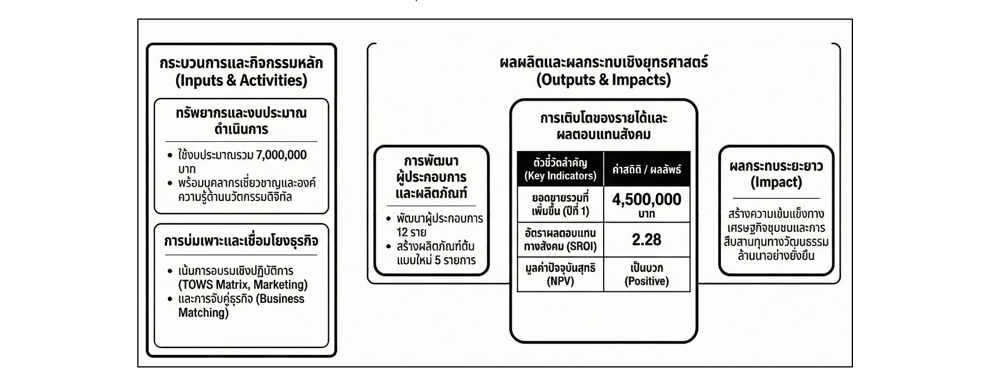
Objectives this study aims to assess the Social Return on Investment (SROI) of the Creative Smart Community Development Project driven by the university mechanism in the pilot area of Chiang Mai province. Methodology: The study employed a mixed-methods evaluative research design. Data were collected from 12 selected community enterprises and OTOP groups using in-depth interviews and financial record forms. The analysis followed the standard 6-step SROI framework, establishing a 5-year benefit period and applying a 5% financial discount rate to calculate the Net Present Value (NPV). Results: The results revealed that with a total investment of 7,000,000 THB, the project generated a Net Present Value (NPV) of 8,946,549 THB and an SROI ratio of 2.28. This indicates that every 1 THB invested yields a social and economic return of 2.28 THB. Key financial outcomes were primarily driven by incremental sales from online channels, physical shop improvements, and recurring revenue from new prototype products. Conclusion: It is concluded that the "University as a Driver" model, focusing on product innovation and market incubation, is a highly cost-effective approach for upgrading the grassroots economy and ensuring tangible community competitiveness.
References
ธีรพงษ์ กีรติพงศ์ไพบูลย์. (2559). การเพิ่มมูลค่าผลิตภัณฑ์ OTOP ด้วยการเล่าเรื่องราว (Storytelling) และเศรษฐกิจสร้างสรรค์. วารสารศิลปกรรมศาสตร์ มหาวิทยาลัยขอนแก่น, 8(2), 150-172.
รัตนา แก้วมณี. (2564). บทบาทของมหาวิทยาลัยกับการพัฒนาพื้นที่เชิงสร้างสรรค์: กรณีศึกษาจังหวัดภาคเหนือตอนล่าง. วารสารสังคมศาสตร์ มหาวิทยาลัยนเรศวร, 17(1), 1-25.
คณะวิทยาการจัดการ มหาวิทยาลัยราชภัฏเชียงใหม่. (2566). รายงานฉบับสมบูรณ์ โครงการยกระดับชุมชนฉลาดรู้อย่างสร้างสรรค์ด้วยกลไกการขับเคลื่อนจากมหาวิทยาลัยสู่ชุมชน. มหาวิทยาลัยราชภัฏเชียงใหม่.
ชัยยศ จันทรสมบัติ. (2562). การพัฒนารูปแบบการบริหารจัดการวิสาหกิจชุมชนเพื่อความยั่งยืน. วารสารวิชาการแพรวากาฬสินธุ์ มหาวิทยาลัยกาฬสินธุ์, 6(2), 245-266.
ภาณุวัฒน์ ปัญญธนกุล. (2563). การสร้างมูลค่าเพิ่มผลิตภัณฑ์ชุมชนด้วยอัตลักษณ์ทุนทางวัฒนธรรม. วารสารเศรษฐศาสตร์และกลยุทธ์การจัดการ, 7(1), 88-102.
สุรเชษฐ์ พัฒนพงศ์. (2562). การประเมินผลตอบแทนทางสังคมจากการลงทุน (SROI) ของโครงการพัฒนาอาชีพผู้สูงอายุ. วารสารพัฒนบริหารศาสตร์, 59(3), 45-68.
สำนักงานสภาพัฒนาการเศรษฐกิจและสังคมแห่งชาติ. (2564). แผนพัฒนาเศรษฐกิจและสังคมแห่งชาติ ฉบับที่ 13 (พ.ศ. 2566-2570). สำนักงานสภาพัฒนาการเศรษฐกิจและสังคมแห่งชาติ.
สำนักงานส่งเสริมเศรษฐกิจสร้างสรรค์ (องค์การมหาชน). (2563). รายงานประจำปี 2563: การขับเคลื่อนเศรษฐกิจสร้างสรรค์ไทย. สำนักงานส่งเสริมเศรษฐกิจสร้างสรรค์.
วรรณา สุขใส. (2563). การประยุกต์ใช้ SROI ในการประเมินโครงการ CSR ขององค์กรธุรกิจในตลาดหลักทรัพย์. วารสารบริหารธุรกิจ นิด้า, 26, 55-78.
Etzkowitz, H., & Leydesdorff, L. (2000). The dynamics of innovation: from National Systems and “Mode 2” to a Triple Helix of university–industry–government relations. Research policy, 29(2), 109-123.
Florida, R. (2002). The Rise of the Creative Class: And How It's Transforming Work, Leisure, Community and Everyday Life. Basic Books.
Goddard, J. (2009). Re-inventing the civic university. NESTA.
Gunasekara, C. (2006). Reframing the role of universities in the development of regional innovation systems. Journal of Technology Transfer, 31(1), 101-113.
Howkins, J. (2001). The Creative Economy: How People Make Money from Ideas. Penguin.
Maas, K., & Liket, K. (2011). Social Impact Measurement: Classification of Methods. Environmental Management Accounting and Supply Chain Management, 171-202.
The SROI Network. (2012). A Guide to Social Return on Investment.
UNCTAD. (2010). Creative Economy Report 2010. United Nations Conference on Trade and Development.
Downloads
Published
How to Cite
Issue
Section
License
Copyright (c) 2026 Journal of Economics Maejo University

This work is licensed under a Creative Commons Attribution-NonCommercial-NoDerivatives 4.0 International License.