
Research Article Format (Word) (PDF). 
Contact Information
S Maejo University Journal of Economics 63 Moo 4, Nong Han Sub-district,
San Sai District, Chiang Mai 50290
Phone: 0 5387 5264
Email: maejojournal.sd@gmail.com
Website: https://so10.tci-thaijo.org/index.php/ECONMAEJO_JOURNAL
Editorial Contacts
Article Submission
Manuscripts must be submitted through the online submission system:
https://so10.tci-thaijo.org/index.php/ECONMAEJO_JOURNAL/about/submissions
Manuscript Review and Proofreading
Authors must strictly follow the journal's formatting guidelines and verify the content for accuracy and completeness. Proper preparation facilitates smoother and quicker review processes and reflects professionalism. The editorial board reserves the right to consider only manuscripts that fully comply with journal requirements.
Review Process and Article Selection
All articles undergo a rigorous double-blind peer review by at least two experts in relevant fields from different institutions. Final approval is subject to the editorial board’s discretion to ensure academic quality and standards.
Article Preparation
The article must be typed using the TH SarabunPSK font, size 16, with justified alignment and single line spacing throughout the document. It should be printed on one side of A4 paper. Margins must be set as follows: 2.54 cm on the left and right sides, 2.54 cm at the top, and 2.54 cm at the bottom. Page numbers should be placed at the top right corner of each page. The article should not exceed 15 - 20 printed A4 pages, including illustrations and tables, as follows:
1.1 Research Article: Research findings that present new, valuable, and useful knowledge which has not been previously published in any academic journal.
1.2 Academic Article: In-depth academic content that conveys valuable knowledge and insights.
The abstract should summarize the key content of the article in a complete, clear, and concise manner. It should not include citations, figures, or tables. The abstract must consist of the following four main components:
2.1 Objective: State the purpose of the study.
2.2 Methods/Research Approach: Specify the type of study and briefly describe the population, sample group, sample size, instruments used in the study, as well as methods of data collection and analysis.
2.3 Results: Present the findings of the study according to its stated objectives.
2.4 Keywords: Include three keywords that appear in the article title and content. These should be useful for article search and should represent the study’s topic. Keywords must appear at the end of both the Thai and English abstracts and be separated by Comma (,).
3.1 Manuscript Preparation for Research Articles
3.1.1 Introduction: This section initiates the study by reviewing relevant information from previous research, books, and academic journals. It aims to present the rationale and significance of the research problem that led to the study.
3.1.2 Research Objectives: This is the core of the study, defining its direction and goals. It provides a framework outlining what needs to be explored, analyzed, and systematically answered. It also establishes the principles and methods used to ensure that the data synthesis and presentation of research findings are clear and credible.
3.1.3 Methods: This section outlines the systematic procedures and steps of the research process. It includes the planning of research activities, detailed study design, selection of the population and sample groups, data collection instruments, and statistical techniques used for data analysis to derive reliable and valuable findings.
3.1.4 Results: This part presents the findings from the study and the analysis conducted as outlined in 3.1.2. The results should be systematically grouped according to the research objectives and presented clearly through concise and easy-to-understand descriptions. Supplementary materials such as illustrations, tables, graphs, or charts should be included to enhance clarity and allow for deeper understanding by the readers.
3.1.5 Discussion: This is a crucial process that links the researcher’s findings with existing knowledge by comparing them to previous research. It aims to deepen understanding or generate new knowledge related to the studied issue. This section also serves as a platform to evaluate the strengths and limitations of the research methods used, propose new ideas, and reflect on encountered problems and obstacles. These insights can guide future practical applications.
3.1.6 References : The article must follow the in-text citation style of the APA (American Psychological Association). Source citations are placed in parentheses ( ) within the text. This citation format is widely used and well-regarded for its clarity and ease of application, allowing users to efficiently identify and reference sources for both study and practical use.
3.2 Manuscript Preparation for Academic Articles
3.2.1 Introduction:This section initiates the study through a review and analysis of information from research reports, in-depth knowledge, and various forms of evidence from relevant sources, such as books, journals, and important research works. The aim is to understand the significance of the studied issue, while also emphasizing the reasons why this study is important and necessary for development in various fields.
3.2.2 Content: This refers to the subject matter the author intends to communicate to the readers. Effective content presentation must be clear and detailed in a way that captures attention. The success of this largely depends on the author’s ability and creativity in delivering the message.
3.2.3 Summarizing: This is a writing technique in which the author selects and refines the information to include only the most essential points. The process involves filtering and condensing content to make it easier to understand and as focused as possible.
3.2.4 References: Citations must follow the in-text referencing format of the APA (American Psychological Association). Sources are cited within parentheses ( ) in the body of the text. This widely accepted referencing style is designed for clarity and ease of use, allowing readers to identify sources accurately and conveniently, making it well-suited for academic study and practice.
4.1 Books, Journal Articles, Theses/Dissertations/Independent Studies/Research Reports, and Electronic Media
(Author’s Name, Year of Publication) or Author’s Name (Year of Publication) For a single author: Thai authors: Use both first and last names without any title or honorific. Foreign authors: Begin with the surname.
Example: (Kritwit Atchariyapanichkul, 2018) or Kritwit Atchariyapanichkul (2018)
(Autchariyapanitkul, 2018) or Autchariyapanitkul (2018)
two authors, include the full names of both authors: Use “and” (with a space before and after) between the names for Thai authors. Use “&” (with a space before and after) between the names for foreign authors.
Examples: (Krittawit Autchariyapanitkul and Winit Phajaroen, 2561) or
(Autchariyapanitkul & Pharcharuen, 2018)
Three to five authors: include the full names of all authors in the reference list. Separate the names with commas, and before the final author's name, use “และ” for Thai authors or “&” for international authors. Leave one space after each word.
Example : (Autchariyapanitkul, Pharcharuen, & Phromkun, 2015)
More than six authors: If a work has more than five authors, include only the first author's full name followed by “และคณะ” for Thai authors or “et al.” for non-Thai authors. Leave one space after each word.
Example : (Autchariyapanitkul et al., 2018)
Autchariyapanitkul et al. (2018)
In cases where only a portion of the content is cited, the page number(s) from which the information is taken must be specified. The citation should be formatted as follows:
(Jones, 2007, p. 199) or (Kernis, Cornell, Sun, Berry, & Harlow, 1993, p. 145)
When referencing multiple works within the same in-text citation, separate each source with a semicolon (;). For example: (Kritwit Acharayapanichkul, 2017, p. 45; Winit Phacharoen, 2018; Jones, 2009, p. 199)
4.2 Interviews
Format: (Author, Interview, Date)
When citing an interviewee, include their full name (first and last) without any prefix, title, or honorific.
Example : (Kittawit Autchariyapanitkul, personal communication, August 11, 2007)
(E. Robbins, personal communication, January 4, 2001).
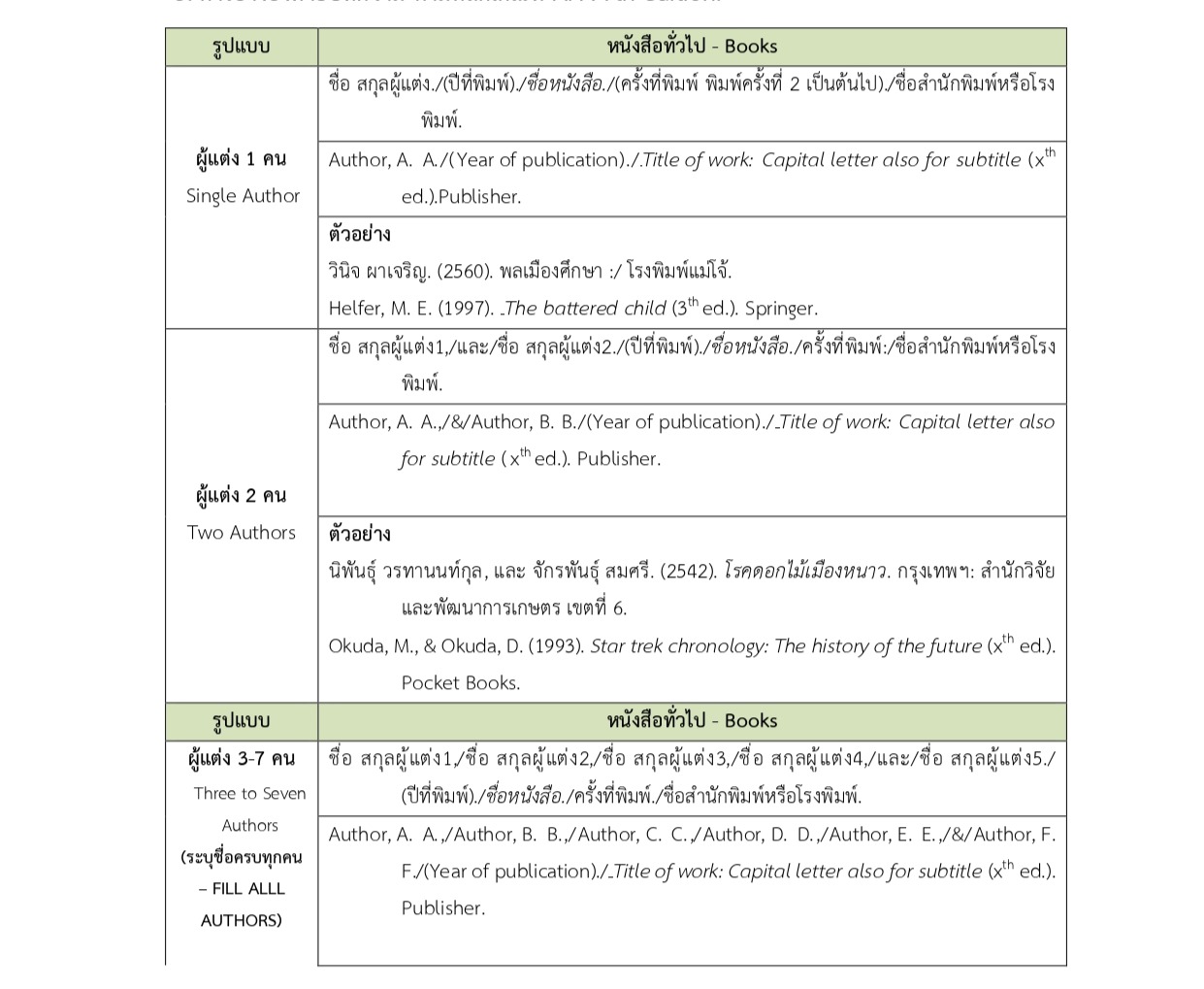
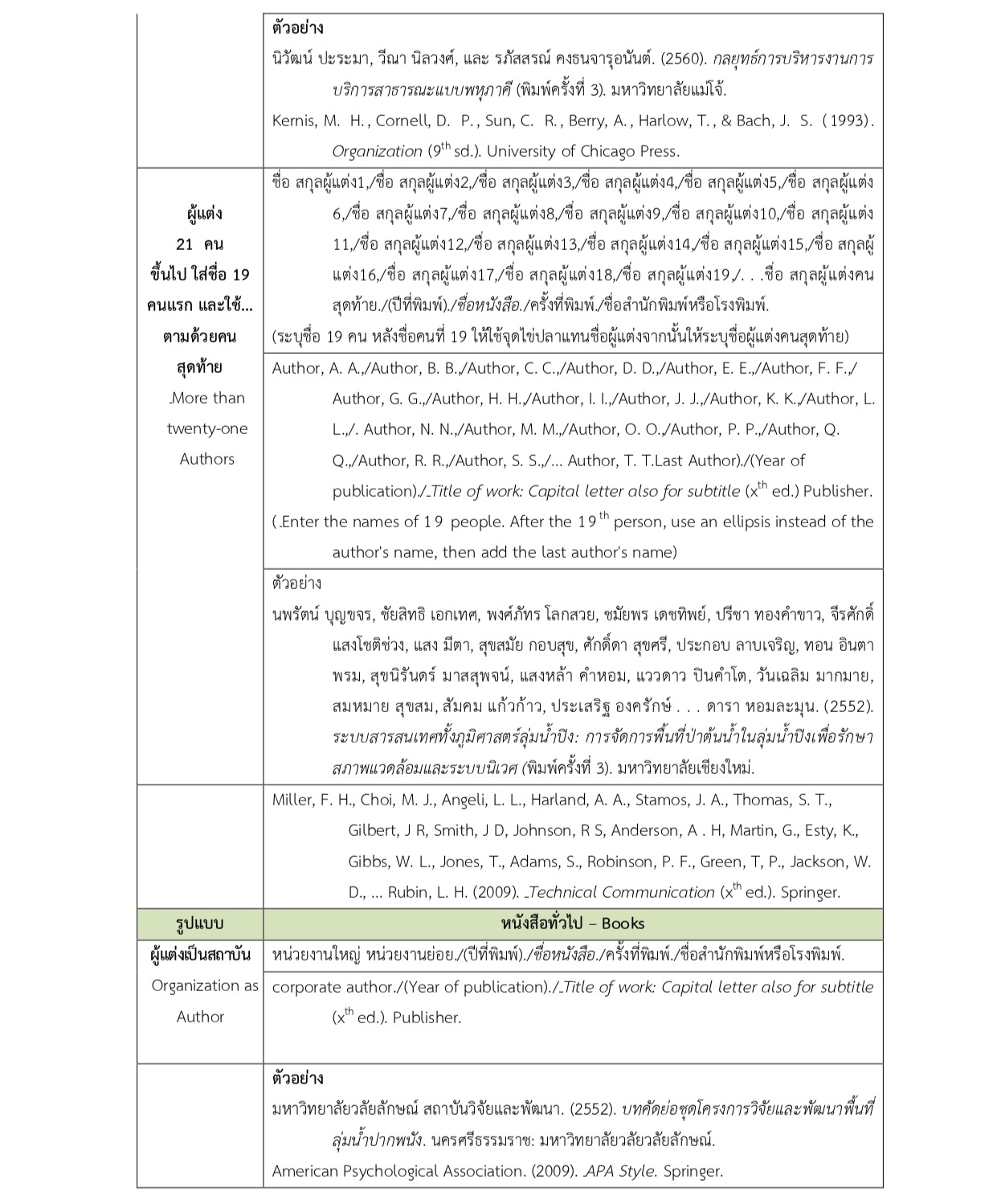
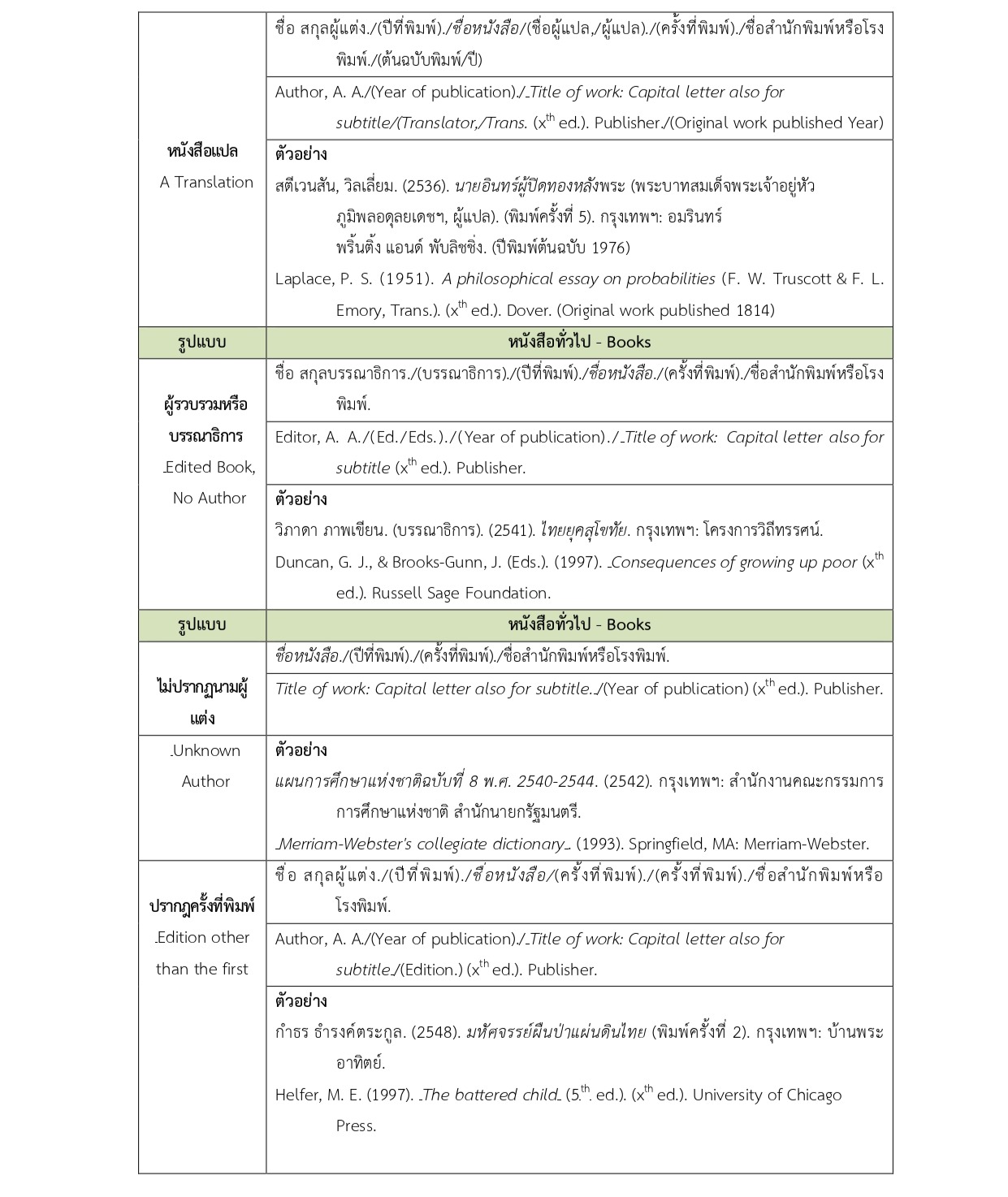
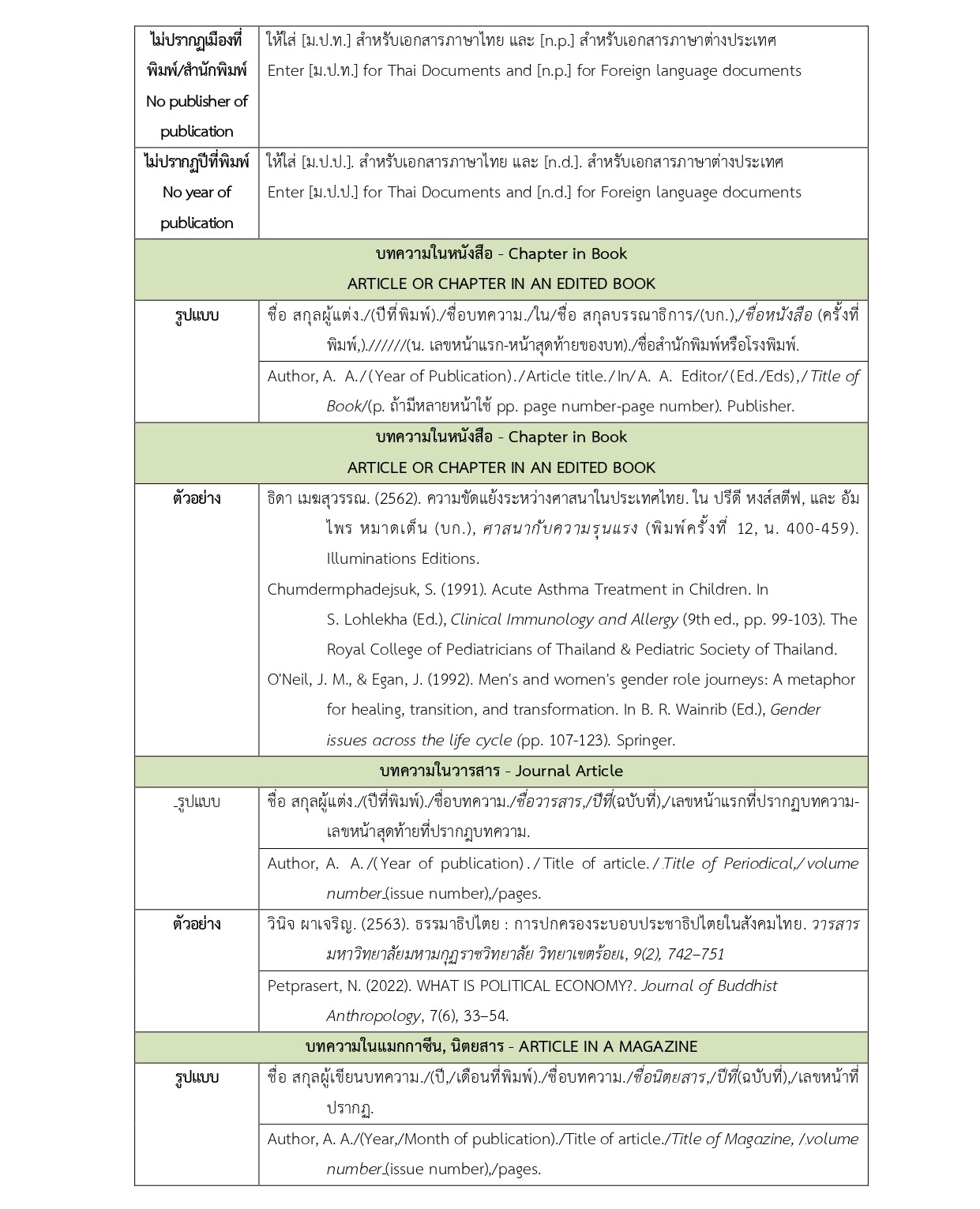
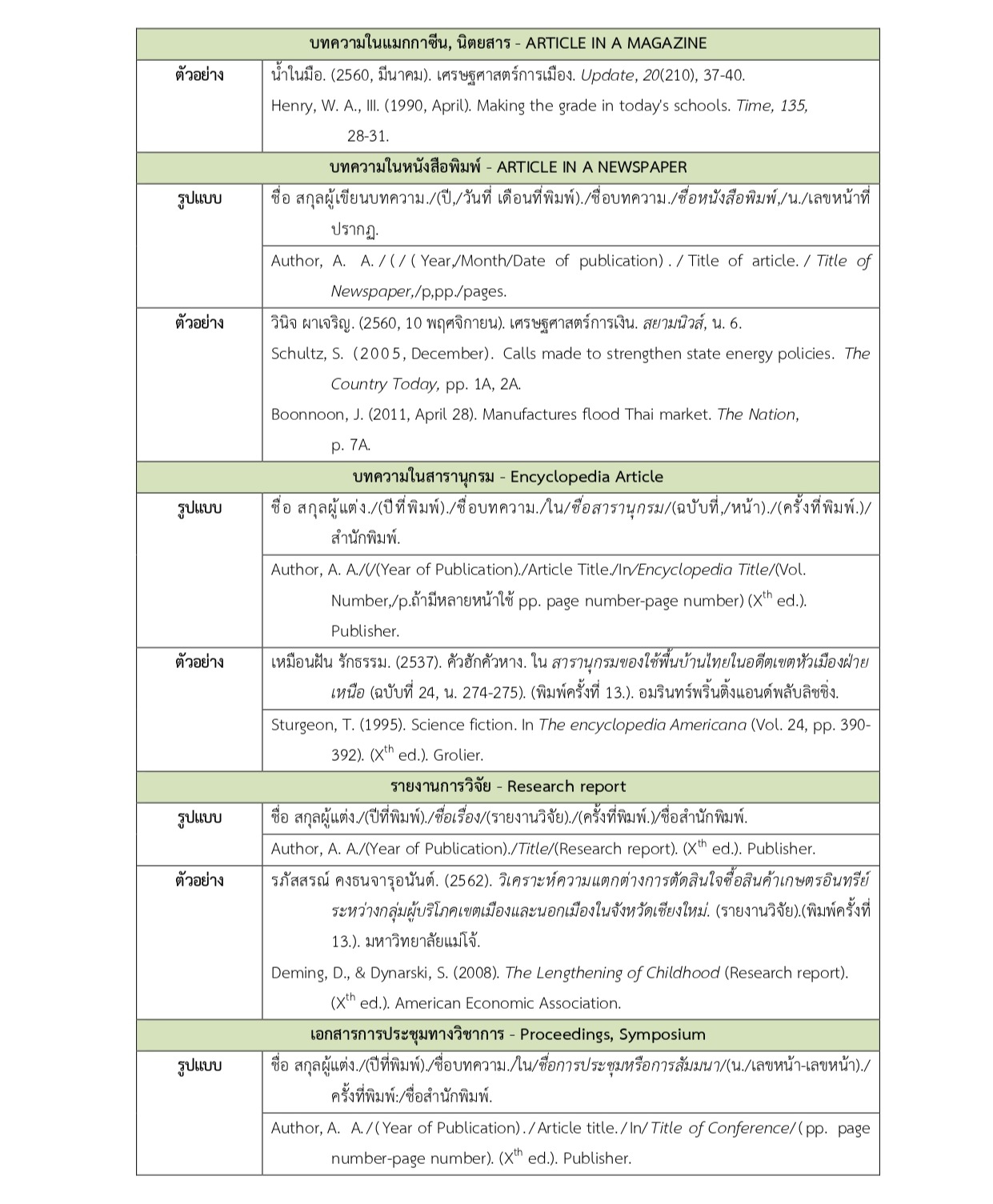
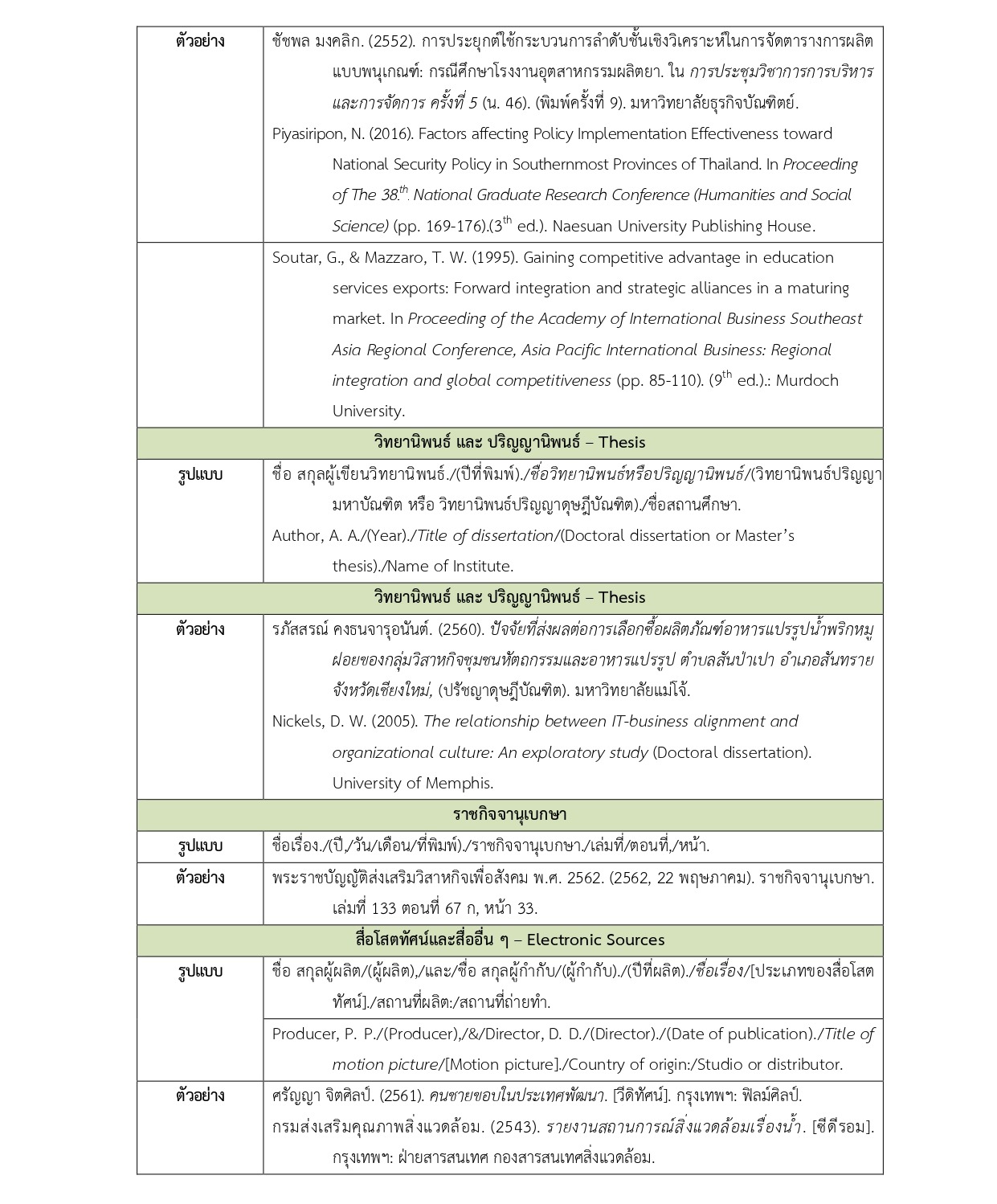
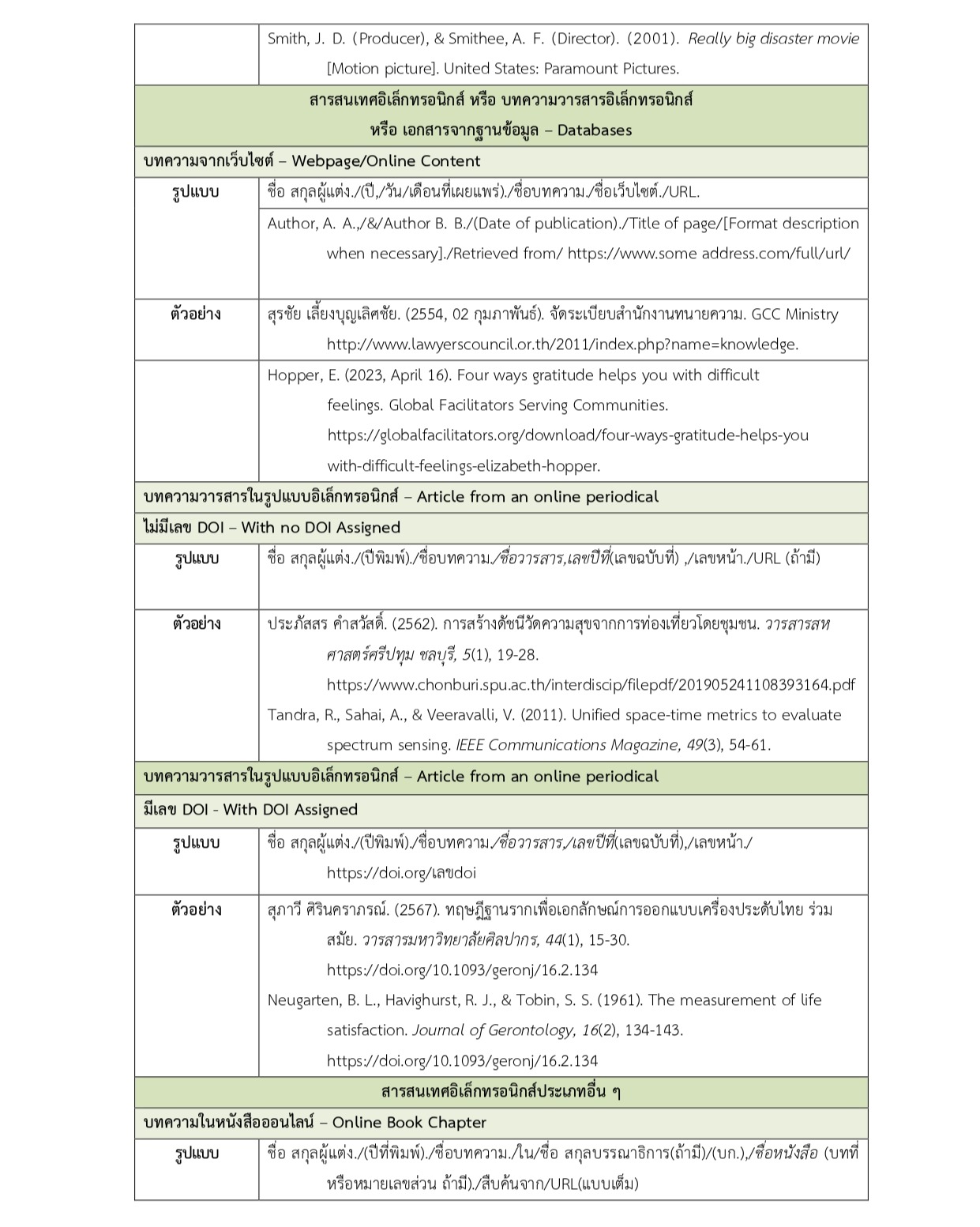
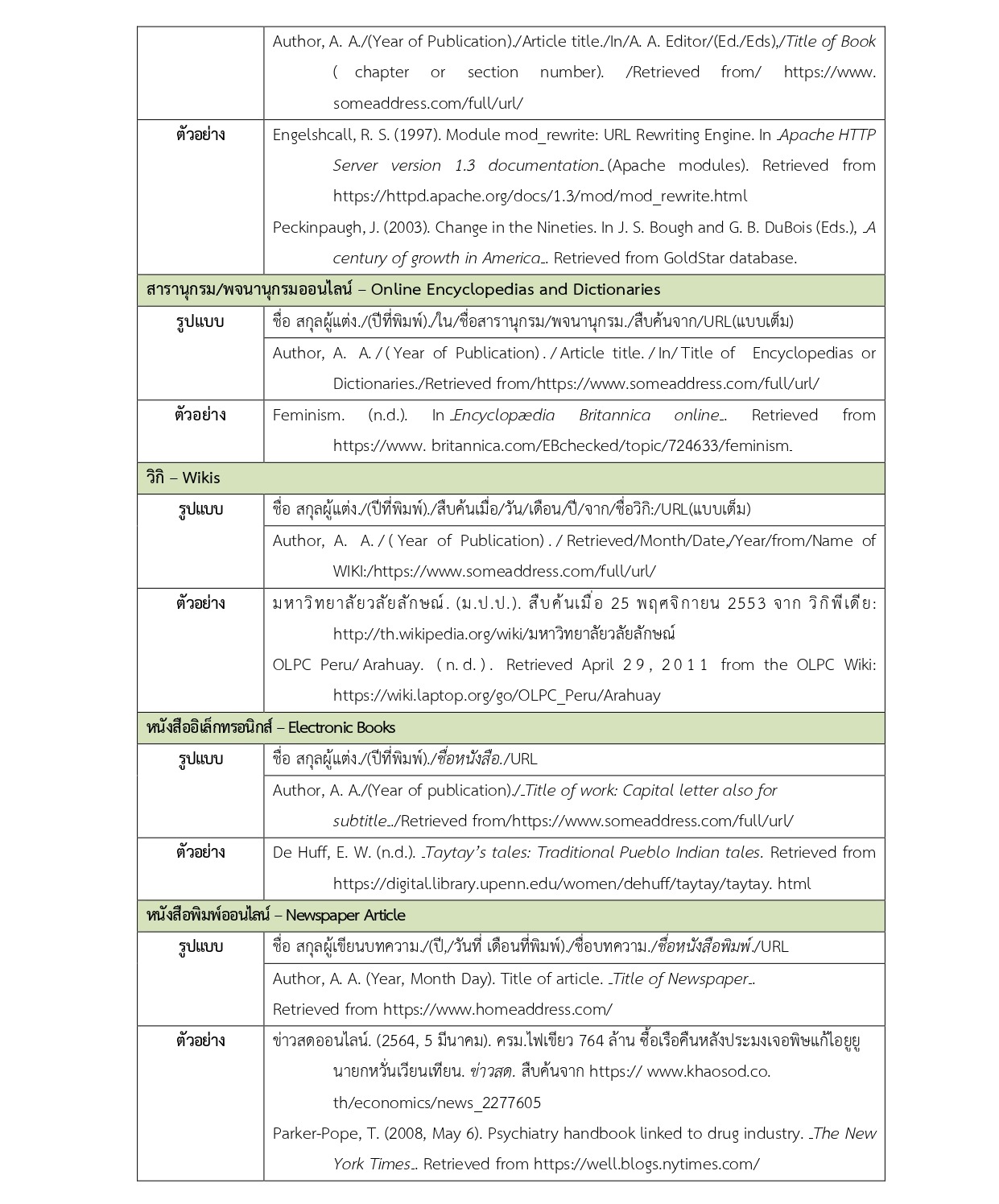
หมายเหตุ:
For more information, please refer to official resources on APA Style 6PPthPP edition Example: APA Formatting and Style Guide. From 56Thttp://owl.english.purdue.edu/owl/resource /560/01/American56T56T Psychological Association (APA) 6PPthPP edition style Examples. From56T56Twww.lib.monash.edu.au/tutorials/citing/56T56Tapa-a4.pdf
When references are in English, they are arranged alphabetically by the surname of the first author, following the standard dictionary order (A–Z). If multiple works have the same first author, order them by year of publication, from earliest to latest.
Please use only essential figures and tables. Each figure or table should be placed appropriately on a page, with no more than one figure or one table per page. For tables, provide a caption above the table, aligned to the left margin, and include additional explanations below the table as needed, following the prescribed format.
Table/1// Title of the Table
Captions for figures, graphs, charts, and pictorial diagrams should be typed below the image, centered on the page. Any additional explanations should be placed directly beneath the caption, following the specified format below:
Figure /1/ Title of the Figure



Counter installed : 25 Feb. 2025
| JOURNAL OF ECONOMICS MAEJO UNIVERSITY |
| 63 no. 4, nongharn Sub-district, sansai District, ChiangMai 50290 |
| Tel : 0 5387 5264 |
| Fax : 0 5387 5252 |
| E-mail : maejojournal.sd@gmail.com |
| Website: https://so10.tci-thaijo.org/index.php/ECONMAEJO_JOURNAL |


