การบูรณาการบริบทเชิงพื้นที่และเศรษฐศาสตร์พฤติกรรมเพื่อออกแบบมาตรการ ลดการเผาเศษซากพืช: กรณีศึกษาอำเภอแม่แจ่ม จังหวัดเชียงใหม่
คำสำคัญ:
การเผาเศษซากพืช, บริบทเชิงพื้นที่, พฤติกรรมการเผา, มาตรการทางเศรษฐศาสตร์, แบบจำลองโลจิตบทคัดย่อ
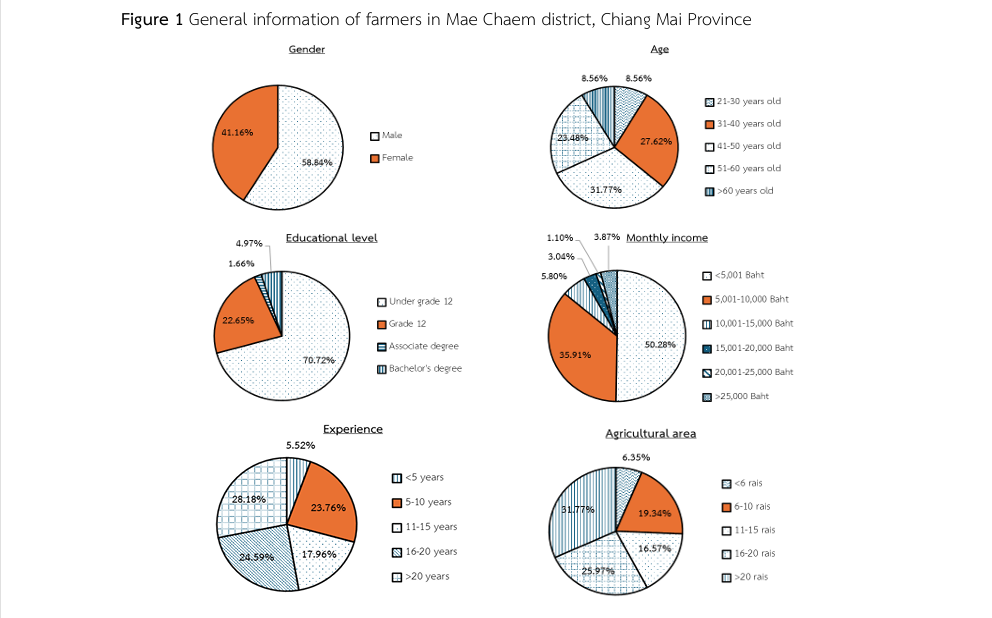
งานวิจัยนี้มีวัตถุประสงค์เพื่อศึกษาบริบทและข้อจำกัดด้านทรัพยากรของพื้นที่เกษตรในอำเภอแม่แจ่ม จังหวัดเชียงใหม่ วิเคราะห์พฤติกรรมและปัจจัยกำหนดการตัดสินใจเผาเศษซากพืชของเกษตรกร และประเมินความเหมาะสมของมาตรการทางเศรษฐศาสตร์ในการลดการเผาภายใต้ความแตกต่างเชิงพื้นที่ เก็บรวบรวมข้อมูลจากเกษตรกร 362 ราย โดยการสุ่มตัวอย่างแบบเจาะจง จากนั้นวิเคราะห์ข้อมูลด้วยสถิติเชิงพรรณนา และแบบจำลองโลจิตแบบสองทางเลือกผลการวิจัย พบว่า พื้นที่เกษตรส่วนใหญ่มีความลาดชันมากกว่า 20% ซึ่งเป็นข้อจำกัดในการใช้เครื่องจักรเพื่อจัดการเศษซากพืช ทำให้การเผาเป็นวิธีหลักในการเตรียมพื้นที่เพาะปลูก ผลการวิเคราะห์แบบจำลองโลจิต พบว่า ระดับการศึกษา ประสบการณ์ทางการเกษตร ต้นทุน และราคาข้าวโพดเลี้ยงสัตว์มีผลต่อการลดโอกาสในการเผา ในขณะที่ขนาดพื้นที่เพาะปลูกและความลาดชันของพื้นที่เพิ่มโอกาสในการเผาอย่างมีนัยสำคัญทางสถิติ ด้านแรงจูงใจสำคัญในการลดการเผาคือ ผลกระทบด้านสุขภาพและความเสื่อมโทรมของดิน สำหรับมาตรการเชิงเศรษฐศาสตร์พบว่า การส่งเสริมการปรับเปลี่ยนชนิดพืชและระบบวนเกษตรมีความเหมาะสมสูง ในขณะที่มาตรการภาษีและการบังคับใช้กฎหมายโดยตรงมีความเหมาะสมต่ำ อย่างไรก็ตามการออกแบบนโยบายควรคำนึงถึงความแตกต่างเชิงพื้นที่และข้อจำกัดเชิงโครงสร้างของเกษตรกร และควรใช้มาตรการแบบผสมผสานเพื่อสามารถปฏิบัติได้จริงและเกิดความยั่งยืนในระยะยาว
เอกสารอ้างอิง
กรมควบคุมมลพิษ. (2569). ร่างรายงานสถานการณ์มลพิษของประเทศไทย ปี 2568. กระทรวงทรัพยากรธรรมชาติและสิ่งแวดล้อม.
นิพนธ์ พัวพงศกร. (2565). การเผาวัสดุการเกษตร: ความเสียหาย สาเหตุและทางเลือกในการจัดการชีวมูลอย่างยั่งยืน. TDRI. https://tdri.or.th/2025/05/sustainable-biomass-management-rice-sugarcane-part1/
วิลาวรรณ น้อยภา และวาสิฐี ภักดีลุน. (2564). การจัดการและลดการเผาในพื้นที่เกษตรของประเทศไทย. สถาบันสิ่งแวดล้อมไทย. https://www.tei.or.th/file/files/Agricultural%20Burning%20Management%20in%20Thailand_TEI-th.pdf
สำนักงานเลขาธิการสภาผู้แทนราษฎร. (2567). ร่างพระราชบัญญัติบริหารจัดการเพื่ออากาศสะอาด. สำนักงานเลขาธิการสภาผู้แทนราษฎร.
อารี วิบูลย์พงศ์. (2549). เศรษฐมิติประยุกต์สำหรับการตลาดเกษตร. มหาวิทยาลัยเชียงใหม่.
Akahoshi, K., Zusman, E., Hanaoka, T., Kim Oanh, N. T., Huy, L. N., Wangwongwatana, S., Homyok, P., Malley, C. S., Hirayama, T., Goto, Y., Kawashima, K., & Amann, M. (2024). The prospects of controlling open burning of crop residues in Thailand: A quantitative assessment of implementation barriers and costs. Atmosphere, 15(11), Article 1309. https://doi.org/10.3390/atmos15111309
Bhuvaneshwari, S., Hettiarachchi, H., & Meegoda, J. N. (2019). Crop residue burning in India: Policy challenges and potential solutions. International Journal of Environmental Research and Public Health, 16(5), Article 832. https://doi.org/10.3390/ijerph16050832
Cao, J., & Ma, R. (2023). Mitigating agricultural fires with carrot or stick? Evidence from China. Journal of Development Economics, 165, Article 103173. https://doi.org/10.1016/j.jdeveco.2023.103173
Chanana, I., Sharma, A., Kumar, P., Kumar, L., Kulshreshtha, S., Kumar, S., & Patel, S. K. S. (2023). Combustion and stubble burning: A major concern for the environment and human health. Fire, 6(2), Article 79. https://doi.org/10.3390/fire6020079
Chang, S. H. E., Benjamin, E. O., & Sauer, J. (2024). Factors influencing the adoption of sustainable agricultural practices for rice cultivation in Southeast Asia: A review. Agronomy for Sustainable Development, 44, Article 27. https://doi.org/10.1007/s13593-024-00960-w
Chendrashekhar, S., Lokesh, G. B., Patil, S. S., & Lokesha, H. (2018). Factors influencing the adoption of paddy straw management practices by farmers of Karnataka (India). Current Agriculture Research Journal, 6(2), 225–232. http://dx.doi.org/10.12944/CARJ.6.2.13
Cordaro, F., & Desdoigts, A. (2021). Bounded rationality, social capital and technology adoption in family farming: Evidence from cocoa-tree crops in Ivory Coast. Sustainability, 13, Article 7483. https://doi.org/10.3390/su13137483
Cordeiro, E. U., Samaddar, A., Munshi, S., Ajay, A., Rossiter, D. G., Sohane, R. K., Malik, R., Craufurd, P., Pingali, P., & McDonald, A. J. (2024). Transitions to crop residue burning have multiple antecedents in Eastern India. Agronomy for Sustainable Development, 44, Article 59. https://doi.org/10.1007/s13593-024-00983-3
Cuong, O. Q., Demont, M., Pabuayon, I. M., & Depositario, D. P. T. (2025). What drives rice farmers away from straw burning? Evidence from the Mekong Delta, Vietnam. Environmental Challenges, 19, Article 101150. https://doi.org/10.1016/j.envc.2025.101150
Cuong, O. Q., Demont, M., Pabuayon, I. M., & Depositario, D. P. T. (2026). Survey data on factors that drive farmers away from straw burning in the Mekong Delta, Vietnam. Data in Brief, 64, Article 112318. https://doi.org/10.1016/j.dib.2025.112318
Erbaugh, J., Singh, G., Luo, Z., Koppa, G., Evans, J., & Shyamsundar, P. (2024). Farmer perspectives on crop residue burning and sociotechnical transition in Punjab, India. Journal of Rural Studies, 111, Article 103387. https://doi.org/10.1016/j.jrurstud.2024.103387
Faisal, M., Chunping, X., Abbas, A., Raza, M. H., Akhtar, S., Ajmal, M. A., & Ali, A. (2021). Do risk perceptions and constraints influence the adoption of climate change practices among small livestock herders in Punjab, Pakistan?. Environmental Science and Pollution Research, 28, 43777–43791. https://doi.org/10.1007/s11356-021-13771-3
Field, B. C., & Field, M. K. (2017). Environmental economics: An introduction (6th ed.). McGraw-Hill Education.
GISTDA. (2023). รายงานสถานการณ์จุดความร้อนและฝุ่นละออง PM2.5 ของประเทศไทย. สำนักงานพัฒนาเทคโนโลยีอวกาศและภูมิสารสนเทศ (องค์การมหาชน).
Policy Watch. (2569). คุณภาพอากาศในไทยดีขึ้น แต่เกินค่าแนะนำของ WHO. https://policywatch.thaipbs.or.th/article/life-281
Vivithkeyoonvong, S., Taweekij, S., Muenkaewnapha, S., Onngernthayakorn, K., & Pala-En, N. (2568). ปัจจัยที่มีผลกระทบต่อพฤติกรรมการเผาในภาคการเกษตรในประเทศไทย: กรณีศึกษาจังหวัดขอนแก่น. https://www.opsmoac.go.th/sakaeo-article_prov-files-471491791800
Chang, S. H. E., Benjamin, E. O., & Sauer, J. (2024). Factors influencing the adoption of sustainable agricultural practices for rice cultivation in Southeast Asia: A review. Agronomy for Sustainable Development, 44, 27. https://doi.org/10.1007/s13593-024-00960-w
Greene, W. H. (2008). Econometric analysis (6th ed.). Prentice Hall.
Gujarati, D. N., & Porter, D. C. (2009). Basic econometrics (5th ed.). McGraw-Hill.
Gupta, S., Agarwal, R., & Mittal, S. K. (2016). Respiratory health concerns in children at some strategic locations from high PM levels during crop residue burning episodes. Atmospheric Environment, 137, 127–134. https://doi.org/10.1016/j.atmosenv.2016.04.030
Hong, H., & Chen, K. (2026). When the fire ends: Straw burning, regulation, and pollution substitution. Journal of Development Economics, 181, Article 103727. https://doi.org/10.1016/j.jdeveco.2026.103727
Hou, L., Chen, X., Kuhn, L., & Huang, J. (2019). The effectiveness of regulations and technologies on sustainable use of crop residue in Northeast China. Energy Economics, 81, 519–527. https://doi.org/10.1016/j.eneco.2019.04.015
Hu, N., Wang, B., Gu, Z., Tao, B., Zhang, Z., Hu, S., Zhu, L., & Meng, Y. (2016). Effects of different straw returning modes on greenhouse gas emissions and crop yields in a rice–wheat rotation system. Agriculture, Ecosystems & Environment, 223, 115–122. http://dx.doi.org/10.1016/j.agee.2016.02.027
Jack, B. K., Jayachandran, S., Kala, N., & Pande, R. (2025). Money (not) to burn: Payments for ecosystem services to reduce crop residue burning. American Economic Review: Insights, 7(1), 39–55. https://doi.org/10.1257/aeri.20230431
Keck, M., & Hung, D. T. (2018). Burn or bury? A comparative cost–benefit analysis of crop residue management practices among smallholder rice farmers in northern Vietnam. Sustainability Science, 13, 1361–1373. https://doi.org/10.1007/s11625-018-0592-z
Liu, T., Marlier, M. E., DeFries, R. S., Westervelt, D. M., Xia, K. R., Fiore, A. M., Mickley, L. J., Cusworth, D. H., & Milly, G. (2018). Seasonal impact of regional outdoor biomass burning on air pollution in three Indian cities: Delhi, Bengaluru, and Pune. Atmospheric Environment, 172, 83–92. https://doi.org/10.1016/j.atmosenv.2017.10.024
Neupane, R. P., Sharma, K. R., & Thapa, G. B. (2002). Adoption of agroforestry in the hills of Nepal: A logistic regression analysis. Agricultural Systems, 72, 177–196. https://doi.org/10.1016/S0308-521X(01)00066-X
Ogutu, S., Mockshell, J., Minh, T., & Remans, R. (2025). A scoping review of the incentives for promoting the adoption of agroecological practices and outcomes among rice farmers in Vietnam. PLoS One, 20(4), e0321029. https://doi.org/10.1371/journal.pone.0321029
Oraby, G. A. E. M., Putra, F., Natsir, M. H., Siswanto, D., Abdullah, M. M., & Abulibdeh, A. (2025). Straw burning dilemma in modern agriculture: A systematic review of driving factors, environmental impacts, and sustainable solutions. Rice Science, 32(5), 637−648. https://doi.org/10.1016/j.rsci.2025.06.007
Parambil-Peedika, A., Laing, A., Gathala, M. K., Cariappa, A. A. G., & Krishna, V. V. (2025). Agroecological impacts of crop residue burning: A qualitative systematic review of direct and inferred evidence. Science of The Total Environment, 994, Article 179963. https://doi.org/10.1016/j.scitotenv.2025.179963
Ravindra, K., Singh, B., & Mor, S. (2019). Emissions of air pollutants from primary crop residue burning in India and their mitigation strategies for cleaner emissions. Journal of Cleaner Production, 208Trace, 261–273. https://doi.org/10.1016/j.jclepro.2018.10.031
Raza, M. H., Abid, M., Faisal, M., Yan, T., Akhtar, S., & Adnan, K. M. M. (2022). Environmental and health impacts of crop residue burning: Scope of sustainable crop residue management practices. International Journal of Environmental Research and Public Health, 19(8), Article 4753. https://doi.org/10.3390/ijerph19084753
Sahlin, J., Ekvall, T., Bisaillon, M., & Sundberg, J. (2007). Introduction of a waste incineration tax: Effects on the Swedish waste flows. Resources, Conservation and Recycling, 51(4), 827–846. https://doi.org/10.1016/j.resconrec.2007.01.002
Singh, G., Mohit, P. N., & Narayan, V. (2025). Legal frameworks for managing agricultural waste: Challenges and impacts of crop residue burning in India and global perspectives. Current Indian Science, 3, 1–21. https://doi.org/10.2174/012210299X380993250826082433
Singh, S., Ranguwal, S., & Guleria, A. (2023). Determinants of crop residue burning practices in Punjab. Agricultural Research Journal, 60(2), 289–294. https://doi.org/10.1371/journal.pone.0253939
World Health Organization. (2021). WHO global air quality guidelines. World Health Organization.
ดาวน์โหลด
เผยแพร่แล้ว
รูปแบบการอ้างอิง
ฉบับ
ประเภทบทความ
สัญญาอนุญาต
ลิขสิทธิ์ (c) 2026 วารสารเศรษฐศาสตร์ มหาวิทยาลัยแม่โจ้

อนุญาตภายใต้เงื่อนไข Creative Commons Attribution-NonCommercial-NoDerivatives 4.0 International License.