กลไกเชิงปฏิสัมพันธ์ระหว่างการฝังตัวทางสังคมและการจัดการทรัพยากร: กรณีศึกษาบริษัทโลจิสติกส์ในประเทศไทย
คำสำคัญ:
การฝังตัวทางสังคม, การจัดการทรัพยากร, กลไกขับเคลื่อนคู่, ตลาดเกิดใหม่บทคัดย่อ
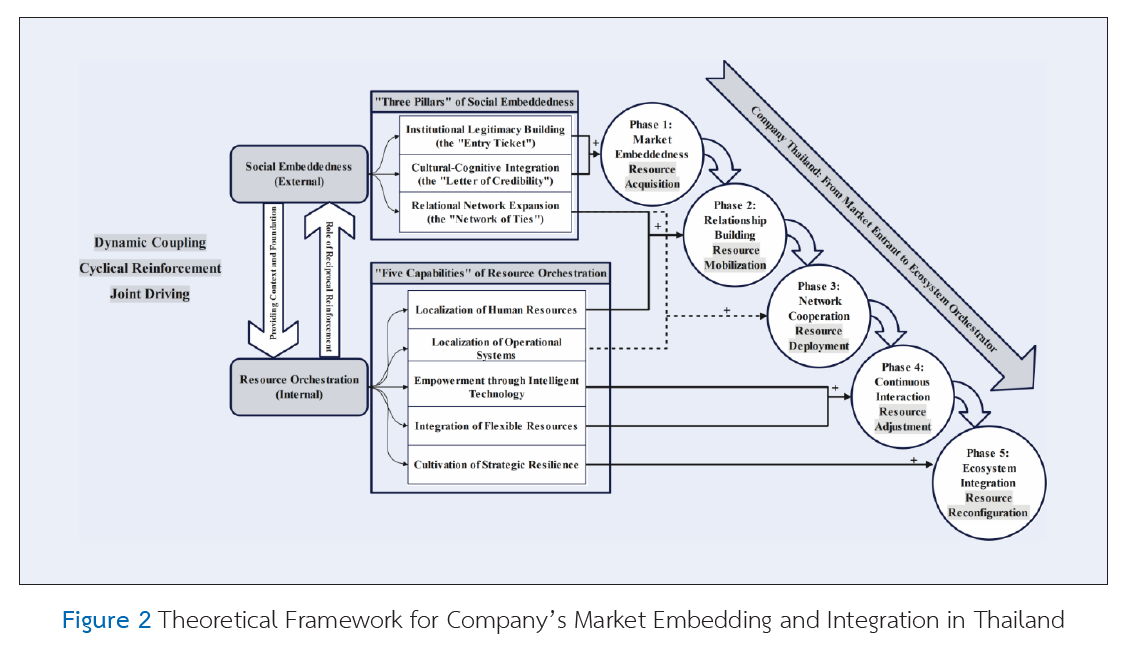
บทความนี้มุ่งศึกษาความเสียเปรียบของผู้ประกอบการโลจิสติกส์ข้ามพรมแดนในฐานะ “คนนอกตลาด” (outsider disadvantage) ในตลาดเกิดใหม่ ภายใต้บริบทของการปรับโครงสร้างห่วงโซ่มูลค่าโลกและการพัฒนาการค้าในยุคดิจิทัล โดยใช้กรณีศึกษาบริษัทโลจิสติกส์ในตลาดประเทศไทย และประยุกต์ใช้ระเบียบวิธีวิจัยเชิงทฤษฎีพื้นฐาน (grounded theory) ผลการศึกษาชี้ให้เห็นว่า องค์กรสามารถบรรลุการเติบโตอย่างยั่งยืนได้ผ่านปฏิสัมพันธ์ระหว่างการฝังตัวทางสังคมและการจัดการทรัพยากร งานวิจัยนี้เสนอ “กลไกขับเคลื่อนคู่สำหรับการฝังตัวและการบูรณาการข้ามตลาด” (dual-drive mechanism for cross-market embedding and integration) โดยการฝังตัวทางสังคมทำหน้าที่เป็นฐานความชอบธรรมและแหล่งทุนเริ่มต้นสำหรับการจัดการทรัพยากร ขณะที่การจัดการทรัพยากรอย่างมีประสิทธิภาพผ่านการสร้างคุณค่า จะช่วยเสริมสร้างและทำให้การฝังตัวทางสังคมมีความลึกซึ้งยิ่งขึ้น กลไกขับเคลื่อนทั้งสองประการร่วมกันผลักดันให้องค์กรพัฒนาจากระยะเริ่มต้นของการเข้าสู่ตลาด ไปสู่การก้าวกระโดดเชิงกลยุทธ์และการเป็นผู้นำในระบบนิเวศทางธุรกิจ คุณูปการหลักของงานวิจัยนี้อยู่ที่การบูรณาการทฤษฎีการฝังตัวทางสังคมและทฤษฎีการจัดการทรัพยากรเข้าด้วยกัน โดยเปิดเผยพลวัตเชิงเสริมพลังระหว่างทั้งสองแนวคิด ซึ่งนำไปสู่กรอบการวิเคราะห์เชิงพลวัตและเชิงบูรณาการในการทำความเข้าใจการปรับตัวที่ซับซ้อนขององค์กรในตลาดเกิดใหม่ และให้ข้อค้นพบเชิงระบบที่เป็นประโยชน์ต่อการนำไปประยุกต์ใช้ในทางปฏิบัติ
เอกสารอ้างอิง
Eisenhardt, K. M., & Schoonhoven, C. B. (1996). Resource-based view of strategic alliance formation: Strategic and social effects in entrepreneurial firms. Organization Science, 7(2), 136–150. https://doi.org/10.1287/orsc.7.2.136
Granovetter, M. (1985). Economic action and social structure: The problem of embeddedness. American Journal of Sociology, 91(3), 481–510. https://doi.org/10.1086/228311
Gulati, R. (1998). Alliances and networks. Strategic Management Journal, 19(4), 293–317. https://sms.onlinelibrary.wiley.com/doi/10.1002/(SICI)1097-0266(199804)19:4%3C293::AID-SMJ982%3E3.0.CO;2-M
Huang, S., Liu, W., & Lin, Y. (2025). 新兴市场跨国公司获取国际化多重合法性的机理及策略研究 [Mechanisms and strategies for emerging-market multinationals to obtain multiple legitimacies in internationalization]. 研究与发展管理, 37(2), 176–189. https://doi.org/10.13581/j.cnki.rdm.20241117
Kostova, T., & Zaheer, S. (1999). Organizational legitimacy under conditions of complexity: The case of the multinational enterprise. Academy of Management Review, 24(1), 64–81. https://doi.org/10.2307/259037
Lee, R. (2017). Entrepreneurial newcomers: Resources and social embeddedness. In The social capital of entrepreneurial newcomers. Palgrave Macmillan. https://doi.org/10.1057/978-1-137-59820-2_2
Li, L. (2024). 极兔的本地化策略及对中国快递企业“出海”的经验借鉴 [J&T’s localization strategy and lessons for Chinese express delivery firms’ overseas expansion]. 邮政研究, 40(5), 79–84. https://doi.org/10.13955/j.yzyj.2024.05.13.06
Shane, S., & Venkataraman, S. (2000). The promise of entrepreneurship as a field of research. Academy of Management Review, 25(1), 217–226. https://doi.org/10.2307/259271
Sirmon, D. G., Hitt, M. A., & Ireland, R. D. (2007). Managing firm resources in dynamic environments to create value: Looking inside the black box. Academy of Management Review, 32(1), 273–292. https://doi.org/10.5465/amr.2007.23466005
Sirmon, D. G., Hitt, M. A., Ireland, R. D., & Gilbert, B. A. (2011). Resource orchestration to create competitive advantage: Breadth, depth, and life cycle effects. Journal of Management, 37(5), 1390–1412. https://doi.org/10.1177/0149206310385695
Suchman, M. C. (1995). Managing legitimacy: Strategic and institutional approaches. Academy of Management Review, 20(3), 571–610. https://doi.org/10.5465/amr.1995.9508080331
Swedberg, R. (1991). Major traditions of economic sociology. Annual Review of Sociology, 17(1), 251–276. https://doi.org/10.1146/annurev.so.17.080191.001343
Teece, D. J., Pisano, G., & Shuen, A. (1997). Dynamic capabilities and strategic management. Strategic Management Journal, 18(7), 509–533. https://doi.org/10.1016/B978-0-7506-7088-3.50009-7
Tian, L. (2025). 泰国快递物流产业:效率提升与价格竞争在平衡木上“共舞” [Thailand’s express logistics industry: Efficiency improvement and price competition “dancing” on a balance beam]. 中国对外贸易, (04), 64–65.
Vestrum, I., & Rasmussen, E. (2013). How community ventures mobilise resources: Developing resource dependence and embeddedness. International Journal of Entrepreneurial Behavior & Research, 19(3), 283–302. https://doi.org/10.1108/13552551311330183
Zaheer, S. (1995). Overcoming the liability of foreignness. Academy of Management Journal, 38(2), 341–363. https://doi.org/10.2307/256683
Zhang, Q., & Hua, Z. (2020). 资源编排理论及其研究进展述评 [Resource orchestration theory and its research progress: A review]. 经济管理, 42(9), 193–208. https://doi.org/10.19616/j.cnki.bmj.2020.09.012
Zhao, Y., & Cheng, Q. (2022). 创新生态系统中核心企业如何实现跨界资源整合? [How do core firms in innovation ecosystems achieve cross-boundary resource integration?]. 科学学与科学技术管理, 43(5), 100–116. https://doi.org/10.20201/j.cnki.ssstm.2022.05.007
ดาวน์โหลด
เผยแพร่แล้ว
รูปแบบการอ้างอิง
ฉบับ
ประเภทบทความ
สัญญาอนุญาต
ลิขสิทธิ์ (c) 2026 คณะบริหารธุรกิจ สถาบันบัณฑิตพัฒนบริหารศาสตร์

อนุญาตภายใต้เงื่อนไข Creative Commons Attribution-NonCommercial-NoDerivatives 4.0 International License.