Causal Relationships Among Perceived Value, Satisfaction, and Sustainable Tourism Intention of Thai Tourists: A Case Study of Koh Tao, Surat Thani Province
Keywords:
Perceived Value, Tourist Satisfaction, Sustainable Tourism Intention, Marine Ecotourism, PLS-SEMAbstract
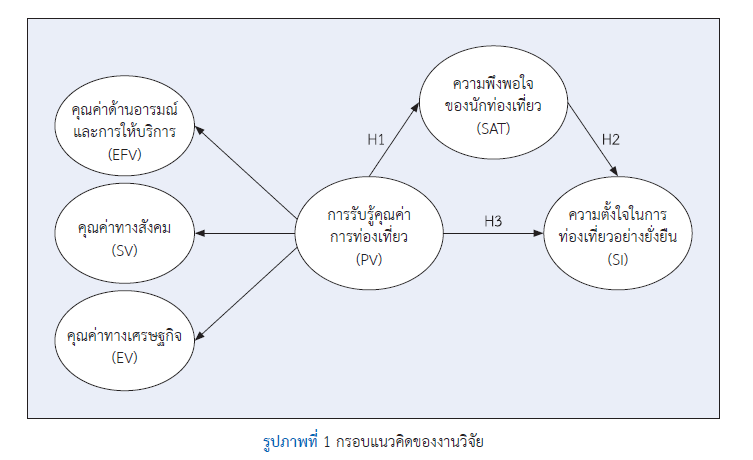
This research examines the causal relationships among perceived tourism value, tourist satisfaction, and sustainable tourism intention of Thai tourists visiting Koh Tao, Surat Thani Province. Employing a quantitative research methodology, data were collected from 316 Thai tourists through purposive sampling and analyzed using Partial Least Squares Structural Equation Modeling (PLS-SEM). Perceived value was conceptualized as a second-order latent variable comprising emotional and functional value, social value, and economic value. The findings revealed statistically significant positive relationships. Perceived tourism value demonstrated a strong positive influence on tourist satisfaction (β = 0.710, p < 0.001), explaining 50.4% of the variance. Tourist satisfaction positively influenced sustainable tourism intention (β = 0.406, p < 0.001), while perceived value exhibited direct influence (β = 0.360, p < 0.001). The model explained 50.2% of the variance in sustainable tourism intention. Tourist satisfaction functioned as a partial mediator with an indirect effect of 0.289 and a Variance Accounted For (VAF) of 44.6%. Importance-Performance Map Analysis (IPMA) revealed that affordable pricing and value for money required urgent improvement, while service quality represented competitive strengths to be maintained. The findings contribute both theoretically and practically to sustainable ecotourism management.
References
Ajzen, I. (1991). The theory of planned behavior. Organizational Behavior and Human Decision Processes, 50(2), 179-211. https://doi.org/10.1016/0749-5978(91)90020-T
Bagozzi, R. P., & Yi, Y. (1988). On the evaluation of structural equation models. Journal of the Academy of Marketing Science, 16(1), 74-94. https://doi.org/10.1007/BF02723327
Barney, J. B. (1991). Firm resources and sustained competitive advantage. Journal of Management, 17, 99-120. https://doi.org/10.1177/014920639101700108
Bayih, B. E., & Singh, A. (2020). Modeling domestic tourism: Motivations, satisfaction and tourist behavioral intentions. Heliyon, 6(9), e04839. https://doi.org/10.1016/j.heliyon.2020.e04839
Bramwell, B., & Lane, B. (1993). Sustainable tourism: An evolving global approach. Journal of Sustainable Tourism, 1(1), 1-5. https://doi.org/10.1080/09669589309450696
Carvache-Franco, W., Pérez-Orozco, A., & Carvache-Franco, O. (2022). Perceived value in sustainable coastal and marine destinations: A study of Jacó in Costa Rica. Sustainability, 14(14), 8569. https://doi.org/10.3390/su14148569
Chen, C.-F., & Tsai, D. (2007). How destination image and evaluative factors affect behavioral intentions? Tourism Management, 28(4), 1115-1122. https://doi.org/10.1016/j.tourman.2006.07.007
Chen, S., & Tung, P. J. (2014). Developing an extended theory of planned behavior model to predict consumers' intention to visit green hotels. International Journal of Hospitality Management, 36, 221-230. https://doi.org/10.1016/j.ijhm.2013.09.006
Chi, C. G. Q., & Qu, H. (2008). Examining the structural relationships of destination image, tourist satisfaction and destination loyalty: An integrated approach. Tourism Management, 29(4), 624-636. https://doi.org/10.1016/j.tourman.2007.06.007
Chi, N. T. K., & Pham, H. (2022). The moderating role of eco-destination image in the travel motivations and ecotourism intention nexus. Journal of Tourism Futures. Advance online publication. https://doi.org/10.1108/JTF-01-2022-0014
Cohen, J. (1988). Statistical power analysis for the behavioral sciences (2nd ed.). Lawrence Erlbaum Associates.
Colglazier, W. (2015). Sustainable development agenda: 2030. Science, 349(6252), 1048-1050. https://doi.org/10.1126/science.aad2333
Dijkstra, T. K., & Henseler, J. (2015). Consistent partial least squares path modeling. MIS Quarterly, 39(2), 297-316.
Dimitrovski, D., Lemmetyinen, A., Nieminen, L., & Pohjola, T. (2021). Understanding coastal and marine tourism sustainability—A multi-stakeholder analysis. Journal of Destination Marketing & Management, 19, 100554. https://doi.org/10.1016/j.jdmm.2021.100554
Dolnicar, S. (2006). Nature-conserving tourists: The need for a broader perspective. Anatolia, 17(2), 235-255. https://doi.org/10.1080/13032917.2006.9687188
Faul, F., Erdfelder, E., Lang, A. G., & Buchner, A. (2007). G*Power 3: A flexible statistical power analysis program for the social, behavioral, and biomedical sciences. Behavior Research Methods, 39(2), 175-191. https://doi.org/10.3758/BF03193146
Fornell, C., & Larcker, D. F. (1981). Evaluating structural equation models with unobservable variables and measurement error. Journal of Marketing Research, 18(1), 39-50. https://doi.org/10.1177/002224378101800104
Gallarza, M. G., & Saura, I. G. (2006). Value dimensions, perceived value, satisfaction and loyalty: An investigation of university students' travel behaviour. Tourism Management, 27(3), 437-452. https://doi.org/10.1016/j.tourman.2004.12.002
Gao, J., Chong, K. M., An, S. Y., & Ding, P. C. (2024). An investigation into the multifactor influences on ecotourism behavioural intention, with satisfaction as a mediating variable. Asian Journal of Environment-Behaviour Studies. https://doi.org/10.21834/aje-bs.v9i27.441
Ge, H., & Chen, X. (2024). Research on tourist satisfaction and behavioral intention in ecological health tourism activities in Bama, Guangxi based on structural equation model. GeoJournal of Tourism and Geosites, 52(1), 121-1198. https://doi.org/10.30892/gtg.52121-1198
Hair, J. F., Black, W. C., Babin, B. J., & Anderson, R. E. (2019). Multivariate data analysis (8th ed.). Cengage Learning.
Hair, J. F., Hult, G. T. M., Ringle, C. M., & Sarstedt, M. (2017). A primer on partial least squares structural equation modeling (PLS-SEM) (2nd ed.). Sage Publications.
Hair, J. F., Hult, G. T. M., Ringle, C. M., & Sarstedt, M. (2022). A primer on partial least squares structural equation modeling (PLS-SEM) (3rd ed.). Sage.
Hair, J. F., Risher, J. J., Sarstedt, M., & Ringle, C. M. (2019). When to use and how to report the results of PLS-SEM. European Business Review, 31(2), 2-24.
Han, H. (2015). Travelers' pro-environmental behavior in a green lodging context: Converging value-belief-norm theory and the theory of planned behavior. Tourism Management, 47, 164-177. https://doi.org/10.1016/j.tourman.2014.09.014
He, X., Hu, D., Swanson, S. R., Su, L., & Chen, X. (2018). Destination perceptions, relationship quality, and tourist environmentally responsible behavior. Tourism Management Perspectives, 28, 93-104. https://doi.org/10.1016/j.tmp.2018.08.001
Henseler, J., Ringle, C. M., & Sarstedt, M. (2015). A new criterion for assessing discriminant validity in variance-based structural equation modeling. Journal of the Academy of Marketing Science, 43(1), 115-135. https://doi.org/10.1007/s11747-014-0403-8
Honey, M. (2008). Ecotourism and sustainable development: Who owns paradise? (2nd ed.). Island Press. https://doi.org/10.1111/j.1477-8947.2009.01256.x
Ibnou-Laaroussi, S., Rjoub, H., & Wong, W.-K. (2020). Sustainability of green tourism among international tourists and its influence on the achievement of green environment: Evidence from North Cyprus. Sustainability, 12(14), 5698. https://doi.org/10.3390/su12145698
Jasrotia, S. S., Kamila, M. K., & Patel, V. K. (2023). Impact of sustainable tourism on tourist's satisfaction: Evidence from India. Business Perspectives and Research, 11(2), 173-189. https://doi.org/10.1177/22785337211043960
Kerstetter, D. L., Hou, J. S., & Lin, C. H. (2004). Profiling Taiwanese ecotourists using a behavioral approach. Tourism Management, 25(4), 491-498. https://doi.org/10.1016/S0261-5177(03)00119-5
Kim, M., & Thapa, B. (2018). Perceived value and flow experience: Application in a nature-based tourism context. Journal of Destination Marketing & Management, 8, 373-384. https://doi.org/10.1016/j.jdmm.2017.08.002
Kim, Y.-S. (2024). Exploring the interplay of psychological need satisfaction, well-being, and tourist behavioral intentions. Journal of Travel Research. Advance online publication. https://doi.org/10.1177/00472875241283404
Kline, R. B. (2005). Principles and practice of structural equation modeling (2nd ed.). The Guilford Press.
Kline, R. B. (2016). Principles and practice of structural equation modeling (4th ed.). Guilford Press.
Kock, N. (2015). Common method bias in PLS-SEM: A full collinearity assessment approach. International Journal of e-Collaboration, 11(4), 1-10. https://doi.org/10.4018/ijec.2015100101
Lai, P. H., & Shafer, S. (2005). Marketing ecotourism through the Internet: An evaluation of selected ecolodges in Latin America and the Caribbean. Journal of Ecotourism, 4(3), 143-160. https://doi.org/10.1080/14724040508668455
Lam, T., & Hsu, C. H. (2006). Predicting behavioral intention of choosing a travel destination. Tourism Management, 27(4), 589-599. https://doi.org/10.1016/j.tourman.2005.02.003
Lee, T. H., & Hsieh, H. P. (2016). Indicators of sustainable tourism: A case study from a Taiwan's wetland. Ecological Indicators, 67, 779-787. https://doi.org/10.1016/j.ecolind.2016.03.023
Litvin, S. W., Goldsmith, R. E., & Pan, B. (2008). Electronic word-of-mouth in hospitality and tourism management. Tourism Management, 29(3), 458-468. https://doi.org/10.1016/j.tourman.2007.05.011
Luongo, S., Napolano, E., & Gul, K. (2024). Sustainable tourism intentions: Extending the theory of planned behavior. Turistica - Italian Journal of Tourism, 32(3), 31-60. https://doi.org/10.70732/tijt.v32i3.28
Martilla, J. A., & James, J. C. (1977). Importance-performance analysis. Journal of Marketing, 41(1), 77-79. https://doi.org/10.1177/002224297704100112
Marzo, D., Cavallini, I., Scaccia, L., Scipioni, S., & Niccolini, F. (2023). Scuba diving tourism and the challenge of sustainability: Evidence from an explorative study in North African-Mediterranean countries. EuroMed Journal of Business. Advance online publication. https://doi.org/10.1108/EMJB-04-2022-0085
Mayer, F. S., & Frantz, C. M. (2004). The connectedness to nature scale: A measure of individuals' feeling in community with nature. Journal of Environmental Psychology, 24(4), 503-515. https://doi.org/10.1016/j.jenvp.2004.10.001
Ministry of Tourism and Sports. (2023). Rāingānsathitkānthō̜ngthīaopračhampīSō̜ngphanhārō̜ihoksiphok [Annual tourism statistics report 2023]. Ministry of Tourism and Sports.
Nunnally, J. C., & Bernstein, I. H. (1994). Psychometric theory (3rd ed.). McGraw-Hill.
Office of the National Economic and Social Development Council. (2023). RāingānsathānkānsētthakitthaipračhampīSō̜ngphanhārō̜ihoksiphok Thailand [Thailand economic situation annual report 2023]. Office of the National Economic and Social Development Council.
Oliver, R. L. (1980). A cognitive model of the antecedents and consequences of satisfaction decisions. Journal of Marketing Research, 17(4), 460-469. https://doi.org/10.2307/3150499
Oliver, R. L. (2014). Satisfaction: A behavioral perspective on the consumer. Routledge. https://doi.org/10.4324/9781315700892
Petrick, J. F. (2004). The roles of quality, value, and satisfaction in predicting cruise passengers' behavioral intentions. Journal of Travel Research, 42(4), 397-407. https://doi.org/10.1177/0047287504263037
Pine, B. J., & Gilmore, J. H. (2011). The experience economy. Harvard Business Press.
Pizam, A., Neumann, Y., & Reichel, A. (1978). Dimensions of tourist satisfaction with a destination area. Annals of Tourism Research, 5(3), 314-322. https://doi.org/10.1016/0160-7383(78)90115-9
Porter, M. E., & Kramer, M. R. (2019). Creating shared value. In G. G. Lenssen & N. C. Smith (Eds.), Managing sustainable business (pp. 323-346). Springer.
Qian, J., & Li, X. (2024). Perceived value, place identity, and behavioral intention: An investigation on the influence mechanism of sustainable development in rural tourism. Sustainability, 16(4), 1583. https://doi.org/10.3390/su16041583
Qiu, N., Li, H., Pan, C., Wu, J., & Guo, J. (2024). The study on the relationship between perceived value, satisfaction, and tourist loyalty at industrial heritage sites. Heliyon, 10(17), e37184. https://doi.org/10.1016/j.heliyon.2024.e37184
Quintal, V. A., Lee, J. A., & Soutar, G. N. (2010). Risk, uncertainty and the theory of planned behavior: A tourism example. Tourism Management, 31(6), 797-805. https://doi.org/10.1016/j.tourman.2009.08.006
Regalado-Pezúa, O., Carvache-Franco, M., Carvache-Franco, O., & Carvache-Franco, W. (2023). Perceived value and its relationship to satisfaction and loyalty in cultural coastal destinations: A study in Huanchaco, Peru. PLOS ONE, 18(8), e0286923. https://doi.org/10.1371/journal.pone.0286923
Ringle, C. M., & Sarstedt, M. (2016). Gain more insight from your PLS-SEM results: The importance-performance map analysis. Industrial Management & Data Systems, 116(9), 1865-1886. https://doi.org/10.1108/IMDS-10-2015-0449
Rovinelli, R. J., & Hambleton, R. K. (1977). On the use of content specialists in the assessment of criterion-referenced test item validity. Dutch Journal of Educational Research, 2, 49-60.
Sarstedt, M., Hair, J. F., Ringle, C. M., Thiele, K. O., & Gudergan, S. P. (2016). Estimation issues with PLS and CBSEM: Where the bias lies! Journal of Business Research, 69(10), 3998-4010. https://doi.org/10.1016/j.jbusres.2016.06.007
Stacchini, A., Guizzardi, A., & Costa, M. (2022). The value of sustainable tourism destinations in the eyes of visitors. Highlights of Sustainability, 1(3), 202-223. https://doi.org/10.54175/hsustain1030015
The International Ecotourism Society. (2015). What is ecotourism? Retrieved from https://ecotourism.org/what-is-ecotourism/
Tourism Authority of Thailand. (2024). Ko̜tao [Koh Tao]. Tourism Authority of Thailand.
UNWTO. (2005). Making tourism more sustainable: A guide for policy makers. United Nations World Tourism Organization.
Wang, M., Cao, K., Muhammad Khan, N., Zhao, Y., Dong, F., & Hu, X. (2025). Relationship between perceived value of rural tourism and tourist behavioral intention. Journal of Quality Assurance in Hospitality & Tourism, 1-31. https://doi.org/10.1080/1528008X.2025.2464167
Weaver, D. B. (2005). Comprehensive and minimalist dimensions of ecotourism. Annals of Tourism Research, 32(2), 439-455. https://doi.org/10.1016/j.annals.2004.08.003
Wongthong, P., & Harvey, N. (2014). Integrated coastal management and sustainable tourism: A case study of the reef-based SCUBA dive industry from Thailand. Ocean & Coastal Management, 95, 138-146. https://doi.org/10.1016/j.ocecoaman.2014.04.004
Woosnam, K. M., Stylidis, D., & Ivkov, M. (2020). Explaining conative destination image through cognitive and affective destination image and emotional solidarity with residents. Journal of Sustainable Tourism, 28(6), 917-935. https://doi.org/10.1080/09669582.2019.1708920
Zeithaml, V. A. (1988). Consumer perceptions of price, quality, and value: A means-end model and synthesis of evidence. Journal of Marketing, 52(3), 2-22. https://doi.org/10.1177/002224298805200302
Zhao, X., Lynch Jr, J. G., & Chen, Q. (2010). Reconsidering Baron and Kenny: Myths and truths about mediation analysis. Journal of Consumer Research, 37(2), 197-206. https://doi.org/10.1086/651257
Zhao, Y., Jun, Y., Song, J., & Lu, Y. (2025). The effects of tourism motivation and perceived value on tourists' behavioral intention toward forest health tourism: The moderating role of attitude. Sustainability, 17(2), 713. https://doi.org/10.3390/su17020713
Zhu, L., Deeprasert, J., & Jiang, S. (2024). Cultural identity, experience quality and revisit intention to Mount Tai as a heritage tourism destinations: Mediation roles of perceived value, perceived destination image and satisfaction. Journal of Ecohumanism, 3(8). https://doi.org/10.62754/joe.v3i8.4754
Downloads
Published
How to Cite
Issue
Section
License
Copyright (c) 2025 NIDA Business School, National Institute of Development Administration

This work is licensed under a Creative Commons Attribution-NonCommercial-NoDerivatives 4.0 International License.