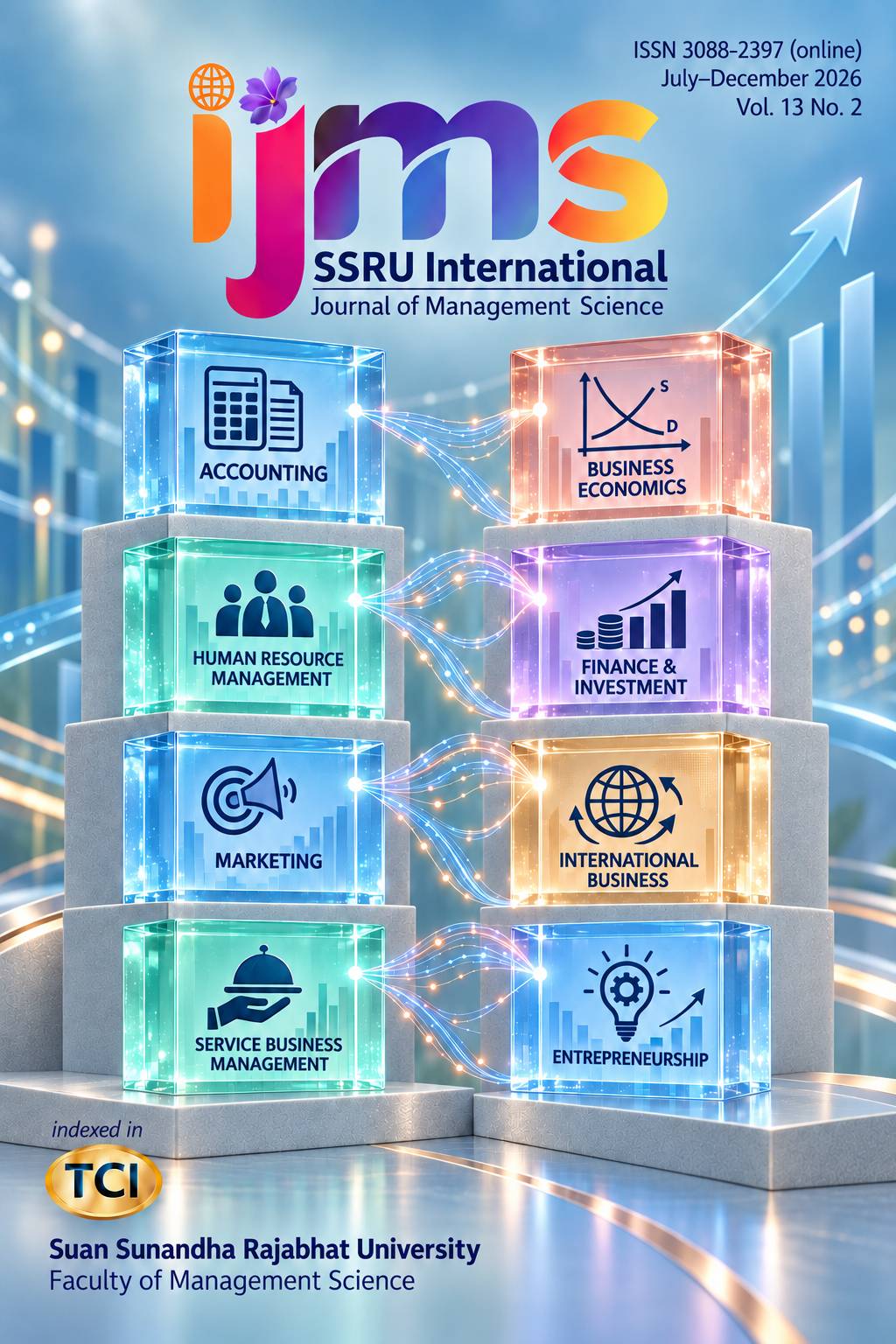
July-December
Vol. 13 No. 2 (2026)
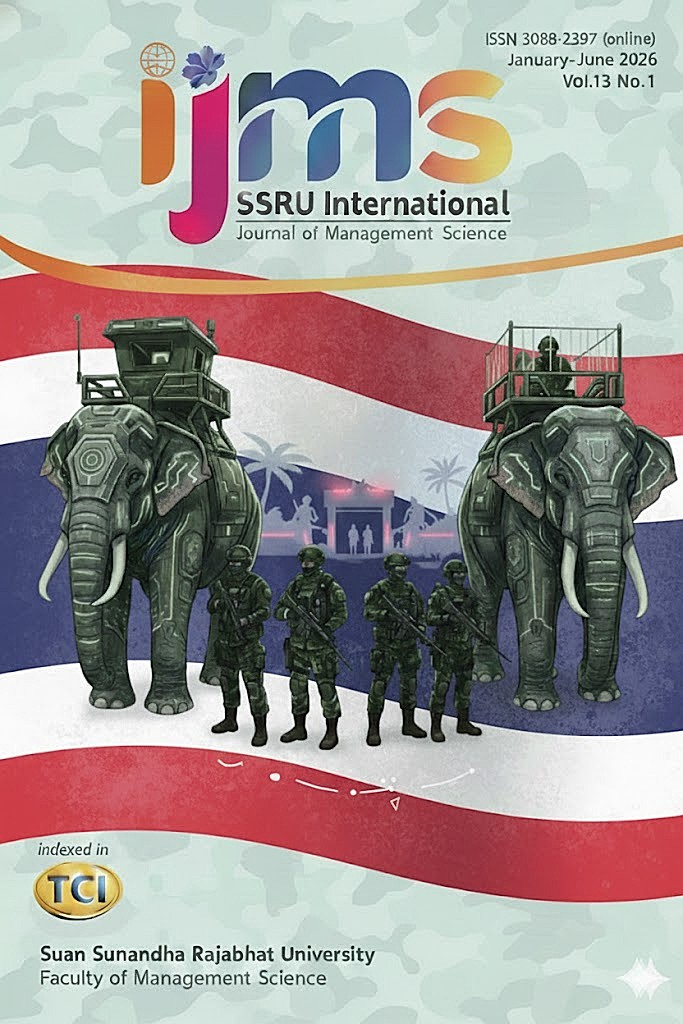
January-June
Vol. 13 No. 1 (2026)
Editorial
Amid economic volatility, social transformation, and increasing political uncertainty, contemporary organizations face not only pressures arising from market competition and technological change but also risks associated with regulatory systems, geopolitical dynamics, and institutional constraints. Such challenges increasingly shape business continuity, strategic decision-making, and organizational adaptability.
International Journal of Management Science (IJMS), Volume 13, Issue 1 (January–June 2026), seeks to advance understanding of contemporary organizational dynamics through scholarship in business and social sciences. This issue presents articles addressing organizational behavior, human resource management, consumer behavior, corporate image, brand experience, and management under conditions of uncertainty.
A distinguished contribution in this issue is “When Politics Meets the Pit: Conventional Production Planning as a Business Continuity Strategy Under Explosive License Disruption” by Aweephan Sornmani, which broadens the scope of Business Continuity Management (BCM) by positioning political and regulatory uncertainty as a significant operational risk affecting organizational continuity. The article further introduces the concept of within-crisis learning, emphasizing that organizational learning can emerge during crises through real-time decision-making and adaptive responses. In addition, it proposes the License Crisis–Proactive Production with Organizational Resilience (LCPP-OR) framework to explain mechanisms for strengthening organizational resilience under compounding crises and institutional uncertainty.
The Editorial Board believes that the articles published in this issue will contribute meaningfully to scholarly dialogue and support the advancement of knowledge characterized by both academic rigor and practical relevance, thereby fostering management perspectives and practices capable of responding effectively to uncertainty and institutional transitions in the contemporary world.
The Editorial Board sincerely thanks all authors, reviewers, and readers for their continued contributions to strengthening the quality and scholarly impact of International Journal of Management Science (IJMS) and supporting its advancement toward broader international academic recognition.
Jeerabhan Chanwichian
Editor-in-Chief
SSRU International Journal of Management Science (IJMS)
July-December
Vol. 12 No. 2 (2025)
Editorial
Issue 2, Volume 12 of the SSRU International Journal of Management Science (IJMS) is prepared amid a rapidly changing economic, social, technological, and environmental context that directly impacts all dimensions of management science, including societal development aligned with SDGs and ESG concepts and safety management. Whether it’s AI, online media image, entrepreneurship, or the application of artificial intelligence and digital technology in organizations, the journal serves as an open academic platform for the exchange of knowledge, research, and high-quality academic articles that can be used both academically and practically.
The articles published in this issue have undergone a rigorous peer review process by experts from various institutions, adhering to international standards. The editorial board emphasized academic accuracy, timeliness of research topics, and the value of knowledge contributing to the sustainable development of management at the organizational, community, and societal levels. This reflects the capabilities of researchers, faculty, and academics from diverse institutions both domestically and internationally.
As the journal prepares for inclusion in the TCI Level 2 academic journal database, the editorial board is committed to continuously raising its standards in areas such as article quality, journal management systems, transparency, and academic ethics, ensuring the journal becomes a recognized source of knowledge at both national and international levels.
The editorial board of the SSRU International Journal of Management Science (IJMS) would like to express its gratitude to all authors, reviewers, and readers for their continuous support and contributions to the journal's development. We sincerely hope that this issue will be beneficial to the study, research, and development of management in the present and future. Furthermore, the editorial board is committed to establishing IJMS as a highquality, internationally recognized academic publication, promoting new findings that can be further developed to help managers, entrepreneurs, researchers, academics, students, and the general public improve themselves and their organizations and prepare to face future challenges.
Jeerabhan Chanwichian
Editor
January-June
Vol. 12 No. 1 (2025)
Editorial
SSRU International Journal of Management Science (IJMS) Volume 12, Issue 1, January - July 2025 is a journal in Group 3 (Humanities and Social Sciences) accepting research articles, academic articles, and review articles to publish a large number of scholarly works, which is considered an area that creates value for society.
This operation aims to meet international academic media standards. To achieve this goal, it is necessary to improve the journal to establish standards, be efficient, and maximize academic productivity. The IJMS editorial team has opened for submissions in the 12th year and the following years with a new format, which is accepting articles in English through the THAIJO 2.0 system to meet the same standards as the Thai-Journal Citation Index: TCI, the Thai Journal Citation Index Center, which is recognized both nationally and internationally. It adheres to the original objective of disseminating knowledge in social sciences and humanities covering content on management, finance and banking, marketing, human resource management, international business, entrepreneurship, service business, business computers, accounting, economics, communication arts, and being a medium for exchanging knowledge, academic experiences, and research between researchers, scholars, students, and interested persons.
An interesting research article in this issue is, “COSO Internal Control Implementation and Its Influence on Financial Reporting Reliability: Evidence from Accounting Professionals in Bangkok, Thailand” by Khwanchat Wongjantip, which discovered new knowledge: This research contributes significant new knowledge to the literature by providing the differential impact of COSO components on the reliability of financial reporting in the Thai accounting system. Specifically, the finding that only the control environment and monitoring activities had statistically significant positive correlations with financial reporting reliability misrepresents the assumption that all five COSO components have an equal role in reporting quality. Such contextual variation suggests that cultural, organizational, and professional conditions in Thailand are likely to influence the operation of internal control mechanisms. The research provides empirical evidence that monitoring activities have the most substantial impact on the reliability of financial reporting among Thai accountants, with practical implications for organizations that intend to invest in internal controls.
The editorial board of SSRU International Journal of Management Science (IJMS) is ready to support academics, lecturers, and students who are interested in publishing research articles and academic articles to promote the value and develop the quality of scholarly work at the national and international levels and continue to create benefits for society as a whole.
Jeerabhan Chanwichian
Editor
July-December
Vol. 11 No. 2 (2024)
January-June
Vol. 11 No. 1 (2024)
July-December
Vol. 10 No. 2 (2023)
January-June
Vol. 10 No. 1 (2023)

July-December
Vol. 9 No. 2 (2022)