THE IMPACT OF SUPERVISORS POWER HARASSMENT ON EMPLOYEES WELL-BEING AND WORK PERFORMANCE IN THAI INDUSTRIAL WORKPLACES
Keywords:
power-based harassment; workplace bullying; burnout; turnover; Thai industrial sectorAbstract
This qualitative study examines the effects of supervisors’ power harassment on employees’ well-being and work performance in Thai industrial workplaces, drawing on the Conservation of Resources (COR) theory and Social Exchange Theory (SET). Data were collected through in-depth interviews with 30 purposively selected informants, comprising 18 production workers, six supervisors, and six representatives from human resources, occupational health, and labor unions, alongside participant observation. Data were analyzed using a hybrid inductive–deductive thematic analysis. Rigor was enhanced through triangulation, including member checking and joint meetings for code interpretation.
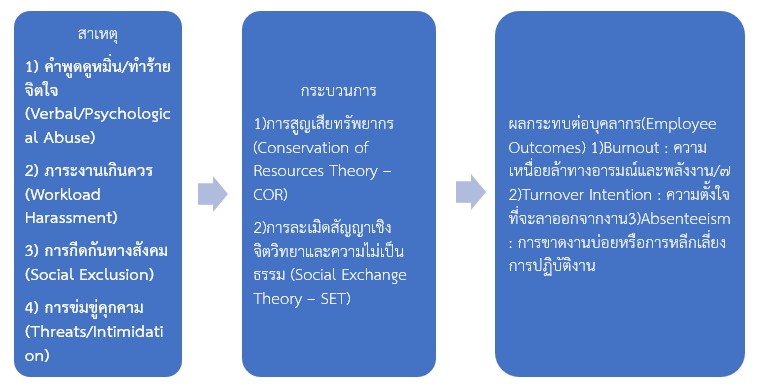
The findings identify four core dimensions of power-based harassment: (1) verbal and psychological abuse, (2) workload harassment, (3) social exclusion, and (4) threats and intimidation. In addition, an emerging dimension, reprimands or public shaming via digital platforms, broadened the scope and intensified the severity of impacts. Individual-level consequences included burnout, stress, silence and withdrawal behaviors, sickness absence, and absenteeism. Organizational-level consequences encompassed reduced perceptions of fairness and safety, diminished organizational commitment, increased turnover intention, and declining work quality. The findings elucidate processes of personal resource depletion and reveal substantial underreporting due to fear of retaliation and lack of evidence, particularly in cases involving digital harassment. These findings underscore the need for systemic measures to prevent power harassment and to sustainably promote employee well-being and work performance in Thailand’s industrial sector.
References
วรเดช จันทร์แก้ว. (2563). โครงสร้างแรงงานไทยกับความท้าทายใหม่. กรุงเทพฯ: สำนักงานคณะกรรมการ พัฒนาเศรษฐกิจและสังคมแห่งชาติ.
สำนักงานสถิติแห่งชาติ. (2566). รายงานภาวะการทำงานของประชากรไทย ปี 2566. กรุงเทพฯ: สำนักงานสถิติแห่งชาติ.
สุนีย์ ไชยรส. (2558). การคุ้มครองสิทธิแรงงานข้ามชาติในประเทศไทย: ช่องว่างและข้อท้าทาย. วารสารนิติศาสตร์ มหาวิทยาลัยธรรมศาสตร์, 44(3), 75–102.
Blau, P. M. (1964). Exchange and power in social life. Wiley.
Boonyasith, P., & Hanwongpaiboon, S. (2024). Protecting employee rights under Thai
laws. Nishimura & Asahi.
Braun, V., & Clarke, V. (2006). Using thematic analysis in psychology. Qualitative Research in Psychology, 3(2), 77–101.
Chaiwuth, S., Siripak, N., & Norkaew, T. (2020). Prevalence of workplace violence among
nurses in upper northern Thailand. Pacific Rim International Journal of Nursing Research, 24(4), 514–526.
Chuemchit, M., Apidechkul, T., & Siri, S. (2024). Discrimination and violence against
women migrant workers in Thailand during COVID-19. PLOS One, 19(2), e0291234.
Cropanzano, R., & Mitchell, M. S. (2005). Social exchange theory: An interdisciplinary
review. Journal of Management, 31(6), 874–900.
Einarsen, S. V., Hoel, H., Zapf, D., & Cooper, C. L. (Eds.). (2020). Bullying and
harassment in the workplace: Theory, research, and practice (3rd ed.). CRC Press.
Einarsen, S. V., Nielsen, M. B., & Gjerstad, J. (2023). Bullying and bystanders in
organizations: Integrating evidence from research on bystander behavior and workplace bullying. Journal of Occupational Health Psychology, 28(3), 203–216.
European Agency for Safety and Health at Work (EU-OSHA). (2018). Framework agreement on harassment and violence at work. EU Publications.
Glambek, M., Matthiesen, S. B., & Einarsen, S. (2015). Workplace bullying, the development of job insecurity and the role of laissez‐faire leadership: A two‐wave moderated mediation study. Work & Stress, 29(3), 270–290.
Guest, G., Bunce, A., & Johnson, L. (2006). How many interviews are enough?.Field Methods, 18(1), 59–82.
Hennink, M. M., Kaiser, B. N., & Marconi, V. C. (2017). Code saturation versus meaning saturation. Qualitative Health Research, 27(4), 591–608.
Hobfoll, S. E. (1989). Conservation of resources: A new attempt at conceptualizing stress. American Psychologist, 44(3), 513–524.
Hobfoll, S. E., Halbesleben, J., Neveu, J. P., & Westman, M. (2018). Conservation of resources in the organizational context: The reality of resources and their consequences. Annual Review of Organizational Psychology and Organizational Behavior, 5, 103–128.
Hofstede Insights. (2024). Country comparison: Thailand.
Human Rights Watch. (2018). Hidden chains: Rights abuses and forced labor in Thailand’s fishing industry. Human Rights Watch. https://www.hrw.org/report/2018/01/23/hidden- chains/rights-abuses-and-forced-labor-thailands-fishing-industry
Malterud, K., Siersma, V. D., & Guassora, A. D. (2016). Sample size in qualitative interview
studies: Guided by information power. Qualitative Health Research. 26(13), 1753–1760.
Maslach, C., & Leiter, M. P. (2016). Burnout: A multidimensional perspective. Routledge.MHLW (Ministry of Health, Labour and Welfare, Japan). (2020). Power harassment prevention guidelines. Government of Japan.
Morrison, E. W. (2014). Employee voice and silence. Annual Review of Organizational Psychology and Organizational Behavior, 1, 173–197.
Naothavorn, W., Apidechkul, T., & Siri, S. (2023). Mistreatment among Thai medical students: Prevalence and associated factors. BMC Medical Education., 23(1), 4462. https://doi.org/10.1186/s12909-023-04462-3
Nielsen, M. B., Einarsen, S. V., Notelaers, G., & Nielsen, G. H. (2022). Workplace bullying
and mental health: A meta-analysis. Work & Stress, 36(4), 365–384.
Nishi, D., & Yoshida, T. (2020). Power harassment in Japanese workplaces: Current status
and countermeasures. Journal of Occupational Health, 62(1), e12134. https://doi.org/10.1002/1348-9585.12134
Nishimura & Asahi. (2024). Employment 2024: Thailand – Trends and developments. Chambers Global Practice Guides. https://practiceguides.chambers.com
Ouyyanont, P. (2009). Bangkok as an industrial hub: Labour migration and structural transformation. Asian Pacific Economic and Business History Conference. https://apebhconference.wordpress.com
Park, J. H., Song, J., & Lim, D. H. (2020). Cultural influences on employee silence and
voice behavior: A comparative study of Korea and the US. Human Resource Development Quarterly, 31(1), 55–76.
Reuters. (2024, July 14). Thai economy faces upheaval due to factory closures, cheap Chinese imports. Reuters. https://www.reuters.com/markets/asia/thai-economy- faces- upheaval-due-factory-closures-cheap-chinese-imports-2024-07-14
Sokantat, W. (2021). Workplace bullying and cultural hierarchy in Thailand. International Journal of Criminal Justice Sciences. 16(2), 280–294.
Downloads
Published
Issue
Section
License
Copyright (c) 2026 Journal of MCU Dvravati Review

This work is licensed under a Creative Commons Attribution-NonCommercial-NoDerivatives 4.0 International License.



