
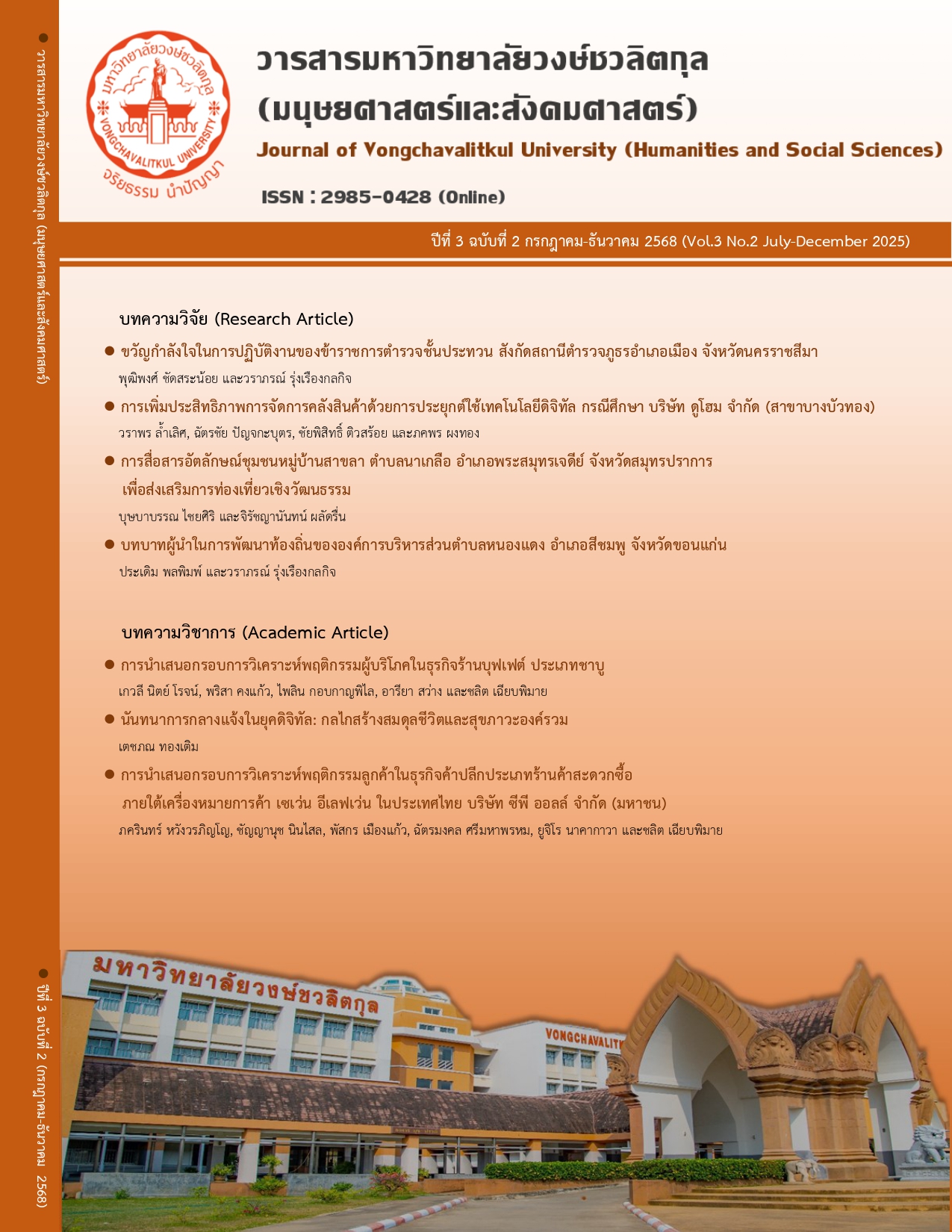
นันทนาการกลางแจ้งในยุคดิจิทัล: กลไกสร้างสมดุลชีวิตและสุขภาวะองค์รวม
Article Sidebar
Main Article Content
บทคัดย่อ
ในยุคดิจิทัลที่ผู้คนเผชิญกับการไหลบ่าของข้อมูลและความเร่งรีบในชีวิตประจำวัน ภาวะความเหนื่อยล้าทางดิจิทัลและความถดถอยของปฏิสัมพันธ์ทางกายภาพได้กลายเป็นประเด็นสำคัญทางสังคม ซึ่งความต้องการพื้นที่นันทนาการกลางแจ้งที่เปิดโอกาสให้บุคคลได้เชื่อมโยงกับธรรมชาติและฟื้นฟูสมดุลชีวิตจึงได้ทวีความสำคัญมากขึ้น บทความนี้มีวัตถุประสงค์เพื่อ 1) วิเคราะห์ลักษณะและผลกระทบของสังคมยุคดิจิทัลที่มีต่อพฤติกรรมการใช้เวลาว่าง สุขภาวะ และความต้องการหลีกหนีสู่ธรรมชาติ 2) จำแนกรูปแบบและลักษณะของกิจกรรมนันทนาการกลางแจ้งที่สอดคล้องกับบริบทสังคมดิจิทัล 3) สังเคราะห์กรอบแนวคิดเชิงทฤษฎีที่ใช้อธิบายพลังในการเยียวยาของธรรมชาติและบทบาทของนันทนาการกลางแจ้งที่มีต่อการสร้างสมดุลชีวิตและส่งเสริมสุขภาวะองค์รวม และ 4) เสนอแนวทางเชิงระบบและนโยบายเพื่อขับเคลื่อนนันทนาการกลางแจ้งให้เป็นกลไกสำคัญในการรับมือกับความท้าทายของสังคมยุคดิจิทัลอย่างยั่งยืน โดยใช้การสังเคราะห์เนื้อหาเชิงตีความจากเอกสารวิชาการร่วมสมัยและกรอบแนวคิดด้านนันทนาการ ผลการสังเคราะห์พบว่า นันทนาการกลางแจ้งเป็นพลังเชิงยุทธศาสตร์ที่ตอบสนองต่อความต้องการฟื้นฟูสุขภาวะในมิติทางกาย จิตใจ สังคม และสิ่งแวดล้อม อีกทั้งผู้เขียนได้เสนอกรอบ Recreation–Technology Restoration Model (RTRM) เพื่ออธิบายการบูรณาการระหว่างธรรมชาติและเทคโนโลยีในฐานะพลังคู่ขนานที่เกื้อหนุนสุขภาวะและการเรียนรู้ของมนุษย์ ซึ่งแนวทางเชิงระบบที่เน้นความเท่าเทียมในการเข้าถึง การบูรณาการนโยบายกับชุมชน และการพัฒนาระบบติดตามที่ใช้ข้อมูลเชิงหลักฐาน จะช่วยสร้างระบบนิเวศของนันทนาการกลางแจ้งที่ปลอดภัย เท่าเทียม และยั่งยืน อันเป็นรากฐานสำคัญของการพัฒนาสังคมไทยให้ก้าวสู่ยุคดิจิทัลอย่างสมดุลและมั่นคง
Article Details

อนุญาตภายใต้เงื่อนไข Creative Commons Attribution-NonCommercial-NoDerivatives 4.0 International License.
เอกสารอ้างอิง
ธนกฤต สังข์เฉย. (2564). แรงจูงใจทางนันทนาการกลางแจ้ง: การศึกษาเชิงสำรวจกิจกรรมเดินป่าระยะไกล. วารสารสุขศึกษา พลศึกษา และสันทนาการ, 47(2), 38–49.
นัทธี บุณจันทร์. (2557). การพัฒนาตัวแบบกิจกรรมกีฬาและนันทนาการเพื่อส่งเสริมการมีส่วนร่วมของนักศึกษา มหาวิทยาลัยสงขลานครินทร์ วิทยาเขตปัตตานี. วารสารวิชาการ มหาวิทยาลัยการกีฬาแห่งชาติ, 6(3), 145–156.
วิรัตน์ ทองแก้ว, สุปราณี ขวัญบุญจันทร์, สราวุธ ชัยวิชิต, และสุวิมล ตั้งสัจจพจน์. (2562). ผลของการเข้าร่วมโปรแกรมนันทนาการกลางแจ้งที่มีต่อการสร้างเสริมการเป็นผู้นําของเยาวชนอาสาสมัครการท่องเที่ยว. วารสารวิเทศศึกษา มหาวิทยาลัยสงขลานครินทร์, 9(1), 138–158.
วิรัตน์ ทองแก้ว. (2563). การออกแบบโปรแกรมนันทนาการกลางแจ้งที่เพิ่มประสบการณ์การใช้เวลาว่างของผู้เข้าร่วม. วารสารวิเทศศึกษา มหาวิทยาลัยสงขลานครินทร์, 10(1), 81–99.
Alexander, G. K., Brooks, V., & Williams, T. S. (2025). Advocacy for equitable access to nature and outdoor recreation. Journal of Nursing Education, 64(5), 313–316.
Bakshi, B., & Polasky, S. (2024). The effect of forest composition on outdoor recreation. Journal of Environmental Management, 364, Article 121397.
Bakshi, B., Polasky, S., & Frelich, L. E. (2024). Using structural equation models (SEM) to link climate change, forest composition, deer, and outdoor recreation. Ecological Modelling, 493, Article 110731.
Banwell, N., Michel, S., & Senn, N. (2024). Greenspaces and health: Scoping review of studies in Europe. Public Health Reviews, 45, Article 1606863.
Beery, T., Olsson, M. R., & Vitestam, M. (2021). Covid-19 and outdoor recreation management: Increased participation, connection to nature, and a look to climate adaptation. Journal of Outdoor Recreation and Tourism, 36, Article 100457.
Bermingham, C., & Schultz, M. (2025). Montana resident report: participation in outfitted and guided outdoor recreation and sports tourism within montana. (19 p.). Institute for Tourism and Recreation Research, University of Montana.
Broom, D. (2022). Health: What are green prescriptions and which countries offer them? World Economic Forum. Retrieved November 12, 2025, from https://www.weforum.org/stories/2022/02/green-prescriptions-health-wellbeing/
Butler, R. W. (2020). Tourism carrying capacity research: A perspective article. Tourism Review, 75(1), 207–211.
Capdevila, T. V., McLellan, B. A., Loosen, A., Forshner, A., Pigeon, K., Jacob, A. L., ... & Ehlers, L. (2024). Advancements in monitoring: A comparison of traditional and application-based tools for measuring outdoor recreation. PeerJ, 12, Article 17744.
Charles-Rodriguez, U., & Larouche, R. (2025). Being “outdoors” in a new country: associations between immigrant characteristics, outdoor recreation activities, and settlement satisfaction in Canada. Leisure Studies, 44(3), 397–411.
Crossan, C., & Salmoni, A. (2021). A simulated walk in nature: Testing predictions from the attention restoration theory. Environment and Behavior, 53(3), 277–295.
Egner, L. E., Sütterlin, S., & Calogiuri, G. (2020). Proposing a framework for the restorative effects of nature through conditioning: Conditioned restoration theory. International Journal of Environmental Research and Public Health, 17(18), Article 6792.
Fagerholm, N., Samuelsson, K., Eilola, S., Giusti, M., Hasanzadeh, K., Kajosaari, A., ... & Barthel, S. (2022). Analysis of pandemic outdoor recreation and green infrastructure in Nordic cities to enhance urban resilience. npj Urban Sustainability, 2(1), Article25.
Fukano, Y., & Soga, M. (2025). The biophilia hypothesis revisited: Back to basics, moving forward. Trends in Ecology & Evolution, 40(6), 527-528.
Gellman, J., Walls, M., & Wibbenmeyer, M. (2025). Welfare losses from wildfire smoke: Evidence from daily outdoor recreation data. Journal of Environmental Economics and Management, Article 103166.
Groulx, M., Wigglesworth, J., DeLorey, R., Harris, N., Harris, P., Lamb, H., & McBride, C. (2024). Not for all: Barriers to universal accessibility in nature-based tourism and recreation spaces across British Columbia, Canada. Journal of Outdoor Recreation and Tourism, 47, Article 100772.
Hansen, A. S., Beery, T., Fredman, P., & Wolf-Watz, D. (2023). Outdoor recreation in Sweden during and after the Covid-19 pandemic – Management and policy implications. Journal of Environmental Planning and Management, 66(7), 1472–1493.
Heart Foundation. (2021). Returning to normal activities. Heart Foundation New Zealand. Retrieved November 12, 2025, from https://www.heartfoundation.org.nz/your-heart/post-heart-attack/returning-to-normal-activities
Hills, D., & Thomas, G. (2020). Digital technology and outdoor experiential learning. Journal of Adventure Education and Outdoor Learning, 20(2), 155–169.
Hsu, J. L., & Sharma, P. (2023). Disaster and risk management in outdoor recreation and tourism in the context of climate change. International Journal of Climate Change Strategies and Management, 15(5), 712–728.
Kennell, J. (2024). Carrying capacity. In J. Jafari & H. Xiao (Eds.), Encyclopedia of Tourism (2nd ed., pp. 139–140). Cham: Springer Nature Switzerland.
King, K., Tråsavik, H., & Sareen, S. (2024). Take a hike: Spatializing allemannsretten and transportation accessibility for outdoor recreation in the Greater Stavanger Region, Norway. Norsk Geografisk Tidsskrift – Norwegian Journal of Geography, 78(5), 324–337.
Komossa, F., Wartmann, F. M., Kienast, F., & Verburg, P. H. (2020). Comparing outdoor recreation preferences in peri-urban landscapes using different data gathering methods. Landscape and Urban Planning, 199, Article 103796.
Le Corre, N., Saint-Pierre, A., Hughes, M., Peuziat, I., Cosquer, A., Michot, T., & Bernard, N. (2021). Outdoor recreation in French coastal and marine protected areas: Exploring recreation experience preference as a way for building conservation support. Journal of Outdoor Recreation and Tourism, 33, Article 100332.
Lehto, C., Sirén, A., Hedblom, M., & Fredman, P. (2025). A conceptual framework of indicators for the suitability of forests for outdoor recreation. Ambio, 54(2), 184–197.
Lengieza, M. L., & Aviste, R. (2025). Relationships between people and nature: Nature connectedness and relational environmental values. Current Opinion in Psychology, 62, Article 101984.
Liu, Y., Zhang, J., Liu, C., & Yang, Y. (2024). A review of attention restoration theory: Implications for designing restorative environments. Sustainability, 16(9), Article 3639.
Livingston, A. S. (2022). Technology that inspires a connection to nature: Reframing the role of technology in outdoor engagement and conservation. Journal of Outdoor Recreation, Education, and Leadership, 14(1), 87–94.
Mangold, M., Schwietering, A., Zink, J., Steinbauer, M. J., & Heurich, M. (2024). The digitalization of outdoor recreation: Global perspectives on the opportunities and challenges for protected area management. Journal of Environmental Management, 352, Article 120108.
Marion, S., Davies, A., Demšar, U., Irvine, R. J., Stephens, P. A., & Long, J. (2020). A systematic review of methods for studying the impacts of outdoor recreation on terrestrial wildlife. Global Ecology and Conservation, 22, Article 00917.
Marzetti, E., Calvani, R., Tosato, M., Cesari, M., Di Bari, M., Cherubini, A., Collamati, A., D’Angelo, E., Pahor, M., Bernabei, R., Landi, F., & SPRINTT Consortium. (2017). Sarcopenia: An overview. Aging Clinical and Experimental Research, 29(1), 11–17.
Menzies, A., Mazan, C., Borisoff, J. F., Mattie, J. L., & Mortenson, W. B. (2021). Outdoor recreation among wheeled mobility users: Perceived barriers and facilitators. Disability and Rehabilitation: Assistive Technology, 16(4), 384–390.
Morse, W. C., Stern, M., Blahna, D., & Stein, T. (2022). Recreation as a transformative experience: Synthesizing the literature on outdoor recreation and recreation ecosystem services into a systems framework. Journal of Outdoor Recreation and Tourism, 38, Article 100492.
Paterson, D. H., & Warburton, D. E. R. (2010). Physical activity and functional limitations in older adults: A systematic review related to Canada’s Physical Activity Guidelines. The International Journal of Behavioral Nutrition and Physical Activity, 7, Article 38.
Pedersen, B. K., & Saltin, B. (2015). Exercise as medicine – evidence for prescribing exercise as therapy in 26 different chronic diseases. Scandinavian Journal of Medicine & Science in Sports, 25(Suppl 3), 1–72.
Pringle, G., Boddy, J., Slattery, M., & Harris, P. (2023). Adventure therapy for adolescents with complex trauma: A scoping review and analysis. Journal of Experiential Education, 46(4), 433–454.
Reese, G., Stahlberg, J., & Menzel, C. (2022). Digital shinrin-yoku: Do nature experiences in virtual reality reduce stress and increase well-being as strongly as similar experiences in a physical forest? Virtual Reality, 26(3), 1245–1255.
Rivera, E., Veitch, J., Loh, V. H., Salmon, J., Cerin, E., Mavoa, S., ... & Timperio, A. (2022). Outdoor public recreation spaces and social connectedness among adolescents. BMC Public Health, 22(1), Article 165.
Rogers, S. H., Ashcraft, C. M., Seaman, J., Lemos, S. R., Krans, L., & Marsh, J. (2024). A community-based approach to the nature economy: Insights from outdoor recreation, conservation, and economic development. Journal of Outdoor Recreation, Education, and Leadership, 16(3), 1–13.
Rogerson, M., Wood, C., Pretty, J., Schoenmakers, P., Bloomfield, D., & Barton, J. (2020). Regular doses of nature: The efficacy of green exercise interventions for mental wellbeing. International Journal of Environmental Research and Public Health, 17(5), Article 1526.
Rubio-Cabañez, M. (2025). Stratifying cities: The effect of outdoor recreation areas on children’s well-being. European Sociological Review, 41(3), 472–486.
Schlüter, M., Biggs, R., Clements, H., de Vos, A., Maciejewski, K., & Preiser, R. (2021). Synthesis and emerging frontiers in social-ecological systems research methods. In The Routledge Handbook of Research Methods for Social-Ecological Systems (pp. 453–479). Routledge.
Selin, S., Cerveny, L. K., & Blahna, D. J. (2020). Igniting research for outdoor recreation: Linking science, policy, and action. Gen. Tech. Rep. PNW-GTR-987. Portland, OR: US Department of Agriculture, Forest Service, Pacific Northwest Research Station.
Sheffield, D., Butler, C. W., & Richardson, M. (2022). Improving nature connectedness in adults: A meta-analysis, review and agenda. Sustainability, 14(19), Article 12494.
Shuda, Q., Bougoulias, M. E., & Kass, R. (2020). Effect of nature exposure on perceived and physiologic stress: A systematic review. Complementary Therapies in Medicine, 53, Article 102514.
Spangenberger, P., Geiger, S. M., & Freytag, S. C. (2022). Becoming nature: Effects of embodying a tree in immersive virtual reality on nature relatedness. Scientific Reports, 12(1), Article 1311.
Sullivan, W. C., & Li, D. (2021). Nature and attention. In Nature and psychology: Biological, cognitive, developmental, and social pathways to well-being (pp. 7–30). Cham: Springer International Publishing.
Taff, B. D., Rice, W. L., Lawhon, B., & Newman, P. (2021). Who started, stopped, and continued participating in outdoor recreation during the COVID-19 pandemic in the United States? Results from a national panel study. Land, 10(12), Article 1396.
Tohan, M. M., Ahmed, F., Juie, I. J., Kabir, A., & Rahman, M. A. (2024). Outdoor recreational activities and mental well-being of geriatric people in Bangladesh: Structural equation modelling. Discover Psychology, 4(1), Article 33.
Ulrich, R. S. (2023). Stress reduction theory. In D. Marchand, E. Pol, & K. Weiss (Eds.), 100 (pp. 143–146). Routledge.
Valenzuela, F. (2020). Technology and outdoor recreation in the dawning of the age of constant and instant digital connectivity. In S. Selin, L. K. Cerveny, D. J. Blahna, & A. B. Miller (Eds.), Igniting research for outdoor recreation: Linking science, policy, and action (pp. 101–114). Gen. Tech. Rep. PNW-GTR-987. Portland, OR: US Department of Agriculture, Forest Service, Pacific Northwest Research Station.
Wilkins, E. J., & Horne, L. (2024). Effects and perceptions of weather, climate, and climate change on outdoor recreation and nature-based tourism in the United States: A systematic review. PLOS Climate, 3(4), Article 0000266.
Woods, V., & Knuth, M. (2023). The biophilia reactivity hypothesis: Biophilia as a temperament trait, or more precisely, a domain specific attraction to biodiversity. Journal of Bioeconomics, 25(3), 271–293.
Yang, E., & Smith, J. W. (2023). The spatial and temporal resilience of the tourism and outdoor recreation industries in the United States throughout the COVID-19 pandemic. Tourism Management, 95, Article 104661.
Yumuk, E. D. (2023). Tech in rec: Technology use in outdoor recreation. In I. Bayraktar (Ed.), The Use of Developing Technology in Sports (p. 151). Özgür Yayınları.
Zhang, W., Wan, X., Fan, W., & Ji, Y. (2024). Uncovering disparities in water-based outdoor recreation using cell phone mobility data. Environmental Research Letters, 19(11), Article 114057.
