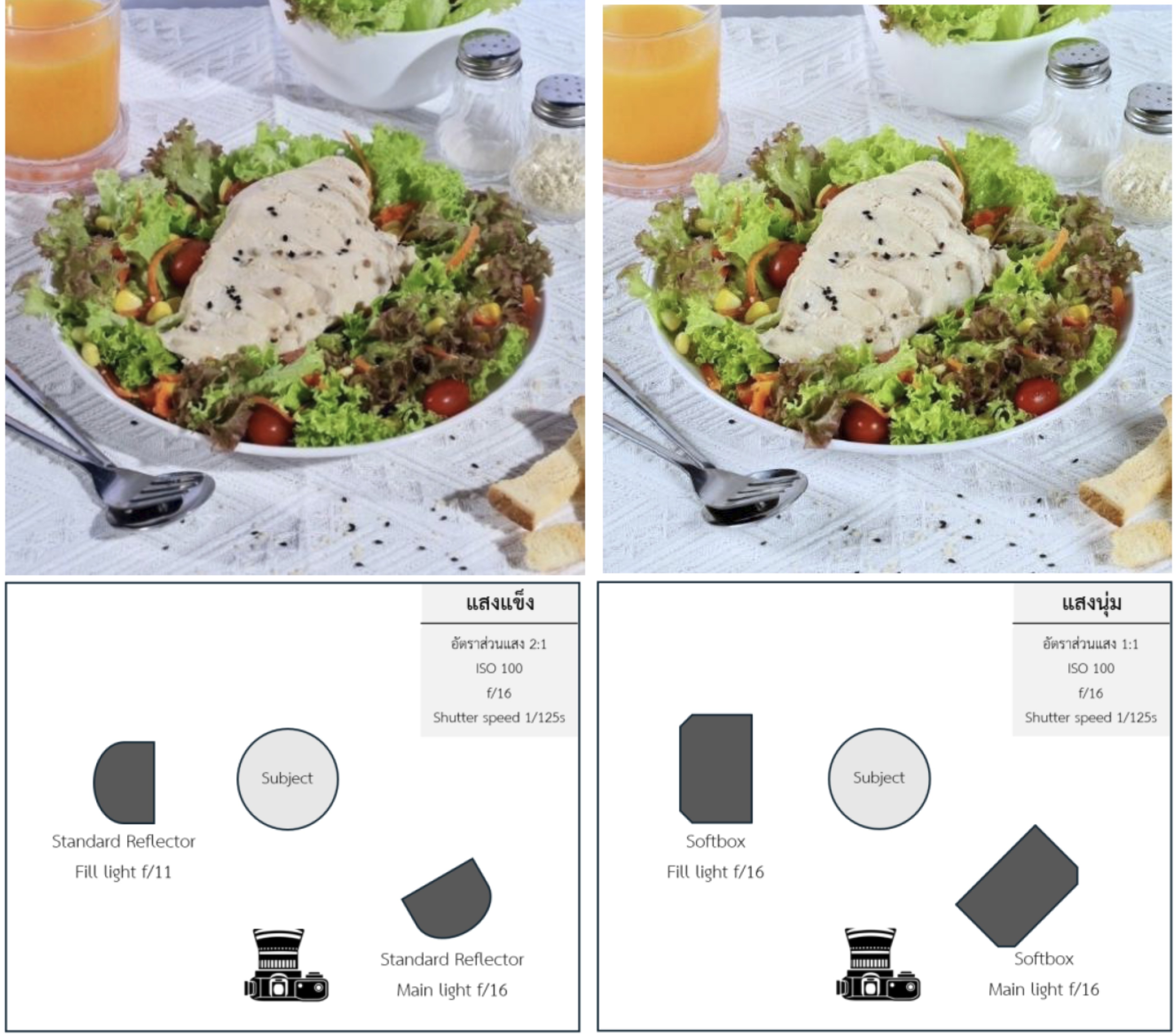
The Impact of Lighting Ratio on the Advertisement Photography of Clean Food
DOI:
https://doi.org/10.60101/jimc2025.2996Keywords:
Healthy Food, Clean Food, Advertisement Photography, Light Ratio, SatisfactionAbstract
The objectives of this research were to (1) study the suitability of light ratio in clean food advertisement photography, (2) study the production process of clean food advertisements, and (3) to assess the satisfaction of the sample group regarding clean food advertisements. The research methodology involved generating 8 images of clean food, comprising 4 images taken with hard lighting and 4 images with soft lighting, while employing various lighting ratios: 1:1, 2:1, 4:1, and 8:1. An experimental group of 30 individuals residing in Pathum Thani Province was presented with the images to assess the suitability of the lighting ratios. The evaluation results were utilized to create clean food advertisements, which were afterwards assessed by experts for image quality and by a sample group of 102 individuals for their satisfaction with the advertisements.
The research results showed that the suitable lighting ratio using hard light was 2:1 and the suitable lighting ratio for photographing clean food with soft light is 1:1. Also, the production process of advertisements comprises three stages: Pre-Production, Production, and Post-Production. Following the experts' quality assessment, clean food images can be used in advertising if the props are chosen carefully and communicate clean food according to nutritional principles. The sample group were satisfied with clean food images illuminated with hard lighting at a 2:1 lighting ratio and those illuminated with soft lighting at a 1:1 lighting ratio at high level. The sample group expressed the opinion that clean food images illuminated with both hard and soft lighting were perceived as having the most vivid colors and appearing to be the most appetizing.
References
ภาษาไทย
กรมโยธาธิการและผังเมือง. (2568, 24 มิถุนายน). รายงานประจำปี 2567 กรมโยธาธิการและผังเมือง กระทรวง มหาดไทย. https://library.dopa.go.th/manual-resources/685a20832f46a
กรุงเทพธุรกิจ. (2566, 22 กุมภาพันธ์). ธุรกิจ ‘อาหารเพื่อสุขภาพ’ ยุคใหม่ ทำอย่างไรให้ตอบโจทย์ คนทุกวัย. https://www.bangkokbiznews.com/health/well- being/1054386
ดรุณีวัลย์ วโรดมวิจิตร. (2560, 24 เมษายน). กินคลีนอย่างไรให้ถูกวิธี. https://www.rama.mahidol.ac.th/ ramachannel/article
ปรมัยวัฒน์ เก่งงาน. (2559). อิทธิพลของอัตราส่วนแสงในการถ่ายภาพอาหารที่มีต่อความรู้สึกของผู้บริโภค[วิทยานิพนธ์ปริญญามหาบัณฑิต, มหาวิทยาลัยเทคโนโลยีราชมงคลธัญบุรี]
ภักตร์พิมล เสนีย์. (2548). การถ่ายภาพเพื่อการสื่อสาร. ศูนย์เทคโนโลยีการพิมพ์ มหาวิทยาลัยเทคโนโลยีราชมงคลธัญบุรี.
ภักตร์พิมล เสนีย์. (2550). ออบติกส์ทางการถ่ายภาพ. ศูนย์เทคโนโลยีการพิมพ์ มหาวิทยาลัยเทคโนโลยีราชมงคลธัญบุรี.
เยาวนารถ พันธุ์เพ็ง. (2565, 25 เมษายน). กระบวนการผลิตภาพถ่ายโฆษณา. https://www.chonburi.spu.ac.th/ comm/admin/knowledge/A4023.pdf
สุทัศน์ บุรีภักดี. (2544). เทคนิคการจัดแสงเพื่อการถ่ายทำภาพยนตร์. มหาวิทยาลัยสุโขทัยธรรมาธิราช.
อรวรรณ สมุห์เสนีโตและศิวพร เสาวคนธ์. (2567). ปัญหาทางกฎหมายเกี่ยวกับการควบคุมการแต่งภาพในการซื้อขายสินค้าออนไลน์ประเภทเครื่องแต่งกาย. Interdisciplinary Academic and Research Journal, 4 (1), 711-720.
Karn Triamsiriworakul. (2564, 15 ตุลาคม). ความสำคัญและเทคนิคการถ่ายภาพอาหารที่แบรนด์ควรรู้. https://www.unboxbkk.com/blog/food-photography/
MGR Online. (2558, 25 ธันวาคม). อาหารคลีน. https://mgronline.com/qol/detail/9580000140322
NOK THANAPHON. (2562, 8 มกราคม). ประเภทของอาหารเพื่อสุขภาพ. https://healthyHealth099.blogspot.com
Unileverfoodsolutions (2568, 25 สิงหาคม). เทคนิคการตลาดร้านอาหารผ่านสื่อสังคมออนไลน์. https://www.unileverfoodsolutions.co.th/th/chef-inspiration/restaurant-marketing/social-media-marketing-for-restaurants.html
ภาษาอังกฤษ
Zukowski, A. (2014). The art of photography: A personal approach to artistic expression. Rocky Nook.