การทดสอบเชิงประจักษ์ของความมีประสิทธิภาพในระดับอ่อน: กรณีศึกษาจากกองทุนรวมหุ้นไทย
คำสำคัญ:
ความมีประสิทธิภาพของตลาดในระดับอ่อน, กองทุนรวมหุ้นไทย, การทดสอบแบบนอนพาราเมตริก, พฤติกรรมสุ่มของผลตอบแทน, ความเป็นอิสระต่อกันของผลตอบแทนบทคัดย่อ
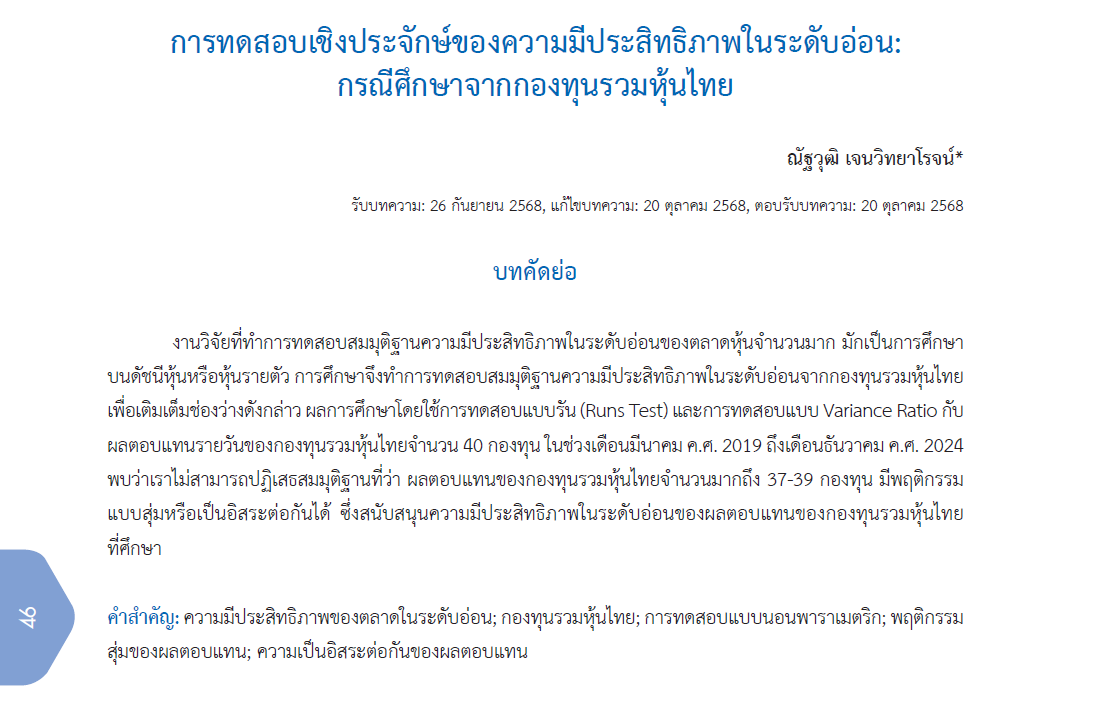
งานวิจัยที่ทำการทดสอบสมมุติฐานความมีประสิทธิภาพในระดับอ่อน (Fama, 1970) ของตลาดหุ้นจำนวนมาก มักเป็นการศึกษาบนดัชนีหุ้นหรือหุ้นรายตัว การศึกษาจึงทำการทดสอบสมมุติฐานความมีประสิทธิภาพในระดับอ่อนจากกองทุนรวมหุ้นไทยเพื่อเติมเต็มช่องว่างดังกล่าว ผลการศึกษาโดยใช้การทดสอบแบบรัน (Runs Test) และการทดสอบแบบ Variance Ratio กับผลตอบแทนรายวันของกองทุนรวมหุ้นไทยจำนวน 40 กองทุนในช่วงเดือนมีนาคม ค.ศ. 2019 ถึงเดือนธันวาคม ค.ศ. 2024 พบว่า เราไม่สามารถปฏิเสธสมมุติฐานที่ว่าผลตอบแทนของกองทุนรวมหุ้นไทยจำนวนมากถึง 37 ถึง 39 กองทุนมีพฤติกรรมแบบสุ่มหรือเป็นอิสระต่อกันได้ ซึ่งสนับสนุนความมีประสิทธิภาพในระดับอ่อนของผลตอบแทนของกองทุนรวมหุ้นไทยที่ศึกษา
เอกสารอ้างอิง
Abraham, A., F. J. Seyyed, & S. A. Alsakran. (2002). Testing the random walk behavior and efficiency of the Gulf stock markets. Financial Review, 37(3), 469-480. https://doi.org/10.1111/0732-8516.00008
Banchuenvijit, W., & Choochuen, S. (2013). Market efficiency of the Stock Exchange of Thailand. University of the Thai Chamber of Commerce Journal Humanities and Social Sciences, 33(1), 68-80.
Fama, E. F. (1965). The behavior of stock-market prices. The Journal of Business, 38(1), 34-105. http://www.jstor.org/stable/2350752
Fama, E. F. (1970). Efficient capital markets: A review of theory and empirical work. The Journal of Finance, 25(2), 383-417. https://doi.org/10.2307/2325486
Fama, E. F. (1991). Efficient capital markets: II. The Journal of Finance, 46(5), 1575-1617. https://doi.org/10.1111/j.1540-6261.1991.tb04636.x
Getmansky, M., Lo, A. W., & Makarov, I. (2004). An econometric model of serial correlation and illiquidity in hedge fund returns. Journal of Financial Economics, 74(3), 529-609. https://doi.org/10.1016/j.jfineco.2004.04.001
Jenwittayaroje, N. (2020). Return behavior of the individual stocks: An empirical test on the weak form efficiency of SET50 and SET100 stocks on the Stock Exchange of Thailand. Kasetsart Applied Business Journal, 14(20), 78-96.
Jenwittayaroje, N. (2021). Testing weak-form market efficiency in the Stock Exchange of Thailand. Global Business and Economics Review, 24(3), 211-224. https://doi.org/10.1504/GBER.2021.114657
Jenwittayaroje, N. (2022). The study of the return behavior of the big-cap stocks on the Stock Exchange of Thailand: Evidence from pre-, during, and post-Covid-19. NIDA Business Journal, (31), 96-112. https://so10.tci-thaijo.org/index.php/NIDABJ/article/view/93
Jenwittayaroje, N. (2024). Testing weak-form efficiency of commodities open-ended funds in Thailand. NIDA Business Journal, (34), 74-85. https://so10.tci-thaijo.org/index.php/NIDABJ/article/view/1195
Kenourgios, D., & Y. Samios. (2021). Halloween effect and active fund management. Quarterly Review of Economics and Finance, 80, 534-544. https://doi.org/10.1016/j.qref.2021.04.006
Lo, A. W., & MacKinlay, A. C. (1988). Stock market prices do not follow random walks: Evidence from a simple specification test. The Review of Financial Studies, 1(1), 41-66. http://www.jstor.org/stable/2962126
ดาวน์โหลด
เผยแพร่แล้ว
รูปแบบการอ้างอิง
ฉบับ
ประเภทบทความ
สัญญาอนุญาต
ลิขสิทธิ์ (c) 2025 คณะบริหารธุรกิจ สถาบันบัณฑิตพัฒนบริหารศาสตร์

อนุญาตภายใต้เงื่อนไข Creative Commons Attribution-NonCommercial-NoDerivatives 4.0 International License.