
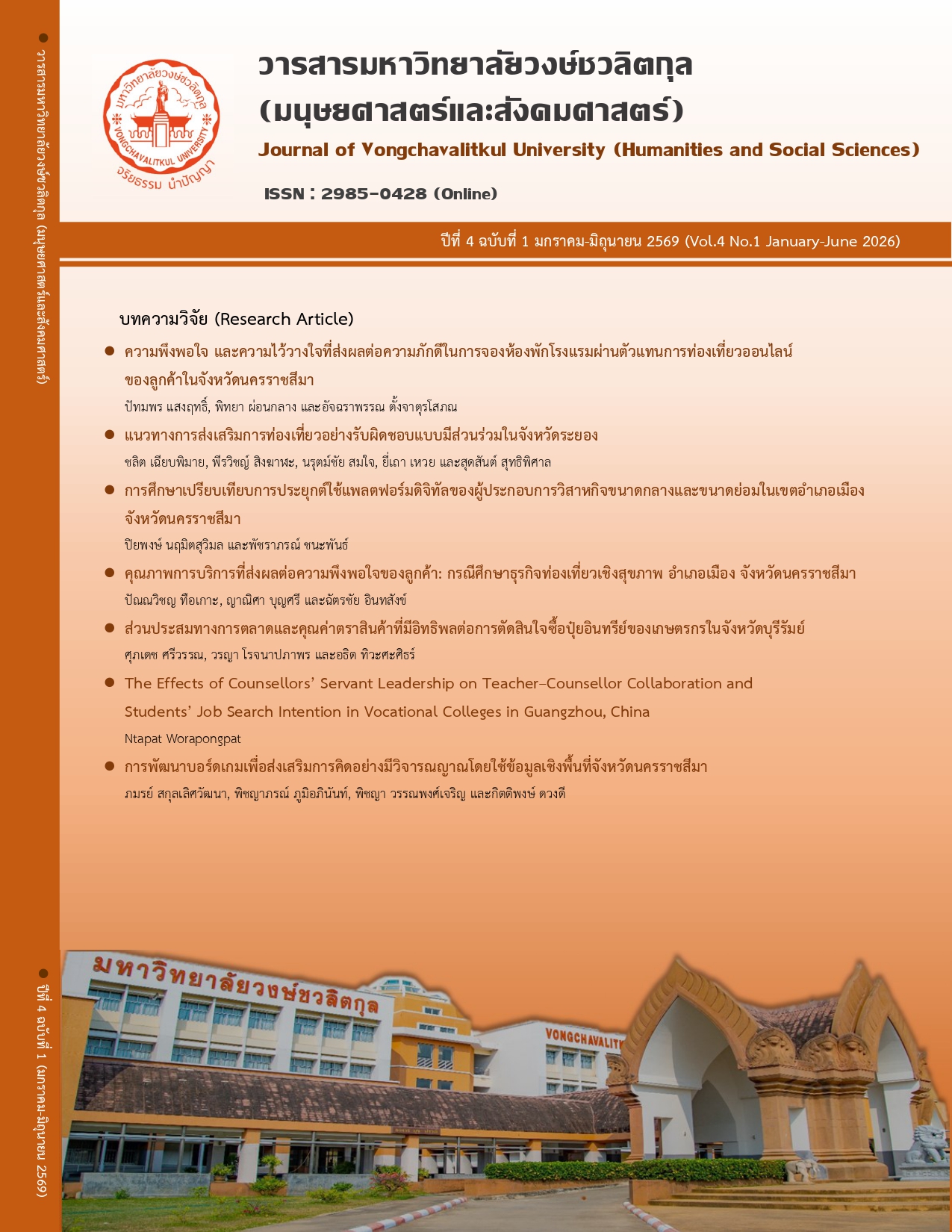
การศึกษาเปรียบเทียบการประยุกต์ใช้แพลตฟอร์มดิจิทัลของผู้ประกอบการวิสาหกิจขนาดกลางและขนาดย่อม ในเขตอำเภอเมือง จังหวัดนครราชสีมา
Article Sidebar
Main Article Content
บทคัดย่อ
การวิจัยครั้งนี้มีวัตถุประสงค์เพื่อ 1) ศึกษาการประยุกต์ใช้แพลตฟอร์มดิจิทัลของผู้ประกอบการวิสาหกิจขนาดกลางและขนาดย่อม ในเขตอำเภอเมือง จังหวัดนครราชสีมา และ 2) เปรียบเทียบการประยุกต์ใช้แพลตฟอร์มดิจิทัลจำแนกตามลักษณะทางประชากรศาสตร์ ได้แก่ เพศ อายุ ประเภทของธุรกิจ และระยะเวลาการประกอบธุรกิจ การวิจัยนี้เป็นการวิจัยเชิงปริมาณ โดยใช้กลุ่มตัวอย่างคือ ผู้ประกอบการวิสาหกิจขนาดกลางและขนาดย่อมในเขตอำเภอเมือง จังหวัดนครราชสีมา จำนวน 400 ราย ด้วยวิธีการเลือกกลุ่มตัวอย่างแบบไม่ใช้ความน่าจะเป็น โดยใช้วิธีการเลือกกลุ่มตัวอย่างแบบเจาะจง ใช้แบบสอบถามในการเก็บรวบรวมข้อมูล สถิติที่ใช้ในการวิเคราะห์ข้อมูล ได้แก่ ค่าความถี่ ร้อยละ ค่าเฉลี่ย ส่วนเบี่ยงเบนมาตรฐาน และทดสอบสมมติฐานด้วยการวิเคราะห์ความแปรปรวนทางเดียว และการทดสอบความแตกต่างเป็นรายคู่ด้วยวิธีผลต่างนัยสำคัญน้อยที่สุด
ผลการวิจัยพบว่า ในภาพรวมการประยุกต์ใช้แพลตฟอร์มดิจิทัลของผู้ประกอบการวิสาหกิจขนาดกลางและขนาดย่อม อยู่ในระดับมากที่สุด ผลการทดสอบสมมติฐานพบว่า ลักษณะทางประชากรศาสตร์ด้านอายุที่แตกต่างกัน ส่งผลให้การประยุกต์ใช้แพลตฟอร์มดิจิทัลแตกต่างกันอย่างมีนัยสำคัญทางสถิติที่ระดับ 0.01 โดยผู้ประกอบการกลุ่มที่มีอายุต่ำกว่า 25 ปี จนถึง 54 ปี มีการประยุกต์ใช้แพลตฟอร์มดิจิทัลสูงกว่ากลุ่มผู้ประกอบการที่มีอายุ 55 ปีขึ้นไป นอกจากนี้ยังพบว่าระยะเวลาที่ประกอบธุรกิจที่แตกต่างกัน ส่งผลต่อการประยุกต์ใช้แพลตฟอร์มดิจิทัลแตกต่างกันอย่างมีนัยสำคัญทางสถิติที่ระดับ 0.05 โดยกิจการที่เปิดดำเนินการมา 1 - 3 ปี และ 4 - 6 ปี มีการนำเทคโนโลยีมาประยุกต์ใช้สูงกว่ากิจการที่เปิดดำเนินการมานานกว่า 6 ปี
Article Details

อนุญาตภายใต้เงื่อนไข Creative Commons Attribution-NonCommercial-NoDerivatives 4.0 International License.
เอกสารอ้างอิง
กัลยา วานิชย์บัญชา. (2561). สถิติสำหรับงานวิจัย: หลักการเลือกใช้เทคนิคทางสถิติในงานวิจัยพร้อมทั้งอธิบายผลลัพธ์ที่ได้จาก SPSS (พิมพ์ครั้งที่ 12). ห้างหุ้นส่วนจำกัดสามลดา.
ธีรวัฒน์ ธีรเสนี. (2564). แนวทางการปรับตัวของผู้ประกอบการขายสินค้าออนไลน์ในยุค COVID-19 (วิทยานิพนธ์ปริญญาบริหารธุรกิจมหาบัณฑิต). มหาวิทยาลัยธุรกิจบัณฑิตย์.
บุญชม ศรีสะอาด. (2553). การวิจัยเบื้องต้น (พิมพ์ครั้งที่ 8). สุวีริยาสาส์น.
พรพรรณ พรมโพธิ์, ณัฐนรินทร์ เนียมประดิษฐ์, และณัฐหทัย บรรจงจิตร. (2568). การบริหารธุรกิจในยุค Digital Transformation. วารสารโพธิศาสตร์ปริทัศน์, 5(2), 109–124. https://so09.tci-thaijo.org/index.php/BRJ/article/view/7539
สำนักงานพัฒนาธุรกรรมทางอิเล็กทรอนิกส์. (2567). อิทธิพลของแพลตฟอร์มดิจิทัล สื่อกลางที่จำเป็นต้องมีการกำกับดูแล The influence of digital platforms and why they need to be regulated. สืบค้นเมื่อวันที่ 7 เมษายน 2569, จาก https://www.timeconsulting.co.th/what-is-digital-platforms
สำนักงานส่งเสริมวิสาหกิจขนาดกลางและขนาดย่อม. (2566). รายงานสถานการณ์วิสาหกิจขนาดกลางและขนาดย่อม ปี 2566. สำนักงานส่งเสริมวิสาหกิจขนาดกลางและขนาดย่อม (สสว.). สืบค้นเมื่อวันที่ 7 เมษายน 2569, จาก https://bds.sme.go.th/Files/f5e20d92-138e-48f2-a29f-5a6c3a37cfd0.pdf
Creswell, J. W., & Creswell, J. D. (2018). Research design: Qualitative, quantitative, and mixed methods approaches (5th ed.). SAGE Publications.
Davis, F. D. (1989). Perceived usefulness, perceived ease of use, and user acceptance of information technology. MIS Quarterly, 13(3), 319–340. https://doi.org/10.2307/249008
Dwivedi, Y. K., Kshetri, N., Hughes, L., Slade, E. L., Jeyaraj, A., Kar, A. K., & Wright, R. (2023). The metaverse: A brief overview of underlying technologies, opportunities and challenges. International Journal of Information Management, 71, 102642. https://doi.org/10.1016/j.ijinfomgt.2023.102642
Gilbert, C. G. (2005). Unbundling the structure of inertia: Resource versus routine rigidity. Academy of Management Journal, 48(5), 741–763. https://doi.org/10.5465/amj.2005.18803920
Hair, J. F., Black, W. C., Babin, B. J., & Anderson, R. E. (2019). Multivariate data analysis (8th ed.). Cengage.
Khin, S., & Ho, T. C. (2019). Digital technology, digital capability and organizational performance: A mediating role of digital innovation. International Journal of nnovation Science, 11(2), 177-195. https://doi.org/10.1108/IJIS-08-2018-0083
Kotler, P., & Keller, K. L. (2021). Marketing management (16th ed.). Pearson Education.ss
Kotler, P., Kartajaya, H., & Setiawan, I. (2021). Marketing 5.0: Technology for humanity. John Wiley & Sons.
Kraus, S., Palmer, C., Kailer, N., Kallinger, F. L., & Spitzer, J. (2019). Digital entrepreneurship: A research agenda on new business models for the twenty-first century. International Journal of Entrepreneurial Behavior & Research, 25(2), 353–375. https://doi.org/10.1108/IJEBR-06-2018-0425
Mergel, I., Edelmann, N., & Haug, N. (2019). Defining digital transformation: Results from expert interviews. Government Information Quarterly, 36(4), Article 101385. https://doi.org/10.1016/j.giq.2019.06.002
Nayak, M., Nayak, P. M., & Joshi, H. G. (2025). Digital platforms’ use in SMEs – A critical analysis of entrepreneurs’ behaviour. Cogent Economics & Finance, 13(1), Article 2461337. https://doi.org/10.1080/23322039.2025.2461337
Parker, G. G., Van Alstyne, M. W., & Choudary, S. P. (2021). Platform revolution: How networked markets are transforming the economy and how to make them work for you (Updated and expanded ed.). W. W. Norton & Company.
Prensky, M. (2001). Digital natives, digital immigrants part 1. On the Horizon, 9(5), 1-6. https://doi.org/10.1108/10748120110424816
Solomon, M. R., Russell-Bennett, R., & Previte, J. (2020). Consumer behaviour: Buying, having, and being (4th Asia–Pacific ed.). Pearson Australia.
Teece, D. J. (2018). Dynamic capabilities as (workable) management systems theory. Journal of Management & Organization, 24(3), 356-368. https://doi.org/10.1017/jmo.2017.75
Thongmak, M. (2022). Website quality and company's market value: An exploration of SMEs and large firms in the Stock Exchange of Thailand. Measuring Business Excellence, 26(4), 508-523. https://doi.org/10.1108/MBE-03-2021-0045
Venkatesh, V., Morris, M. G., Davis, G. B., & Davis, F. D. (2003). User acceptance of information technology: Toward a unified view. MIS Quarterly, 27(3), 425–478. https://doi.org/10.2307/30036540
Verhoef, P. C., Broekhuizen, T., Bart, Y., Bhattacharya, A., Dong, J. Q., Fabian, N., & Haenlein, M. (2021). Digital transformation: A multidisciplinary reflection and research agenda. Journal of Business Research, 122, 889-901. https://doi.org/10.1016/j.jbusres.2019.09.022
Vogels, E. A. (2019). Millennials stand out for their technology use, but older generations also embrace digital life. Pew Research Center. https://www.pewresearch.org/short-reads/2019/09/09/us-generations-technology-use/
Yamane, T. (1973). Statistics: An introductory analysis (3rd ed.). Harper & Row.
