
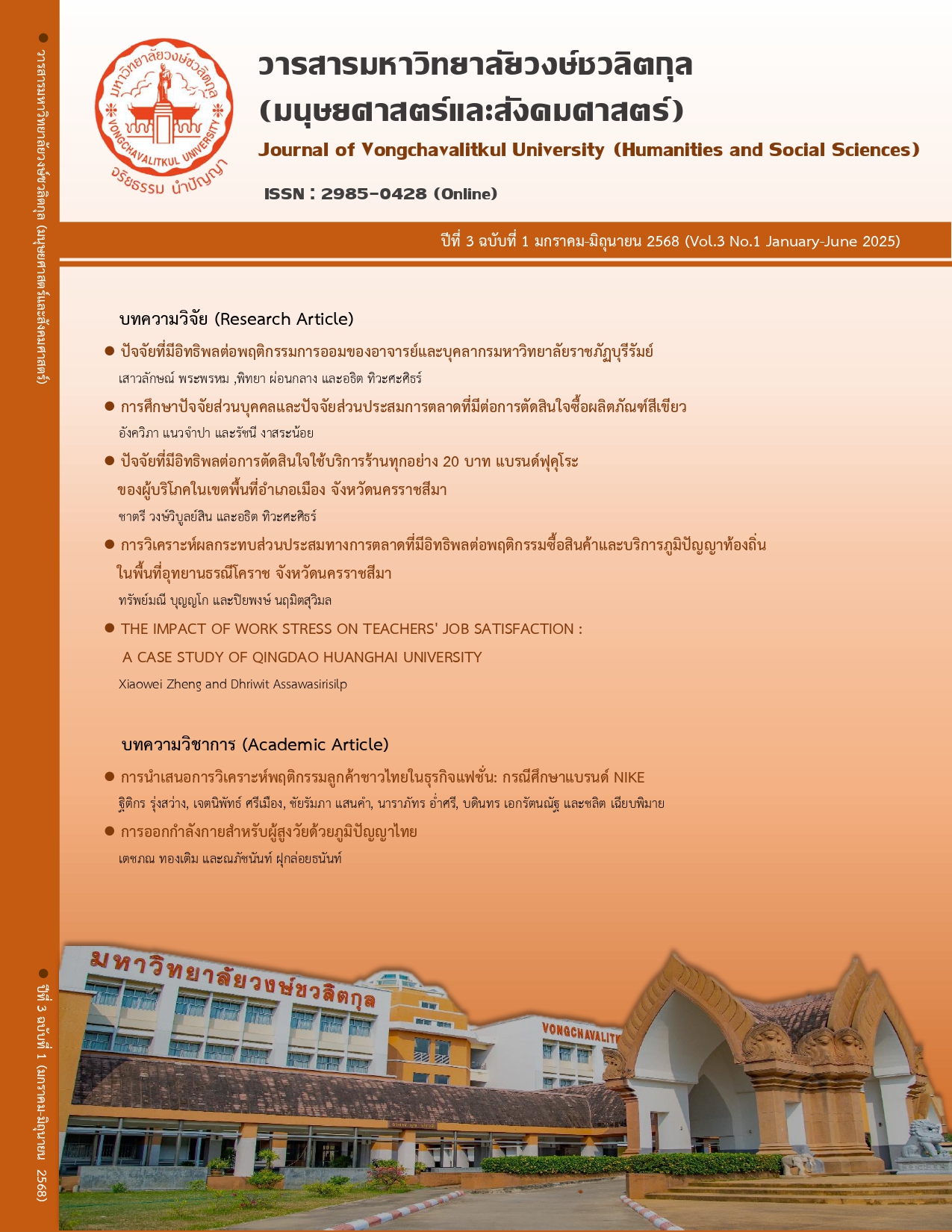
THE IMPACT OF WORK STRESS ON TEACHERS' JOB SATISFACTION : A CASE STUDY OF QINGDAO HUANGHAI UNIVERSITY
Article Sidebar
Main Article Content
บทคัดย่อ
The objectives were: 1) To assess the teachers’job satisfaction at Qingdao Huanghai University. 2) To study Qingdao Huanghai University teachers’ work stress. 3) To study the impact of work stress on job satisfaction. The sample consisted of 314 teachers, academic year 2024, using simple random sampling. The instrument used was a questionnaire. to collect data with an index of consistency (IOC) between 0.67 and 1.00 and the overall reliability of 0.95. Statistics used to analyze the data were mean and standard deviation. The hypothesis was tested by using the Pearson’s correlation coefficient. The statistical significance was set at the 0.05 level.
The study's results indicated that: 1) This study shows that different dimensions of work stress have important impacts on job satisfaction. Based on general research patterns and the logic of this study, it is inferred that teacher work stress and job satisfaction usually show a negative correlation—i.e., the greater the work stress, the lower the job satisfaction may be. Conversely, when stress is within a controllable range, it is more conducive to maintaining relatively high job satisfaction. 2) Reducing work stress, especially the interference between work and leisure time, is an effective strategy to improve teachers' job satisfaction, which can significantly enhance teachers' job satisfaction and student satisfaction.
Article Details

อนุญาตภายใต้เงื่อนไข Creative Commons Attribution-NonCommercial-NoDerivatives 4.0 International License.
เอกสารอ้างอิง
Avanzi, L., Miglioretti, M., Velasco, V., Balducci, C., Vecchio, L., Fraccaroli, F., & Skaalvik, E. M. (2013). Cross-validation of the Norwegian Teacher’s Self-Efficacy Scale. Teaching and Teacher Education, 31(1), 69–78.
Bermejo-Toro, L., Prieto-Ursúa, M., & Hernández, V. (2016). Towards a model of teacher well-being: Personal and job resources involved in teacher burnout and engagement. Educational Psychology, 36(3), 481–501.
Collie, R. J., Shapka, J. D., & Perry, N. E. (2012). School climate and social-emotional learning: Predicting teacher stress, job satisfaction, and teaching efficacy. Journal of Educational Psychology, 104(4), 1189–1204.
García-Carmona, M., Marín, M. D., & Aguayo, R. (2019). Burnout syndrome in secondary school teachers: A systematic review and meta-analysis. Social Psychology of Education, 22(1), 189–208.
Hakanen, J. J., Bakker, A. B., & Schaufeli, W. B. (2006). Burnout and work engagement among teachers. Journal of School Psychology, 43(6), 495–513.
Klassen, R. M., & Chiu, M. M. (2010). Effects on teachers’ self-efficacy and job satisfaction: Teacher gender, years of experience, and job stress. Journal of Educational Psychology, 102(3), 741–756.
Kyriacou, C. (2001). Teacher stress: Directions for future research. Educational Review, 53(1), 27–35.
Liu, S., & Onwuegbuzie, A. J. (2012). Chinese teachers’ work stress and their turnover intention. International Journal of Educational Research, 53, 160–170.
McCarthy, C. J., Lambert, R. G., & Reiser, J. (2014). Vocational teachers’ coping resources and job satisfaction. Teaching and Teacher Education, 40, 55–66.
Qingdao Huanghai University. (2024). About us. Retrieved from [Qingdao Huanghai University official website] (http://www.qdhhxy.edu.cn/)
Skaalvik, E. M., & Skaalvik, S. (2010). Teacher self-efficacy and teacher burnout: A study of relations. Teaching and Teacher Education, 26(4), 1059–1069.
Travers, C. J., & Cooper, C. L. (1996). Teachers under pressure: Stress in the teaching profession. Routledge.
Wang, H., Hall, N. C., & Taxer, J. L. (2019). Antecedents and outcomes of teachers’ emotional labor: A meta-analysis. Educational Psychology Review, 31(3), 663–698.
Yin, H., Huang, S., & Wang, W. (2016). Work environment characteristics and teacher well-being: The mediation of emotion regulation strategies. International Journal of Environmental Research and Public Health, 13(9), 907.
Zembylas, M., & Papanastasiou, E. C. (2004). Job satisfaction among school teachers in Cyprus. Journal of Educational Administration, 42(3), 357–374.
Zhao, X., Selman, R. L., & Haste, H. (2022). How teacher stress links to job satisfaction: The mediating role of emotional exhaustion. Teaching and Teacher Education, 119, 103856.
