Ideology of Public Service Broadcasting in Different Media Systems: From State Instrument to Citizen Institute of Thailand?
DOI:
https://doi.org/10.60101/jimc2026.3384Keywords:
Thailand Context, Public Service Broadcasting (PSB), Media System, State Instrument, Civic InstituteAbstract
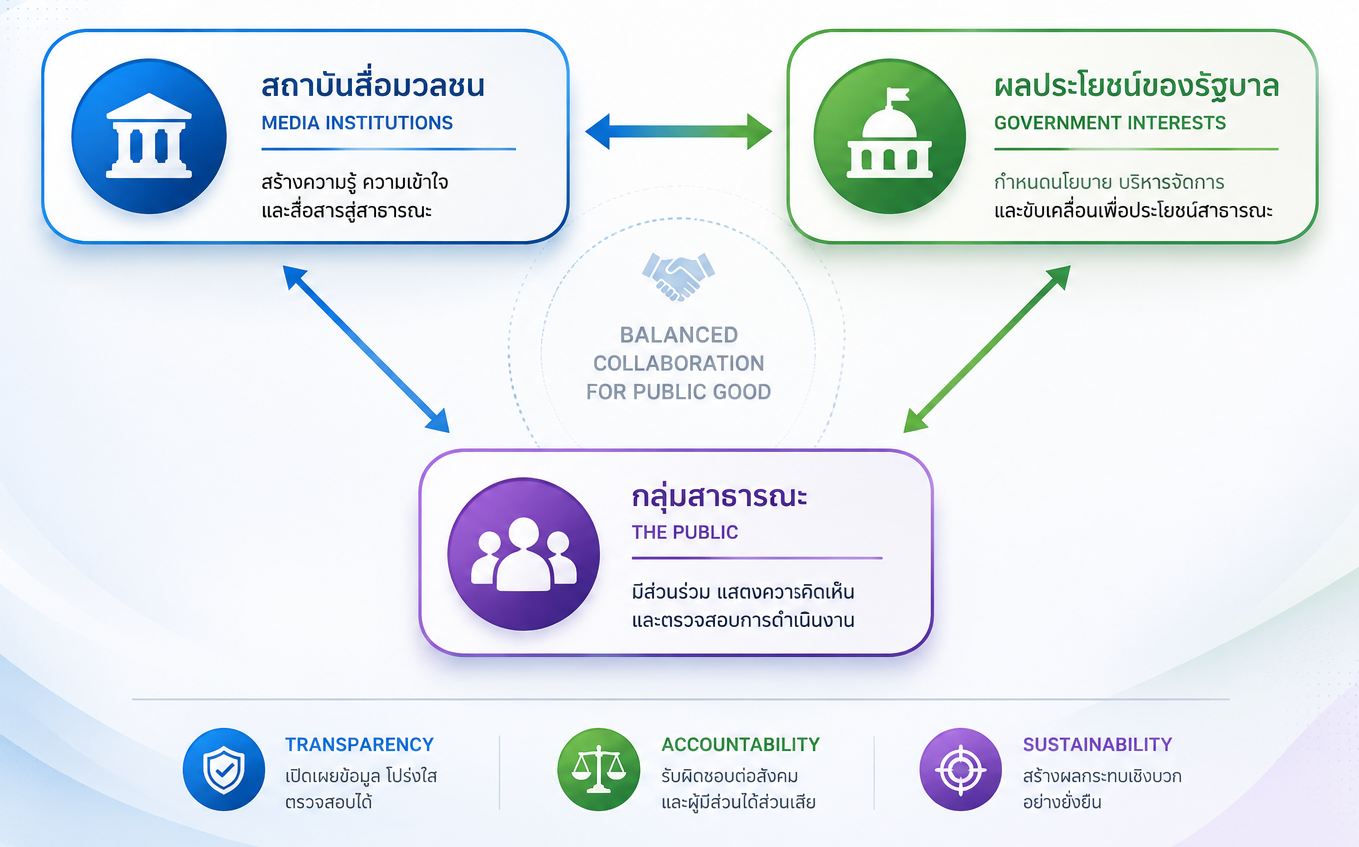
This article presents different concepts of Public Service Broadcasting (PSB) framing the ideology of PSB as public sphere to empower the citizens in democracy society and PSB accountabilities, particularly in the relation to program content and audiences. Comparative media systems of diverse contexts result in the Thailand’s PSB to perform the designated roles and responsibilities. For Thailand, the PSB faces a range of challenges affecting ideology, functions, positionings and accountabilities.
This article additionally aims to review literatures regarding theories and concepts of PSB as a public sphere and its accountabilities, comparative media systems, and PSB as state instrument and civic institute through the consideration the PSB principles relevant to Thailand context.
This article, therefore, focuses on the key issues of ideology of public service broadcasting such as PSB origin, public sphere, and public sphere to empower the people in democracy society and accountabilities of PSB. Also, the comparative media systems include overall structure of media systems, comparison of media systems, and challenges of PSB in the media systems. The PSB as the state instrument and PSB as civic institute are also considered with Thailand context of an in-between space.
References
ภาษาอังกฤษ
Abbot, S. (2016). Rethinking public service broadcasting’s place in international media development. The Center for International Media Assistance.
Bardoel, J. & d’Haenens, L. (2008). Reinventing public service broadcasting in Europe: Prospects, promises and problems. Media, Culture & Society, 30(3), 337–355.
Barnett, S. (2009). Journalism, democracy and the public interest: Rethinking media pluralism for the digital age. Reuters Institute for the Study of Journalism Working Paper.
Blumler, J. G. (1994). Television and the Public Interest (2nd ed.). Sage.
Brevini, B. (2013). Public service broadcasting online. A comparative European policy study of PSB 2.0. Palgrave Macmillan.
Calhoun, C. (2011). Civil society and the public sphere. In M. Edwards (Ed), The Oxford handbooks of civil society (pp. 311-323). Oxford University Press.
Collins, R. (1992). Public service broadcasting & freedom. Media Information Australia, 66(1), 4–15.
Dobek-Ostrowska, B., et al. (2010). Comparative media systems: European and global perspectives. Central European University Press.
Freedom House. (2023). Freedom in the World 2022: Thailand. https://freedomhouse.org/country/ thailand/freedom-world/2022.
Green, M. (2013). Media regulation in the Mekong and opportunities for the development of public service and community broadcasting. Themma Group.
Habermas, J. (1992) The structural transformation of the public sphere: An inquiry into a category of bourgeois society. Polity Press.
Hallin, D. C. & Mancini, P. (2012). Comparing media systems beyond the western world. Cambridge University Press.
Hallin, D. & Mancini, P. (2004). Comparing media systems three models of media and politics. Cambridge University Press.
Hardy, J. (2008). Western media systems. Routledge.
Hewison, K. & Kitirianglarp, K. (2010). ‘Thai-style democracy’: The royalist struggle for Thailand’s politics. In S. Ivarsson & L. Isager (Eds), Saying the unsayable, monarchy and democracy in Thailand (pp. 179–202). Nordic Institute of Asian Studies Press.
Humphreys, P. J. (1996). Mass media and media policy in Western Europe. Manchester University Press.
Iosifidis, P. (2010). The public sphere, social networks and public service media. Information, Communication & Society, 14(5), 619–637.
Klaikao, L. (2004). Community radio in Thailand 1998–2002: Comparative studies of four community radio stations [Unpublished doctoral dissertation]. University of Canberra.
Livingstone, S. & Lunt, P. (1994). Talk on television: Audience participation and public debate. Routledge.
Lunt, P. (2009). Television, public participation, and public service: From value consensus to the politics of identity. The Annals of the American Academy of Political and Social Science, 625(1), 128–138.
Lunt, P. & Livingstone, S. M. (2012). Media regulation: Governance and the interests of citizens and consumers. Sage.
Masduki, M. (2017). Media and politics: Rethinking the Indonesian broadcasting system. Jurnal Ilmu Sosial dan Ilmu Politik, 21(1), 14-27.
McCargo, D. (2000). Politics and the press in Thailand: Media machinations. Routledge.
Michalis, M. (2016). Radio spectrum battle: Television broadcasting vs wireless broadband and the future of PSB. International Journal of Digital Television, 7(3), 347–62.
Nissen, C. (2006). Making a difference: Public service broadcasting in the European media landscape. John Libbey.
O’Neill, B. O. (2015). What is public about public service broadcasting? In K. Arriaza Ibarra, E. Nowak, & R. Kuhn (Eds), Public service media in Europe: A comparative approach (pp. 2-5). Routledge.
Padovani, C. & Tracey, M. (2003). Report on the conditions of public service broadcasting. Television & Media, 4(2), 131–53.
Raboy, M. (2006). Public broadcasting for the 21st century. University of Luton Press.
Reporters Without Borders. (2021). Asia-Pacific: Thailand. https://rsf.org/en/country/thailand.
Scannell, P. (1990). Public service broadcasting: The history of a concept. In A. Goodwin & G. Whannel (Eds), Understanding Television (pp. 11-29). Routledge.
Steemers, J. (2003). Public service broadcasting is not yet dead: Survival strategies in the twenty-first century. In G. F. Lowe & T. Hujanen (Eds), Broadcasting and convergence: New articulations of the public service remit (pp. 123-136). Nordicom.
Susen, S. (2011). Critical notes on Habermas's theory of the public sphere. Sociological Analysis, 5(1), 37–62.
Thomass, B. (2003). Knowledge society and public sphere: Two concepts for the remit. In T. Hujanen & G. Lowes (Eds), Broadcasting and convergence: New articulations of the public service remit (pp. 29-39). Nordicom.
Thomass, B. & Kleinsteuber, H. J. (2011). Comparing media systems: the European dimension. In J. Trappel, W. A. Meier, L. d’Haenens, J. Steemers, & B. Thomass (Eds.), Media in Europe today (pp. 5-20). Intellect Ltd.
Tracey, M. (1998). The decline and fall of public service broadcasting. Oxford University Press.
Tunstall, J. (2004). The United Kingdom. In M. Kelly, G. Mazzoleni, & D. McQuail (Eds), The media in Europe: The Euromedia handbook (pp. 261-274). Sage.
Vartanova, E., et al. (2011). Media industries: Ownership, copyright and regulation. In J. Trappel, W. A. Meier, L. d’Haenens, J. Steemers, & B. Thomass (Eds), Media in Europe today (pp.167-183). Intellect Ltd.
We Are Social. (2020). Digital 2020 Global Digital Overview. https://wearesocial.com/digital-2020.