The Role of Social Media in Genderless Marketing Trend: Fostering or Shaping
DOI:
https://doi.org/10.60101/jimc2025.1786Keywords:
Social Media, Genderless Trend, Stereotype, Gender Neutrality, QueerAbstract
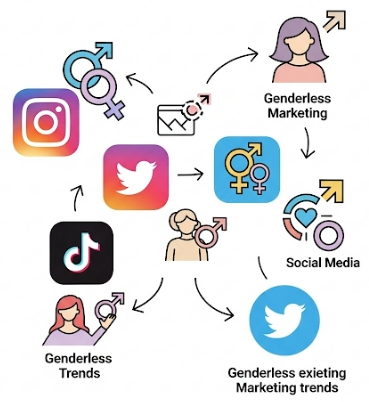
This article aims to examine the role of social media in fostering and shaping the genderless marketing trend, an emerging phenomenon that reflects contemporary social changes emphasizing gender equality and sexual diversity. In doing so, the study analyzes the impact of genderless marketing on products, services, and consumer behavior. It compares traditional advertising content, which relies on gender-based segmentation, with campaigns that adopt a genderless marketing approach. Furthermore, the article applies a Queer theoretical framework to elucidate how the genderless trend is constructed and manifested in society, thereby contributing to an understanding of its implications for social transformation toward greater inclusivity. The discussion highlights the potential of social media as a vehicle for promoting genderless marketing strategies that not only limit gender stereotypes but also raise consumer awareness of gender equality and diversity. From a business standpoint, genderless marketing can enhance brand image, expand market value, and support long-term competitiveness. Ultimately, the insights gleaned from this study offer guidelines for organizations and marketers seeking to advance genderless marketing in order to encourage societal change and inclusion, as well as to foster positive engagement with diverse consumer communities.
References
ภาษาไทย
จิตรลดา พลายด้วง. (2564). การสื่อสารการตลาดดิจิทัลกับการตัดสินใจซื้อสินค้าแฟชั่นผ่านอีคอมเมิร์ชของผู้บริโภคที่มีความหลากหลายทางเพศ (LGBT) [วิทยานิพนธืปริญญามหาบัณฑิต, มหาวิทยาลัยกรุงเทพ]. http://dspace.bu.ac.th/jspui/handle/123456789/5149
จิรันธนิน กมลเลิศและถนัดกิจ จันกิเสน (2567, 1 มีนาคม). ความฮอตของ 'บิวกิ้นและพีพี' จะไปสุดที่ตรงไหน? ชวน วิเคราะห์ทำไมแบรนด์ดังถึงเลือกคู่จิ้นเป็นพรีเซนเตอร์? แม้ค่าตัว 7 หลักก็ยอม. The Standard. https://thestandard.co/why-do-big-brands-use-famous-people-to-represent-their-brands/
ชิษยรัสย์ ศิริไปล์. (2564). การประกอบสร้างภาพตัวแทนความเป็นชายผ่านโฆษณาที่ปรากฏในนิตยสารจีเอ็ม ประเทศไทย. วารสารปาริชาต มหาวิทยาลัยทักษิณ. 32(2), 158-174.
นฤพนธ์ ด้วงวิเศษ. (2565, 24 มิถุนายน). มานุษยวิทยาเควียร์และเพศหลากหลาย Queer Anthropology and Gender/Sexual Diversity. ศูนย์มานุษยวิทยาสิรินธร (องค์การมหาชน). https://www. sac.or.th/portal/th/article/detail/348
นฤพนธ์ ด้วงวิเศษ. (2558, 15 มิถุนายน). ทบทวนวิธีการสร้างความรู้/ความจริงเรื่องเพศ. ศูนย์มานุษยวิทยาสิรินธร (องค์การมหาชน). https://anthropology-concepts.sac.or.th/articles/2
ฆฤณา มหกิจเดชาชัย. (2565). การสื่อสารการตลาดแบบบูรณาการของตราสินค้าที่มีเนื้อหาความหลากหลายทางเพศการเปิดรับสื่อ ทัศนคติ และพฤติกรรมการซื้อของผู้บริโภค [วิทยานิพนธ์ปริญญามหาบัณฑิต, จุฬาลงกรณ์มหาวิทยาลัย]. https://digital.car.chula.ac.th/chulaetd/6321/
เมริษา ยอดมณฑป. (2564, 16 มีนาคม). ภาพในความคิดแบบเหมารวมของสังคมต่อเพศชายหญิงและLGBTQ+ ซึ่ง อาจส่งผลกระทบต่อการเลี้ยงดูเด็ก. https://thepotential.org/family/the-untold-stories-2-ep1/
มหาวิทยาลัยธรรมศาสตร์. (2565, 28 มิถุนายน). QUEER ความหลากหลาย ที่ไม่ได้จำกัดแค่ชื่อ. https://tu.ac.th/ thammasat-280665-lsed-expert-talk-queer
ตรัยรัตน์ ปลื้มปิติชัยกุล. (2562). การลดผลกระทบอันจำกัดของสื่อ: ภาพเหมารวมความเป็นหญิงเป็นชายในละคร โทรทัศน์ไทยด้วยกลวิธีการชี้แนะ. วารสารวิชาการ สถาบันเทคโนโลยีแห่งสุวรรณภูมิ, 5(1), 484- 495. https://so04.tci-thaijo.org/index.php/svittj/article/view/194641
สุรพงษ์ โสธนะเสถียร. (2559). ทฤษฎีการสื่อสาร. ระเบียงทอง.
Data Reportal. (2024, February 23). DIGITAL 2024: THAILAND. https://datareportal.com/reports/digital- 2024-thailand
ForeToday. (2022, October 28). แบรนด์ต้องจับตา! 3 Insight กลุ่มแฟนคลับซีรีส์วายที่ส่งผลกับ Influencer Marketing. https://foretoday.asia/articles/3-insight-influencer-marketing/
ThaiPublica. (2025, January 7). EIC…ไขความลับซีรีส์วายไทย เหตุใดจึงติดเทรนด์โลก. https://thaipublica.org/ 2025/01/eic-bl-gl/
The Standard. (2023, February 10). ‘บี-ควิก’ ดึง ‘พีพี-บิวกิ้น’ ขึ้นแท่นแบรนด์แอมบาสเดอร์ ตอกย้ำ ภาพลักษณ์ ผู้นำศูนย์บริการรถยนต์ครบวงจรที่ ‘อยากดูแลแบบที่คนรักทำให้กัน’ ผ่านกลยุทธ์ Music Marketing [ADVERTORIAL]. https://thestandard.co/pp-billkin-b-quik/
Webmaster SDGPort. (2021, February 5). SDGs กับความหลากหลายทางเพศ (LGBTQI+). SDG Port. https://www.sdgport-th.org/2021/02/sdgs-lgbtqi/
ภาษาอังกฤษ
Butler, J. (2005). Giving an account of oneself. Fordham University Press.
Francis, T., & Hoefel, F. (2018, November 12). ‘True Gen’: Generation Z and its implications for companies. McKinsey & Company. https://www.mckinsey.com/industries/consumer-packaged-goods/our-insights/true-gen-generation-z-and-its-implications-for-companies
Hyojung, K., Inho, C., & Minjung, P. (2022). Analyzing genderless fashion trends of consumers’ perceptions on social media: using unstructured big data analysis through Latent Dirichlet Allocation-based topic modeling. Fashion and Textiles. 9(1), 1-21. https://doi.org/10.1186/ s40691-021-00281-6
Ipsos. (2024, May 27). Ipsos Pride Survey 2024: Gen Zers most likely to identify as LGBT+. https://www.ipsos.com/en/ipsos-pride-survey-2024-gen-zers-most-likely-identify-lgbt
Katz, E., Blumler, J. G., & Gurevitch, M. (1983). Utilization of mass communications by the individual. Sage Publication.
Liu, Y. (2019). Gender Difference in perception and use of social media Tools. In Information Resources Management Association (Ed.), Gender and Diversity: Concepts, Methodologies, Tools, and Applications (pp.1845-1858). https://doi.org/10.4018/978-1-5225-6912-1.ch097
Russo, G. (2020, July 22). Gucci launches new genderless shopping section “Gucci MX”. Teen Vogue. https://www.teenvogue.com/story/gucci-genderless-shopping-section-gucci-mx
Singh, S. (2023). Gender neutrality: Its role and impact in society. Journal of The Asiatic Society of Mumbi. XCVI (16), 62-70.
Sultana, N., & Shahriar, H. (2017). Understanding the impact of gender neutral communication on brand Image Trend or Tool? [Master Thesis, University School of Economics & Management]. https://lup.lub.lu.se/luur/download?func=downloadFile&recordOId=8916522&fileOId=8916539