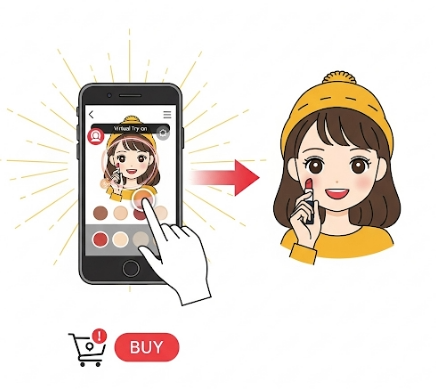
The Influence of Augmented Reality in Virtual Experience Satisfaction and Usage Intention of Beauty Products on Applications
DOI:
https://doi.org/10.60101/jimc2025.1745Keywords:
Augmented Reality (AR), Brand Engagement, Experience Satisfaction, Usage Intention, Technology AcceptanceAbstract
This article aims to examine the influence of Augmented Reality (AR) technology on brand engagement, satisfaction with virtual experiences, and intention to use beauty products through mobile applications. The study employs the Technology Acceptance Model and the concept of Customer Brand Engagement as theoretical frameworks. This article aims to explain the effects of augmented reality technology acceptance in terms of perceived usefulness, risk reduction, increased confidence, ease of use, and enjoyment, which influence the enhancement of brand engagement in cognitive, affective, and behavioral dimensions of consumer interaction, leading to satisfaction with experience and intention to use beauty products on applications.The conclusions regarding positive risk perception and enjoyment derived from utilizing augmented reality are significant determinants influencing the intention to use.
References
ภาษาไทย
กัญญาณัฏฐ์ สิมมี. (2566). การยอมรับเทคโนโลยีโลกเสมือนจริง และทัศนคติทางออนไลน์ของผู้บริโภคมีอิทธิพลต่อ กระบวนการตัดสินใจซื้อสินค้าเครื่องแต่งกายแฟชั่นผ่านช่องทางออนไลน์ของผู้บริโภคในกรุงเทพมหานคร. Procedia of Multidisciplinary Research, 1(7), 1-13
เกียรติภูมิ นาควรรณกิจ. (2564). การยอมรับเทคโนโลยี ความเป็นเอกลักษณ์ และการรับรู้ความเสี่ยงที่ส่งผลต่อการตัดสินใจใช้แอปพลิเคชัน TikTok. [วิทยานิพนธ์ปริญญามหาบัณฑิต, มหาวิทยาลัยกรุงเทพ]. http://dspace.bu.ac.th/jspui/bitstream/123456789/4946/1/kiattipoom_nakw.pdf
ญาตาวี ทิพย์เที่ยงแท้. (2565). อิทธิพลของเทคโนโลยีความจริงเสริมที่มีต่อความตั้งใจซื้อสินค้ากลุ่มเครื่องสำอางผ่าน ทัศนคติต่อเทคโนโลยี. [วิทยานิพนธ์ปริญญามหาบัณฑิต, มหาวิทยาลัยมหิดล]. https://archive.cm.mahidol.ac.th /bitstream/123456789/4576/1/TP%20MM.019%202565.pdf
ณิชารีย์ กิตติคุณศิริ. (2562). ปัจจัยที่ส่งผลต่อการยอมรับเทคโนโลยีปัญญาประดิษฐ์แชทบอท. [วิทยานิพนธ์ปริญญามหาบัณฑิต, มหาวิทยาลัยธรรมศาสตร์]. https://doi.org/10.14457/TU.the.2019.97
ปราโมทย์ ลือนาม. (2554). แนวความคิดและวิวัฒนาการแบบจำลองการยอมรับการใช้เทคโนโลยี. วารสารการจัดการสมัยใหม่, 9(1), 9-17. https://so04.tci-thaijo.org/index.php/stou-sms- r/article/view/11933/10754
ผู้จัดการออนไลน์. (2566, 20 กันยายน). สนค. แนะใช้ AR–VR สร้างประสบการณ์ให้ลูกค้า เพิ่มประสิทธิภาพ ลดต้นทุนทำธุรกิจ. https://mgronline.com/business/detail/9660000084886
ภูริตา บุญล้อม. (2563, มีนาคม 27). เปิดข้อดีของ Virtual Makeup โลกใหม่สำหรับคนรักการลองเครื่องสำอาง. The Standard. https://thestandard.co/virtual-makeup/
มูรธา จรรยาวรลักษณ์. (2563). การศึกษาความสัมพันธ์ระหว่างปัจจัยของเทคโนโลยีความจริงเสริมกับความตั้งใจซื้ออุปกรณ์ตกแต่งบ้านของผู้บริโภคในเขตพื้นที่กรุงเทพมหานครและปริมณฑล. [วิทยานิพนธ์ปริญญามหาบัณฑิต, มหาวิทยาลัยมหิดล]. https://archive.cm.mahidol.ac.th/bitstream/123456789/3811/1/TP%20MM.070%202563.pdf
วิกานดา พรสกุลวานิช. (2565). สื่อใหม่และการจัดการการสื่อสาร (พิมพ์ครั้งที่ 3). สำนักพิมพ์มหาวิทยาลัยธรรมศาสตร์.
Aittipon N. (2566, 27 กุมภาพันธ์). เดอะมอลล์ กรุ๊ป เปิดตัว MNIVERSE โลกเสมือนจริง (VIRTUAL WORLD) ปักธงเป็น FUTURE RETAIL แรกในไทย. Marketeer. https://marketeeronline.co/archives/299029
Demeter. (2568, 7 มกราคม). 10 Marketing Trends สำหรับปี 2025 มีอะไรบ้าง. https://www.dmit.co.th/th/demeter-ict-updates-th/10-marketing-trends-in-2025/
Pepticles.com. (2564, 27 เมษายน). “Amazon Salon” ร้านทำผมไฮเทค เลือกสีผมได้ผ่าน AR ก่อนลงมือจริง. https://www.popticles.com/business/news-amazon-launch-salon-ar/
ภาษาอังกฤษ
Alimamy, S., & Gnoth, J. (2022). I want it my way! The effect of perceptions of personalization through augmented reality and online shopping on customer intentions to co-create value. Computers in Human Behavior, 128(3), 107105. https://doi.org/10.1016/j.chb.2021.107105
Arghashi, V. (2022). Shopping with augmented reality: How wow-effect changes the equations. Electronic Commerce Research and Applications, 54, 101166. https://doi.org/10.1016/j.elerap.2022.101166
Davis, F. D. (1989). Perceived usefulness, perceived ease of use, and user acceptance of information technology. MIS Quarterly, 13(3), 319-340. https://doi.org/10.2307/249008
Davis, F. D., Bagozzi, R. P., & Warshaw, P. R. (1989). User acceptance of computer technology: A comparison of two theoretical models. Management Science, 35(8), 982-1003.
Deloitte. (2024, 11 June). Personalizing growth: It’s a value exchange between brands and customers. https://www.deloittedigital.com/us/en/insights/research/personalizing-growth.html
Freepix. (2024, January 15). How augmented reality is transforming beauty and cosmetics. https://www.technolynx.com/post/how-augmented-reality-is-transforming-beauty-and- cosmetics#post-div
Gabriel, A., Ajriya, A. D., Fahmi, C. Z. N., & Handayani, P. W. (2023). The influence of augmented reality on E-commerce: A case study on fashion and beauty products. Cogent Business & Management, 10(2). https://doi.org/10.1080/23311975.2023.2208716
Han, D. I. D., Tom Dieck, M. C., & Jung, T. (2019). Augmented Reality Smart Glasses (ARSG) visitor adoption in cultural tourism. Leisure Studies, 38(5), 618–633. https://doi.org/ 10.1080/02614367.2019.1604790
Hinsch, C., Felix, R., & Rauschnabel, P. A. (2020). Nostalgia beats the wow-effect: Inspiration, awe and meaningful associations in augmented reality marketing. Journal of Retailing and Consumer Services, 53, 101987. https://doi.org/10.1016/j.jretconser.2019.101987
Hollebeek, L. D., & Belk, R. (2021). Consumers’ technology-facilitated brand engagement and wellbeing: Positivist TAM/PERMA-vs. Consumer Culture Theory perspectives. International Journal of Research in Marketing, 38, 387–401. https://doi.org/10.1016/j.ijresmar.2021.03.001
Hollebeek, L. D., Glynn, M. S., & Brodie, R. J. (2014). Consumer brand engagement in social media: Conceptualization, scale development and validation. Journal of Interactive Marketing, 28, 149–165. https://doi.org/10.1016/j.intmar.2013.12.002
Hsu, S. H. Y., Tsou, H. T., & Chen, J.S. (2021). “Yes, we do. Why not use augmented reality?” Customer responses to experiential presentations of AR-based applications. Journal of Retailing and Consumer Services, 62(5),102649. https://doi.org/10.1016/j.jretconser.2021.102649
Hung, S. W., Chang, C. W., & Ma, Y. C. (2021). A new reality: Exploring continuance intention to use mobile augmented reality for entertainment purposes. Technology in Society, 67(4), 101757. https://doi.org/10.1016/j.techsoc.2021.101757
Jessen, A., Hilken, T., Chylinski, M., Mahr, D., Heller, Keeling, D. I., & de Ruyter, K. (2020). The playground effect: How augmented reality drives creative customer engagement. Journal of Business Research, 116, 85-98. https://doi.org/10.1016/j.jbusres.2020.05.002
Khan, I., & Fatma, M., (2024). AR app-based brand engagement and outcomes: A moderated mediation approach. Journal of Retailing and Consumer Services, 76, 103618. https://doi.org/ 10.1016/j.jretconser.2023.103618
Kim, S., Baek, T. H., & Yoon, S. (2020). The effects of 360-degree rotatable product images on purchase intention. Journal of Retailing and Consumer Services, 55, 102062. https://doi.org/10.1016/j.jretconser.2020.102062
Kowalczuk, P., Siepmann, C., & Adler, J. (2020). Cognitive, affective, and behavioral consumer responses to augmented reality in e-commerce: A comparative study. Journal of Business Research, 124(1), 357–373. https://doi.org/10.1016/j.jbusres.2020.10.050
Lemon, K. N., & Verhoef, P. C. (2016). Understanding customer experience throughout the customer journey. Journal of Marketing, 80(6), 69-96. https://doi.org/10.1509/jm.15.0420
Lin, K. Y., & Huang, Y. K., (2024). Shopping in the digital world: How augmented reality mobile applications trigger customer engagement. Technology in Society, 77, 102540. https://doi.org/10.1016/j.techsoc.2024.102540
McLean, G., & Wilson, A. (2019). Shopping in the digital world: Examining customer engagement through augmented reality mobile applications. Computers in Human Behavior, 101(12), 210–224. https://doi.org/10.1016/j.chb.2019.07.002
McKinsey. (2024, 30 May). The state of AI in early 2024: Gen Ai adoption spikes and starts to generate value. https://www.mckinsey.com/capabilities/quantumblack/our-insights/the- state-of-ai#/
Nikhashemi, S. R., Knight, H. H., Nusair, K., & Liat, C. B. (2021). Augmented reality in smart retailing: A(n)(A) symmetric approach to continuous intention to use retail brands’mobile AR apps.
Journal of Retailing and Consumer Services, 60(3), 102464. https://doi.org/10.1016/j. jretconser.2021.102464
Plotkina, D., & Saurel, H. (2019). Me or just like me? The role of virtual try-on and physical appearance in apparel M-retailing. Journal of Retailing and Consumer Services, 51(6), 362–377. https://doi.org/10.1016/j.jretconser.2019.07.002
Qin H., Osatuyi B., & Xu L. (2021). How mobile augmented reality applications affect continuous use and purchase intentions: A cognition-affect-conation perspective. Journal of Retailing and Consumer Service, 63, 1-13. https://doi.org/10.1016/j.jretconser.2021.102680
Rauschnabel, P. A., Felix, R., & Hinsch, C. (2019). Augmented reality marketing: How mobile AR-apps can improve brands through inspiration. Journal of Retailing and Consumer Services, 49, 43-53. https://doi.org/10.1016/j.jretconser.2019.03.004
Recalde, D., Jai, T. C., & Jones, R. P. (2024). I can find the right product with AR! The mediation effects of shopper engagement on intent to purchase beauty products. Journal of Retailing and Consumer Services, 78, 103764. https://doi.org/10.1016/j.jretconser. 2024.103764
Schein, K. E., & Rauschnabel, P. A. (2021). Augmented reality in manufacturing: Exploring workers' perceptions of barriers. IEEE Transactions on Engineering Management, 70(10), 3344-3357. https://doi.org/10.1109/TEM.2021.3093833.
Smink, A. R., van Reijmersdal, E. A., van Noort, G., & Neijens, P. C. (2020). Shopping in augmented reality: The effects of spatial presence, personalization and intrusiveness on app and brand responses. Journal of Business Research, 118, 474-485. https://doi.org/10.1016/
j.jbusres.2020.07.018
Soto-Acosta, P., Molina-Castillo, F. J., Lopez-Nicolas, C., & Colomo-Palacios, R. (2014). The effect of information overload and disorganisation on intention to purchase online: The role of perceived risk and internet experience. Online Information Review, 38(4), 543-561. https://doi.org/10.1108/OIR-01-2014-0008
Venkatesh, V., & Davis, F. D. (2000). A theoretical extension of the Technology Acceptance Model: Four longitudinal field studies. Management Science, 46(2), 186-204.
Vieira V. A., Rafael D. N., & Agnihotri R. (2022). Augmented reality generalizations: A meta-analytical review on consumer-related outcomes and the mediating role of hedonic and utilitarian values. Journal of Business Research, 151(11), 170–184. https://doi.org/10.1016/j.jbusres. 2022.06.030
Wang, Y., Ko, E., & Wang, H. (2021). Augmented reality (AR) app use in the beauty product industry and consumer purchase intention. Asia Pacific Journal of Marketing and Logistics, 34(1), 110–131. https://doi.org/10.1108/apjml-11-2019-0684
Yavuz, M., Çorbacıoglu, E., Başoğlu, A. N., Daim, T. U., & Shaygan, A. (2021). Augmented reality technology adoption: A case study for mobile applications in Turkey. Technology in Society, 66, 101598. https://doi.org/10.1016/j.techsoc.2021.101598
Yim, M. Y. C., & Park, S. Y. (2019). “I am not satisfied with my body, so I like augmented reality (AR)” Consumer responses to AR-based product presentations. Journal of Business Research, 100, 581-589. https://doi.org/10.1016/j.jbusres.2018.10.041
Zare Ebrahimabad F., Yazdani, H., Hakim, A., & Asarian, M. (2024). Augmented reality versus web-based shopping: How does AR improve user experience and online purchase intention. Telematics and Informatics Reports, 15, 100152. https://doi.org/10.1016/j.teler.2024.100152