อุดมการณ์สื่อสาธารณะในระบบสื่อที่แตกต่าง : จากเครื่องมือของรัฐสู่สถาบันพลเมืองของประเทศไทย?
DOI:
https://doi.org/10.60101/jimc2026.3384คำสำคัญ:
สื่อสาธารณะ, โครงสร้างสื่อ, เครื่องมือของรัฐ, สถาบันทางพลเมือง, บริบทประเทศไทยบทคัดย่อ
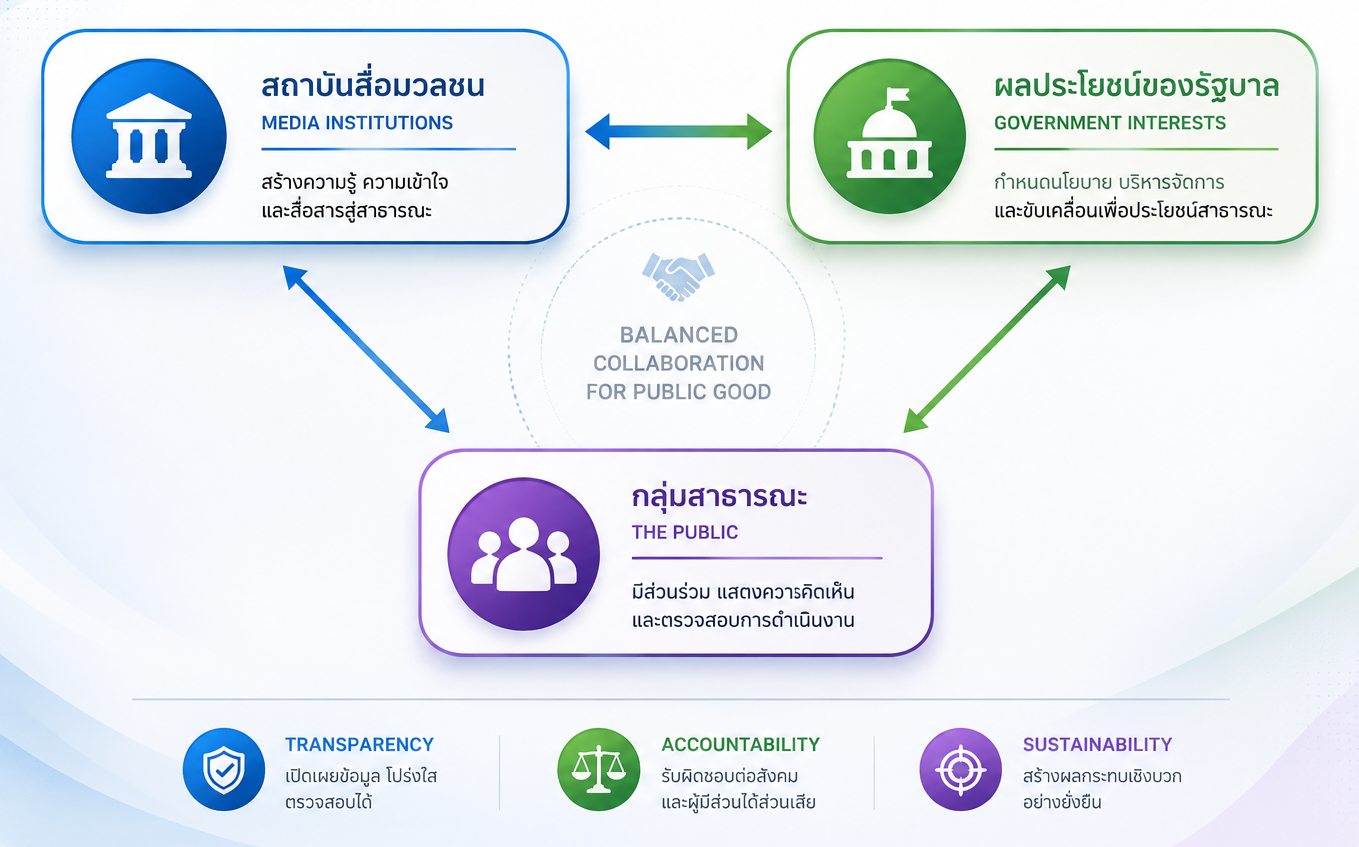
บทความนี้นำเสนอแนวความคิดสื่อสาธารณะในระบบสื่อที่แตกต่าง ซึ่งได้นำเสนออุดมการณ์สื่อสาธารณะในฐานะที่เป็นพื้นที่สาธารณะเพื่อเสริมสร้างพลังอำนาจให้แก่ประชาชนในสังคมประชาธิปไตยและสื่อสาธารณะทำหน้าที่ตามหลักการความรับผิดชอบของสื่อสาธารณะในมิติด้านเนื้อหารายการและผู้รับสาร ในระบบสื่อมวลชนที่แตกต่างของบริบทที่หลากหลายสามารถส่งผลต่อสื่อสาธารณะในประเทศในการทำหน้าที่ตามภาระหน้าที่และความรับผิดชอบที่ได้ระบุไว้ สำหรับประเทศไทยสื่อสาธารณะก็มีความท้าทายด้านต่าง ๆ ที่ส่งผลต่ออุดมการณ์ การทำหน้าที่ จุดยืน และความรับผิดชอบของสื่อสาธารณะ
บทความนี้จึงมีวัตถุประสงค์เพื่อทบทวนวรรณกรรมเกี่ยวกับทฤษฎีและแนวคิดสื่อสาธารณะในฐานะพื้นที่สาธารณะ และความรับผิดชอบของสื่อสาธารณะ ระบบสื่อมวลชนเปรียบเทียบ และสื่อสาธารณะในฐานะเครื่องมือของรัฐและสถาบันของพลเมือง โดยนำหลักการสื่อสาธารณะที่สอดคล้องกับบริบทประเทศไทยมาพิจารณาบทความนี้จึงมุ่งนำเสนอเนื้อหาในประเด็นสำคัญของอุดมการณ์สื่อสาธารณะ ได้แก่ ต้นกำเนิดสื่อสาธารณะ พื้นที่สาธารณะ พื้นที่สาธารณะเพื่อเสริมสร้างพลังอำนาจให้แก่ประชาชนในสังคมประชาธิปไตย และภาระความรับผิดชอบของสื่อสาธารณะส่วนระบบสื่อมวลชนที่แตกต่างกัน ประกอบด้วย โครงสร้างโดยรวมของระบบสื่อการเปรียบเทียบระบบสื่อ และความท้าทายของสื่อสาธารณะในระบบสื่อ ประเด็นต่อมาคือสื่อสาธารณะในฐานะเครื่องมือของรัฐกับสื่อสาธารณะในฐานะสถาบันพลเมือง บริบทในประเทศไทยที่เป็นพื้นที่ก้ำกึ่งและมีปัจจัยหลากหลาย
เอกสารอ้างอิง
ภาษาอังกฤษ
Abbot, S. (2016). Rethinking public service broadcasting’s place in international media development. The Center for International Media Assistance.
Bardoel, J. & d’Haenens, L. (2008). Reinventing public service broadcasting in Europe: Prospects, promises and problems. Media, Culture & Society, 30(3), 337–355.
Barnett, S. (2009). Journalism, democracy and the public interest: Rethinking media pluralism for the digital age. Reuters Institute for the Study of Journalism Working Paper.
Blumler, J. G. (1994). Television and the Public Interest (2nd ed.). Sage.
Brevini, B. (2013). Public service broadcasting online. A comparative European policy study of PSB 2.0. Palgrave Macmillan.
Calhoun, C. (2011). Civil society and the public sphere. In M. Edwards (Ed), The Oxford handbooks of civil society (pp. 311-323). Oxford University Press.
Collins, R. (1992). Public service broadcasting & freedom. Media Information Australia, 66(1), 4–15.
Dobek-Ostrowska, B., et al. (2010). Comparative media systems: European and global perspectives. Central European University Press.
Freedom House. (2023). Freedom in the World 2022: Thailand. https://freedomhouse.org/country/ thailand/freedom-world/2022.
Green, M. (2013). Media regulation in the Mekong and opportunities for the development of public service and community broadcasting. Themma Group.
Habermas, J. (1992) The structural transformation of the public sphere: An inquiry into a category of bourgeois society. Polity Press.
Hallin, D. C. & Mancini, P. (2012). Comparing media systems beyond the western world. Cambridge University Press.
Hallin, D. & Mancini, P. (2004). Comparing media systems three models of media and politics. Cambridge University Press.
Hardy, J. (2008). Western media systems. Routledge.
Hewison, K. & Kitirianglarp, K. (2010). ‘Thai-style democracy’: The royalist struggle for Thailand’s politics. In S. Ivarsson & L. Isager (Eds), Saying the unsayable, monarchy and democracy in Thailand (pp. 179–202). Nordic Institute of Asian Studies Press.
Humphreys, P. J. (1996). Mass media and media policy in Western Europe. Manchester University Press.
Iosifidis, P. (2010). The public sphere, social networks and public service media. Information, Communication & Society, 14(5), 619–637.
Klaikao, L. (2004). Community radio in Thailand 1998–2002: Comparative studies of four community radio stations [Unpublished doctoral dissertation]. University of Canberra.
Livingstone, S. & Lunt, P. (1994). Talk on television: Audience participation and public debate. Routledge.
Lunt, P. (2009). Television, public participation, and public service: From value consensus to the politics of identity. The Annals of the American Academy of Political and Social Science, 625(1), 128–138.
Lunt, P. & Livingstone, S. M. (2012). Media regulation: Governance and the interests of citizens and consumers. Sage.
Masduki, M. (2017). Media and politics: Rethinking the Indonesian broadcasting system. Jurnal Ilmu Sosial dan Ilmu Politik, 21(1), 14-27.
McCargo, D. (2000). Politics and the press in Thailand: Media machinations. Routledge.
Michalis, M. (2016). Radio spectrum battle: Television broadcasting vs wireless broadband and the future of PSB. International Journal of Digital Television, 7(3), 347–62.
Nissen, C. (2006). Making a difference: Public service broadcasting in the European media landscape. John Libbey.
O’Neill, B. O. (2015). What is public about public service broadcasting? In K. Arriaza Ibarra, E. Nowak, & R. Kuhn (Eds), Public service media in Europe: A comparative approach (pp. 2-5). Routledge.
Padovani, C. & Tracey, M. (2003). Report on the conditions of public service broadcasting. Television & Media, 4(2), 131–53.
Raboy, M. (2006). Public broadcasting for the 21st century. University of Luton Press.
Reporters Without Borders. (2021). Asia-Pacific: Thailand. https://rsf.org/en/country/thailand.
Scannell, P. (1990). Public service broadcasting: The history of a concept. In A. Goodwin & G. Whannel (Eds), Understanding Television (pp. 11-29). Routledge.
Steemers, J. (2003). Public service broadcasting is not yet dead: Survival strategies in the twenty-first century. In G. F. Lowe & T. Hujanen (Eds), Broadcasting and convergence: New articulations of the public service remit (pp. 123-136). Nordicom.
Susen, S. (2011). Critical notes on Habermas's theory of the public sphere. Sociological Analysis, 5(1), 37–62.
Thomass, B. (2003). Knowledge society and public sphere: Two concepts for the remit. In T. Hujanen & G. Lowes (Eds), Broadcasting and convergence: New articulations of the public service remit (pp. 29-39). Nordicom.
Thomass, B. & Kleinsteuber, H. J. (2011). Comparing media systems: the European dimension. In J. Trappel, W. A. Meier, L. d’Haenens, J. Steemers, & B. Thomass (Eds.), Media in Europe today (pp. 5-20). Intellect Ltd.
Tracey, M. (1998). The decline and fall of public service broadcasting. Oxford University Press.
Tunstall, J. (2004). The United Kingdom. In M. Kelly, G. Mazzoleni, & D. McQuail (Eds), The media in Europe: The Euromedia handbook (pp. 261-274). Sage.
Vartanova, E., et al. (2011). Media industries: Ownership, copyright and regulation. In J. Trappel, W. A. Meier, L. d’Haenens, J. Steemers, & B. Thomass (Eds), Media in Europe today (pp.167-183). Intellect Ltd.
We Are Social. (2020). Digital 2020 Global Digital Overview. https://wearesocial.com/digital-2020.