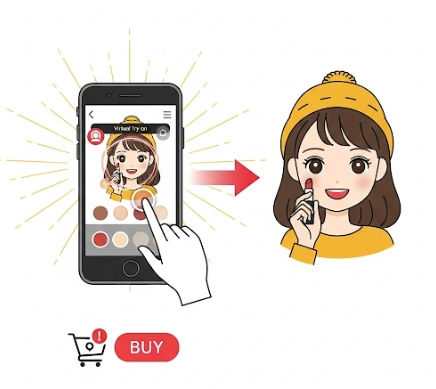
อิทธิพลของความจริงเสริมต่อความพึงพอใจในประสบการณ์เสมือนจริงและความตั้งใจใช้ผลิตภัณฑ์ความงามบนแอปพลิเคชัน
DOI:
https://doi.org/10.60101/jimc2025.1745คำสำคัญ:
ความจริงเสริม, การมีส่วนร่วมของแบรนด์, ความพึงพอใจในประสบการณ์, ความตั้งใจใช้, การยอมรับเทคโนโลยีบทคัดย่อ
บทความนี้มีวัตถุประสงค์เพื่อทบทวนวรรณกรรมอิทธิพลของเทคโนโลยีความจริงเสริม (Augmented Reality: AR) ต่อการมีส่วนร่วมของแบรนด์ในความพึงพอใจประสบการณ์เสมือนจริงและความตั้งใจใช้ผลิตภัณฑ์ความงามบนแอปพลิเคชัน โดยใช้แนวคิดแบบจำลองการยอมรับเทคโนโลยี (Technology Acceptance Model) และแนวคิดการมีส่วนร่วมกับแบรนด์ของลูกค้า (Customer Brand Engagement) เป็นกรอบในการศึกษา บทความนี้มุ่งหวังที่จะอธิบายผลของการยอมรับเทคโนโลยีความจริงเสริมในด้านการรับรู้ประโยชน์ การลดความเสี่ยง การเพิ่มความเชื่อมั่น ความง่ายในการใช้งาน และความสนุกสนานเพลิดเพลิน ซึ่งมีอิทธิพลต่อการเพิ่มการมีส่วนร่วมของแบรนด์ในมิติการรับรู้ความเข้าใจ อารมณ์ความรู้สึก และพฤติกรรมของผู้บริโภค และนำไปสู่ความพึงพอใจในประสบการณ์และความตั้งใจใช้ผลิตภัณฑ์ความงามบนแอปพลิเคชัน โดยเฉพาะผลสรุปจากการรับรู้ความเสี่ยงในแง่บวกและความสนุกสนานจากการใช้งานความจริงเสริม เป็นปัจจัยสำคัญที่ส่งผลกระทบต่อความตั้งใจใช้
เอกสารอ้างอิง
ภาษาไทย
กัญญาณัฏฐ์ สิมมี. (2566). การยอมรับเทคโนโลยีโลกเสมือนจริง และทัศนคติทางออนไลน์ของผู้บริโภคมีอิทธิพลต่อ กระบวนการตัดสินใจซื้อสินค้าเครื่องแต่งกายแฟชั่นผ่านช่องทางออนไลน์ของผู้บริโภคในกรุงเทพมหานคร. Procedia of Multidisciplinary Research, 1(7), 1-13
เกียรติภูมิ นาควรรณกิจ. (2564). การยอมรับเทคโนโลยี ความเป็นเอกลักษณ์ และการรับรู้ความเสี่ยงที่ส่งผลต่อการตัดสินใจใช้แอปพลิเคชัน TikTok. [วิทยานิพนธ์ปริญญามหาบัณฑิต, มหาวิทยาลัยกรุงเทพ]. http://dspace.bu.ac.th/jspui/bitstream/123456789/4946/1/kiattipoom_nakw.pdf
ญาตาวี ทิพย์เที่ยงแท้. (2565). อิทธิพลของเทคโนโลยีความจริงเสริมที่มีต่อความตั้งใจซื้อสินค้ากลุ่มเครื่องสำอางผ่าน ทัศนคติต่อเทคโนโลยี. [วิทยานิพนธ์ปริญญามหาบัณฑิต, มหาวิทยาลัยมหิดล]. https://archive.cm.mahidol.ac.th /bitstream/123456789/4576/1/TP%20MM.019%202565.pdf
ณิชารีย์ กิตติคุณศิริ. (2562). ปัจจัยที่ส่งผลต่อการยอมรับเทคโนโลยีปัญญาประดิษฐ์แชทบอท. [วิทยานิพนธ์ปริญญามหาบัณฑิต, มหาวิทยาลัยธรรมศาสตร์]. https://doi.org/10.14457/TU.the.2019.97
ปราโมทย์ ลือนาม. (2554). แนวความคิดและวิวัฒนาการแบบจำลองการยอมรับการใช้เทคโนโลยี. วารสารการจัดการสมัยใหม่, 9(1), 9-17. https://so04.tci-thaijo.org/index.php/stou-sms- r/article/view/11933/10754
ผู้จัดการออนไลน์. (2566, 20 กันยายน). สนค. แนะใช้ AR–VR สร้างประสบการณ์ให้ลูกค้า เพิ่มประสิทธิภาพ ลดต้นทุนทำธุรกิจ. https://mgronline.com/business/detail/9660000084886
ภูริตา บุญล้อม. (2563, มีนาคม 27). เปิดข้อดีของ Virtual Makeup โลกใหม่สำหรับคนรักการลองเครื่องสำอาง. The Standard. https://thestandard.co/virtual-makeup/
มูรธา จรรยาวรลักษณ์. (2563). การศึกษาความสัมพันธ์ระหว่างปัจจัยของเทคโนโลยีความจริงเสริมกับความตั้งใจซื้ออุปกรณ์ตกแต่งบ้านของผู้บริโภคในเขตพื้นที่กรุงเทพมหานครและปริมณฑล. [วิทยานิพนธ์ปริญญามหาบัณฑิต, มหาวิทยาลัยมหิดล]. https://archive.cm.mahidol.ac.th/bitstream/123456789/3811/1/TP%20MM.070%202563.pdf
วิกานดา พรสกุลวานิช. (2565). สื่อใหม่และการจัดการการสื่อสาร (พิมพ์ครั้งที่ 3). สำนักพิมพ์มหาวิทยาลัยธรรมศาสตร์.
Aittipon N. (2566, 27 กุมภาพันธ์). เดอะมอลล์ กรุ๊ป เปิดตัว MNIVERSE โลกเสมือนจริง (VIRTUAL WORLD) ปักธงเป็น FUTURE RETAIL แรกในไทย. Marketeer. https://marketeeronline.co/archives/299029
Demeter. (2568, 7 มกราคม). 10 Marketing Trends สำหรับปี 2025 มีอะไรบ้าง. https://www.dmit.co.th/th/demeter-ict-updates-th/10-marketing-trends-in-2025/
Pepticles.com. (2564, 27 เมษายน). “Amazon Salon” ร้านทำผมไฮเทค เลือกสีผมได้ผ่าน AR ก่อนลงมือจริง. https://www.popticles.com/business/news-amazon-launch-salon-ar/
ภาษาอังกฤษ
Alimamy, S., & Gnoth, J. (2022). I want it my way! The effect of perceptions of personalization through augmented reality and online shopping on customer intentions to co-create value. Computers in Human Behavior, 128(3), 107105. https://doi.org/10.1016/j.chb.2021.107105
Arghashi, V. (2022). Shopping with augmented reality: How wow-effect changes the equations. Electronic Commerce Research and Applications, 54, 101166. https://doi.org/10.1016/j.elerap.2022.101166
Davis, F. D. (1989). Perceived usefulness, perceived ease of use, and user acceptance of information technology. MIS Quarterly, 13(3), 319-340. https://doi.org/10.2307/249008
Davis, F. D., Bagozzi, R. P., & Warshaw, P. R. (1989). User acceptance of computer technology: A comparison of two theoretical models. Management Science, 35(8), 982-1003.
Deloitte. (2024, 11 June). Personalizing growth: It’s a value exchange between brands and customers. https://www.deloittedigital.com/us/en/insights/research/personalizing-growth.html
Freepix. (2024, January 15). How augmented reality is transforming beauty and cosmetics. https://www.technolynx.com/post/how-augmented-reality-is-transforming-beauty-and- cosmetics#post-div
Gabriel, A., Ajriya, A. D., Fahmi, C. Z. N., & Handayani, P. W. (2023). The influence of augmented reality on E-commerce: A case study on fashion and beauty products. Cogent Business & Management, 10(2). https://doi.org/10.1080/23311975.2023.2208716
Han, D. I. D., Tom Dieck, M. C., & Jung, T. (2019). Augmented Reality Smart Glasses (ARSG) visitor adoption in cultural tourism. Leisure Studies, 38(5), 618–633. https://doi.org/ 10.1080/02614367.2019.1604790
Hinsch, C., Felix, R., & Rauschnabel, P. A. (2020). Nostalgia beats the wow-effect: Inspiration, awe and meaningful associations in augmented reality marketing. Journal of Retailing and Consumer Services, 53, 101987. https://doi.org/10.1016/j.jretconser.2019.101987
Hollebeek, L. D., & Belk, R. (2021). Consumers’ technology-facilitated brand engagement and wellbeing: Positivist TAM/PERMA-vs. Consumer Culture Theory perspectives. International Journal of Research in Marketing, 38, 387–401. https://doi.org/10.1016/j.ijresmar.2021.03.001
Hollebeek, L. D., Glynn, M. S., & Brodie, R. J. (2014). Consumer brand engagement in social media: Conceptualization, scale development and validation. Journal of Interactive Marketing, 28, 149–165. https://doi.org/10.1016/j.intmar.2013.12.002
Hsu, S. H. Y., Tsou, H. T., & Chen, J.S. (2021). “Yes, we do. Why not use augmented reality?” Customer responses to experiential presentations of AR-based applications. Journal of Retailing and Consumer Services, 62(5),102649. https://doi.org/10.1016/j.jretconser.2021.102649
Hung, S. W., Chang, C. W., & Ma, Y. C. (2021). A new reality: Exploring continuance intention to use mobile augmented reality for entertainment purposes. Technology in Society, 67(4), 101757. https://doi.org/10.1016/j.techsoc.2021.101757
Jessen, A., Hilken, T., Chylinski, M., Mahr, D., Heller, Keeling, D. I., & de Ruyter, K. (2020). The playground effect: How augmented reality drives creative customer engagement. Journal of Business Research, 116, 85-98. https://doi.org/10.1016/j.jbusres.2020.05.002
Khan, I., & Fatma, M., (2024). AR app-based brand engagement and outcomes: A moderated mediation approach. Journal of Retailing and Consumer Services, 76, 103618. https://doi.org/ 10.1016/j.jretconser.2023.103618
Kim, S., Baek, T. H., & Yoon, S. (2020). The effects of 360-degree rotatable product images on purchase intention. Journal of Retailing and Consumer Services, 55, 102062. https://doi.org/10.1016/j.jretconser.2020.102062
Kowalczuk, P., Siepmann, C., & Adler, J. (2020). Cognitive, affective, and behavioral consumer responses to augmented reality in e-commerce: A comparative study. Journal of Business Research, 124(1), 357–373. https://doi.org/10.1016/j.jbusres.2020.10.050
Lemon, K. N., & Verhoef, P. C. (2016). Understanding customer experience throughout the customer journey. Journal of Marketing, 80(6), 69-96. https://doi.org/10.1509/jm.15.0420
Lin, K. Y., & Huang, Y. K., (2024). Shopping in the digital world: How augmented reality mobile applications trigger customer engagement. Technology in Society, 77, 102540. https://doi.org/10.1016/j.techsoc.2024.102540
McLean, G., & Wilson, A. (2019). Shopping in the digital world: Examining customer engagement through augmented reality mobile applications. Computers in Human Behavior, 101(12), 210–224. https://doi.org/10.1016/j.chb.2019.07.002
McKinsey. (2024, 30 May). The state of AI in early 2024: Gen Ai adoption spikes and starts to generate value. https://www.mckinsey.com/capabilities/quantumblack/our-insights/the- state-of-ai#/
Nikhashemi, S. R., Knight, H. H., Nusair, K., & Liat, C. B. (2021). Augmented reality in smart retailing: A(n)(A) symmetric approach to continuous intention to use retail brands’mobile AR apps.
Journal of Retailing and Consumer Services, 60(3), 102464. https://doi.org/10.1016/j. jretconser.2021.102464
Plotkina, D., & Saurel, H. (2019). Me or just like me? The role of virtual try-on and physical appearance in apparel M-retailing. Journal of Retailing and Consumer Services, 51(6), 362–377. https://doi.org/10.1016/j.jretconser.2019.07.002
Qin H., Osatuyi B., & Xu L. (2021). How mobile augmented reality applications affect continuous use and purchase intentions: A cognition-affect-conation perspective. Journal of Retailing and Consumer Service, 63, 1-13. https://doi.org/10.1016/j.jretconser.2021.102680
Rauschnabel, P. A., Felix, R., & Hinsch, C. (2019). Augmented reality marketing: How mobile AR-apps can improve brands through inspiration. Journal of Retailing and Consumer Services, 49, 43-53. https://doi.org/10.1016/j.jretconser.2019.03.004
Recalde, D., Jai, T. C., & Jones, R. P. (2024). I can find the right product with AR! The mediation effects of shopper engagement on intent to purchase beauty products. Journal of Retailing and Consumer Services, 78, 103764. https://doi.org/10.1016/j.jretconser. 2024.103764
Schein, K. E., & Rauschnabel, P. A. (2021). Augmented reality in manufacturing: Exploring workers' perceptions of barriers. IEEE Transactions on Engineering Management, 70(10), 3344-3357. https://doi.org/10.1109/TEM.2021.3093833.
Smink, A. R., van Reijmersdal, E. A., van Noort, G., & Neijens, P. C. (2020). Shopping in augmented reality: The effects of spatial presence, personalization and intrusiveness on app and brand responses. Journal of Business Research, 118, 474-485. https://doi.org/10.1016/
j.jbusres.2020.07.018
Soto-Acosta, P., Molina-Castillo, F. J., Lopez-Nicolas, C., & Colomo-Palacios, R. (2014). The effect of information overload and disorganisation on intention to purchase online: The role of perceived risk and internet experience. Online Information Review, 38(4), 543-561. https://doi.org/10.1108/OIR-01-2014-0008
Venkatesh, V., & Davis, F. D. (2000). A theoretical extension of the Technology Acceptance Model: Four longitudinal field studies. Management Science, 46(2), 186-204.
Vieira V. A., Rafael D. N., & Agnihotri R. (2022). Augmented reality generalizations: A meta-analytical review on consumer-related outcomes and the mediating role of hedonic and utilitarian values. Journal of Business Research, 151(11), 170–184. https://doi.org/10.1016/j.jbusres. 2022.06.030
Wang, Y., Ko, E., & Wang, H. (2021). Augmented reality (AR) app use in the beauty product industry and consumer purchase intention. Asia Pacific Journal of Marketing and Logistics, 34(1), 110–131. https://doi.org/10.1108/apjml-11-2019-0684
Yavuz, M., Çorbacıoglu, E., Başoğlu, A. N., Daim, T. U., & Shaygan, A. (2021). Augmented reality technology adoption: A case study for mobile applications in Turkey. Technology in Society, 66, 101598. https://doi.org/10.1016/j.techsoc.2021.101598
Yim, M. Y. C., & Park, S. Y. (2019). “I am not satisfied with my body, so I like augmented reality (AR)” Consumer responses to AR-based product presentations. Journal of Business Research, 100, 581-589. https://doi.org/10.1016/j.jbusres.2018.10.041
Zare Ebrahimabad F., Yazdani, H., Hakim, A., & Asarian, M. (2024). Augmented reality versus web-based shopping: How does AR improve user experience and online purchase intention. Telematics and Informatics Reports, 15, 100152. https://doi.org/10.1016/j.teler.2024.100152