ผลการดำเนินงานด้าน ESG และความแม่นยำในการคาดการณ์ของนักวิเคราะห์: กรณีศึกษาบริษัทจดทะเบียนกลุ่มดัชนี SET100
คำสำคัญ:
ผลการดำเนินงานด้านสิ่งแวดล้อม สังคม และการกำกับดูแลกิจการ, ความแม่นยำในการคาดการณ์กำไร, นักวิเคราะห์ทางการเงิน, SET100บทคัดย่อ
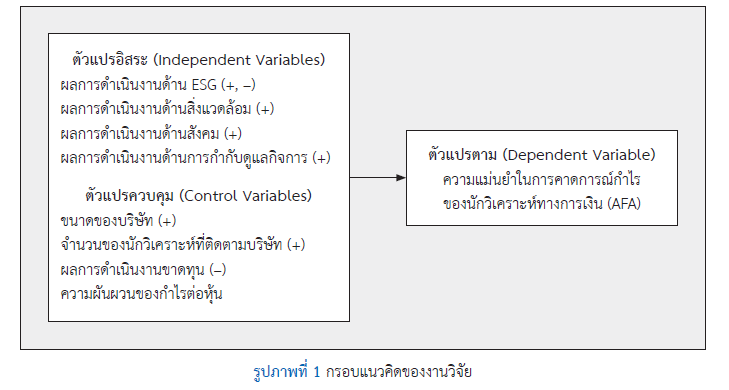
งานวิจัยนี้มีวัตถุประสงค์เพื่อศึกษาความสัมพันธ์ระหว่างผลการดำเนินงานด้านสิ่งแวดล้อม สังคม และการกำกับดูแลกิจการ (ESG) โดยรวมและแยกรายด้านกับความแม่นยำในการคาดการณ์กำไรของนักวิเคราะห์ทางการเงินของบริษัทจดทะเบียนในตลาดหลักทรัพย์แห่งประเทศไทยกลุ่มดัชนี SET100 โดยใช้ข้อมูลในช่วงปี พ.ศ. 2563–2567 จำนวน 342 ตัวอย่าง การวิเคราะห์ข้อมูลใช้แบบจำลองการถดถอยพหุคูณภายใต้แบบจำลองผลคงที่ (Fixed Effects Model)
ผลการศึกษาพบว่า ผลการดำเนินงานด้าน ESG โดยรวมมีความสัมพันธ์เชิงบวกกับความแม่นยำในการคาดการณ์กำไรของนักวิเคราะห์อย่างมีนัยสำคัญทางสถิติที่ระดับ 5% ชี้ให้เห็นว่าเมื่อบริษัทมีผลการดำเนินงานด้าน ESG ระดับสูง นักวิเคราะห์สามารถคาดการณ์กำไรได้แม่นยำยิ่งขึ้น สนับสนุนทฤษฎีการส่งสัญญาณ และทฤษฎีความไม่สมมาตรของข้อมูลที่สะท้อนว่าการเปิดเผยข้อมูล ESG ที่มีคุณภาพสามารถลดช่องว่างข้อมูลและยกระดับคุณภาพสภาพแวดล้อมข้อมูลในตลาดทุนไทย
โดยสรุปผลการศึกษาเสนอแนะได้ว่า การพัฒนามาตรฐานการเปิดเผยข้อมูล ESG ที่โปร่งใส สอดคล้อง และมีคุณภาพสูงโดยรวม สามารถช่วยเพิ่มประสิทธิภาพของการวิเคราะห์และการประเมินมูลค่าในตลาดทุนในระยะยาว อย่างไรก็ตาม เมื่อพิจารณารายด้านของ ESG พบว่าด้านสังคมมีอิทธิพลต่อความแม่นยำในการคาดการณ์ของนักวิเคราะห์มากที่สุด รองลงมาคือ ด้านสิ่งแวดล้อม ขณะที่ด้านการกำกับดูแลกิจการไม่พบความสัมพันธ์อย่างมีนัยสำคัญ สะท้อนว่าข้อมูลด้านสังคมซึ่งเกี่ยวข้องโดยตรงกับผู้มีส่วนได้เสียจึงมีบทบาทสำคัญในการลดความไม่สมมาตรของข้อมูลได้มากกว่าด้านอื่น
เอกสารอ้างอิง
Akerlof, G. A. (1970). The market for “lemons”: Quality uncertainty and the market mechanism. The Quarterly Journal of Economics, 84(3), 488-500. https://doi.org/10.2307/1879431
Ayem, S., Kusuma, H., & Arifin, J. (2024). Integrated reporting, ESG disclosure, forecast accuracy, and firm value: Profitability as moderating variable. Journal of Lifestyle and SDGs Review, 5(2). https://doi.org/10.47172/2965-730X.SDGsReview.v5.n02.pe02608
Bhat, G., Hope, O.-K., & Kang, T. (2006). Does corporate governance transparency affect the accuracy of analyst forecasts? Accounting & Finance, 46(5), 715-732. https://doi.org/10.1111/j.1467-629X.2006.00191.x
Bradshaw, M. T. (2011). Analysts’ forecasts: What do we know after decades of work? SSRN Electronic Journal. https://doi.org/10.2139/ssrn.1880339
Byard, D., Li, Y., & Weintrop, J. (2006). Corporate governance and the quality of financial analysts’ information. Journal of Accounting and Public Policy, 25(5), 609-625. https://doi.org/10.1016/j.jaccpubpol.2006.07.003
Clarkson, P. M., Li, Y., Richardson, G. D., & Vasvari, F. P. (2013). The relevance of environmental disclosures for investors and other stakeholder groups: Are such disclosures incrementally informative? Journal of Accounting and Public Policy, 32(5), 410-431. https://doi.org/10.1016/j.jaccpubpol.2013.06.008
Cohen, J. (1988). Statistical power analysis for the behavioral sciences (2nd ed.). Lawrence Erlbaum Associates.
Connelly, B. L., Certo, S. T., Ireland, R. D., & Reutzel, C. R. (2011). Signaling theory: A review and assessment. Journal of Management, 37(1), 39-67. https://doi.org/10.1177/
Dhaliwal, D. S., Radhakrishnan, S., Tsang, A., & Yang, Y. G. (2012). Nonfinancial disclosure and analyst forecast accuracy: International evidence on corporate social responsibility disclosure. The Accounting Review, 87(3), 723-759. https://doi.org/10.2308/accr-10218
Eccles, R. G., Ioannou, I., & Serafeim, G. (2014). The impact of corporate sustainability on organizational processes and performance. Management Science, 60(11), 2835-2857. https://doi.org/10.1287/mnsc.2014.1984
Ernstberger, J., & Grüning, M. (2013). How do firm- and country-level governance mechanisms affect firms' disclosure? Journal of Accounting and Public Policy, 32(3), 50-67. https://doi.org/10.1016/j.jaccpubpol.2013.02.003
Freeman, R. E. (1984). Strategic management: A stakeholder approach. Pitman.
Givoly, D., & Lakonishok, J. (1984). The quality of analysts’ forecasts of earnings. Financial Analysts Journal, 40(5), 40-47.
Gujarati, D. N., & Porter, D. C. (2009). Basic econometrics (5th ed.). McGraw-Hill Education.
Healy, P. M., & Palepu, K. G. (2001). Information asymmetry, corporate disclosure, and the capital markets: A review of the empirical disclosure literature. Journal of Accounting and Economics, 31(1–3), 405-440. https://doi.org/10.1016/S0165-4101(01)00018-0
Li, K. (2024). ESG performance and analyst forecast accuracy: A moderating role of economic uncertainty [Master’s thesis, University of Amsterdam]. https://scripties.uba.uva.nl/download?fid=c11220320
Liu, S. (2016). Ownership structure and analysts’ forecast properties: A study of Chinese listed firms. Corporate Governance, 16(1), 54-78. https://doi.org/10.1108/CG-02-2015-0018
Lozano, R. (2008). Envisioning sustainability three-dimensionally. Journal of Cleaner Production, 16(17), 1838-1846. https://doi.org/10.1016/j.jclepro.2008.02.008
Luo, L., & Wu, H. (2022). Corporate sustainability and analysts' earnings forecast accuracy: Evidence from environmental, social and governance ratings. Corporate Social Responsibility and Environmental Management, 29(5), 1465-1481. https://doi.org/10.1002/csr.2284
Michelon, G., Pilonato, S., & Ricceri, F. (2015). CSR reporting practices and the quality of disclosure: An empirical analysis. Critical Perspectives on Accounting, 33, 59-78. https://doi.org/10.1016/j.cpa.2014.10.003
Spence, M. (1973). Job market signaling. The Quarterly Journal of Economics, 87(3), 355–374.
Thai, H. M., Thu, T. H. T., Ngoc, S. P., & Thi, A. M. (2023). Corporate governance and the accuracy of analysts' earnings forecast in Vietnam. In Proceedings of the International Conference on Emerging Challenges: Strategic Adaptation in the World of Uncertainties (ICECH 2022) (pp. 442–466). Atlantis Press. https://doi.org/10.2991/978-94-6463-150-0_29
Thai Institute of Directors. (2024). Corporate governance report of Thai listed companies 2024. Thai Institute of Directors.
The Securities and Exchange Commission of Thailand. (2021). Guideline for preparing the annual registration statement/annual report. The Securities and Exchange Commission of Thailand.
The Stock Exchange of Thailand. (2025a). Sustainable capital market development. The Stock Exchange of Thailand.
The Stock Exchange of Thailand. (2025b). Sustainable investment. The Stock Exchange of Thailand.
Wooldridge, J. M. (2016). Introductory econometrics: A modern approach (6th ed.). Cengage Learning.
Zhang, J. (2024). Greenwashing and analyst forecast accuracy: Evidence from China’s listed firms [Master’s thesis, Macquarie University]. https://doi.org/10.25949/
ดาวน์โหลด
เผยแพร่แล้ว
รูปแบบการอ้างอิง
ฉบับ
ประเภทบทความ
สัญญาอนุญาต
ลิขสิทธิ์ (c) 2026 คณะบริหารธุรกิจ สถาบันบัณฑิตพัฒนบริหารศาสตร์

อนุญาตภายใต้เงื่อนไข Creative Commons Attribution-NonCommercial-NoDerivatives 4.0 International License.