อิทธิพลของทุนทางปัญญาต่อผลการประเมินความยั่งยืน หลักฐานเชิงประจักษ์จากบริษัทจดทะเบียนในตลาดหลักทรัพย์แห่งประเทศไทย
คำสำคัญ:
ทุนทางปัญญา, ทุนมนุษย์, MVAIC, บริษัทจดทะเบียนในตลาดหลักทรัพย์แห่งประเทศไทย, ผลการประเมินความยั่งยืนบทคัดย่อ
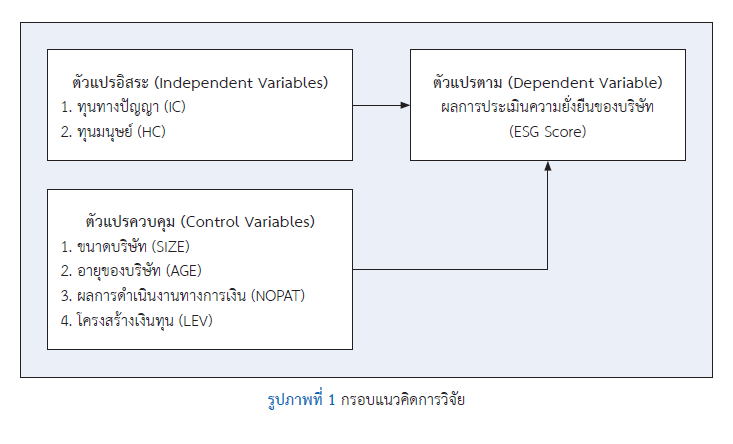
การวิจัยครั้งนี้มีวัตถุประสงค์เพื่อศึกษาความสัมพันธ์ระหว่างทุนทางปัญญากับผลการประเมินความยั่งยืน ซึ่งวัดจากคะแนนด้านสิ่งแวดล้อม สังคม และธรรมาภิบาล (ESG Score) ของบริษัทจดทะเบียนในตลาดหลักทรัพย์แห่งประเทศไทย (SET) โดยมุ่งเน้นการวิเคราะห์บทบาทของทุนทางปัญญา (IC) และทุนมนุษย์ (HC) ที่มีต่อผลการประเมินความยั่งยืน ข้อมูลที่ใช้ในการศึกษาได้มาจากฐานข้อมูล LSEG โดยกลุ่มตัวอย่างประกอบด้วย 212 ตัวอย่างจาก 75 บริษัทในกลุ่มอุตสาหกรรมทรัพยากร อสังหาริมทรัพย์และก่อสร้าง และเทคโนโลยี ในช่วงปี พ.ศ. 2565 ถึง 2567 โดยใช้การวิเคราะห์การถดถอยพหุคูณด้วยแบบจำลองแบบคงที่
ผลการศึกษาพบว่า ทุนทางปัญญาและทุนมนุษย์มีความสัมพันธ์เชิงบวกกับผลการประเมินความยั่งยืน สะท้อนให้เห็นว่าการบริหารและใช้ประโยชน์จากทุนทางปัญญาและทุนมนุษย์ได้อย่างมีประสิทธิภาพ มีส่วนช่วยยกระดับผลการประเมินความยั่งยืน นอกจากนี้ยังพบว่าโครงสร้างเงินทุน ซึ่งวัดด้วยอัตราส่วนหนี้สินต่อทุน มีความสัมพันธ์เชิงบวกกับผลการประเมินความยั่งยืนเช่นเดียวกัน ในขณะที่ ขนาดบริษัท อายุของบริษัท และความสามารถในการทำกำไร ไม่พบความสัมพันธ์กับผลการประเมินความยั่งยืน
เอกสารอ้างอิง
Al Amosh, H., Khatib, S. F., & Ananzeh, H. (2023). Environmental, social and governance impact on financial performance: Evidence from the Levant Countries. Corporate Governance: The International Journal of Business in Society, 23(3), 493-513.
Alves, C. F., & Meneses, L. L. (2024). ESG scores and debt costs: Exploring indebtedness, agency costs, and financial system impact. International Review of Financial Analysis, 94, 103240. https://doi.org/10.1016/j.irfa.2024.103240
Amitrano, C. C., Gheith, M. H., Troise, C., & Cappa, F. (2026). Individual and organizational intellectual capital, ESG dimensions and competitive advantage: A focus on Italian SMEs. Journal of Intellectual Capital, 27(1), 89-109. https://doi.org/10.1108/JIC-12-2024-0411
Asmawanti-S, D., & Wijayanti, I. O. (2017). Intellectual capital and corporate social responsibility in banking industries in Indonesia. Journal of Economics, Business, and Accountancy Ventura, 20(2), 191-200. https://doi.org/10.14414/jebav.v20i2.787
Bakry, A. E. A. (2022). Does intellectual capital efficiency improve the corporate social responsibility of Egyptian firms? Journal of Financial Reporting and Accounting, 20(3-4), 693-711. https://doi.org/10.1108/JFRA-09-2020-0269
Barney, J. (1991). Firm resources and sustained competitive advantage. Journal of Management, 17(1), 99-120. https://doi.org/10.1177/014920639101700108
Bodhanwala, S., & Bodhanwala, R. (2022). Exploring relationship between sustainability and firm performance in travel and tourism industry: A global evidence. Social Responsibility Journal, 18(7), 1251-1269.
Broadstock, D. C., Chan, K., Cheng, L. T. W., & Wang, X. (2021). The role of ESG performance during times of financial crisis: Evidence from COVID-19 in China. Finance Research Letters, 38, Article 101716. https://doi.org/10.1016/j.frl.2020.101716
Chantabutr, P., & Wuttichindanon, S. (2020). Definition, classification, measurement, and reporting of intellectual capital: A literature review. Journal of Management Sciences, Prince of Songkla University, 37(2), 165-194.
Chih, H.-L., Shen, C.-H., & Kang, F.-C. (2008). Corporate social responsibility, investor protection, and earnings management: Some international evidence. Journal of Business Ethics, 79(1-2), 179-198. https://doi.org/10.1007/s10551-007-9383-7
Eccles, R. G., Ioannou, I., & Serafeim, G. (2014). The impact of corporate sustainability on organizational processes and performance. Management Science, 60(11), 2835-2857. https://doi.org/10.1287/mnsc.2014.1984
Edvinsson, L. (1997). Developing intellectual capital at Skandia. Long Range Planning, 30(3), 366-373. https://doi.org/10.1016/S0024-6301(97)00016-2
Han, H., & Kim, Y. (2020). The impact of firm age on corporate social responsibility. In Proceedings of the 49th European Marketing Academy Conference (EMAC 2020) (Article A2020-62801). European Marketing Academy. https://proceedings.emac-online.org/pdfs/A2020-62801.pdf
Higgins, R. C. (1977). How Much Growth Can a Firm Afford? Financial Management, 6, 7-16. https://doi.org/10.2307/3665251
Kaplan, R. S., & Norton, D. P. (1992). The balanced scorecard--measures that drive performance. Harvard Business Review, 70(1), 71-79.
Kartadjumena, E., Djajadikerta, H. G., & Ng, C. (2011). The relationship of profit and corporate social responsibility disclosure: Survey on manufacture industry in Indonesia. In Proceedings of the 2nd International Conference on Business and Economic Research (2nd ICBER 2011) (pp. 662-674). Global Research Agency.
Kranraweekultana, W., Poungsangsuk, S., Maisak, R., & Kankomon, N. (2024). Environmental Social Governance (ESG) Responsibility and Intellectual Capital affect the Profitability of Companies Listed on the Stock Exchange of Thailand. SSRU Journal of Public Administration, 7(1), 67-81.
Kuzmin, E., Vlasov, M., Strielkowski, W., Faminskaya, M., & Kharchenko, K. (2024). Digitalization of the energy sector in its transition towards renewable energy: A role of ICT and human capital. Energy Strategy Reviews, 53, Article 101418. https://doi.org/10.1016/j.esr.2024.101418
LSEG. (2024). Environmental, Social, and Governance (ESG) Scores from LSEG. https://www.lseg.com/content/dam/dataanalytics/en_us/documents/methodology/lseg-esg-scores-methodology.pdf
Malik, M. (2015). Value-Enhancing Capabilities of CSR: A Brief Review of Contemporary Literature. Journal of Business Ethics, 127, 419-438. https://doi.org/10.1007/s10551-014-2051-9
Musibah, A. S., & Alfattani, W. S. B. W. Y. (2013). Impact of intellectual capital on corporate social responsibility: Evidence from Islamic banking sector in GCC. International Journal of Finance and Accounting, 2(6), 307-311. https://doi.org/10.5923/j.ijfa.20130206.01
Naeem, N., Cankaya, S., & Bildik, R. (2022). Does ESG performance affect the financial performance of environmentally sensitive industries? A comparison between emerging and developed markets. Borsa Istanbul Review, 22; S128-S140. https://doi.org/10.1016/j.bir.2022.11.014
Nimtrakoon, S. (2015). The relationship between intellectual capital, firms’ market value and financial performance Empirical evidence from the ASEAN. Journal of Intellectual Capital, 16(3), 587-618. https://doi.org/10.1108/JIC-09-2014-0104
Nurhayadi, W., Fitriani, H., Putri, R. A., Jamaludin, N., & Sucihati, S. (2025). The effect of social risk, intellectual capital, and HR policies on ESG performance of financial technology companies in West Java. West Science Social and Humanities Studies, 3(7), 1073-1087. https://doi.org/10.58812/wsshs.v3i07.2102
Obeidat, B.Y., Abdallah, A.B., Aqqad, N.O., Akhoershiedah, A.H.O.M., & Maqableh, M. (2016). The effect of intellectual capital on organizational performance: The mediating role of knowledge sharing. Communications and Network, 9(1), 1-27.
Ordóñez de Pablos, P. (2004). Human resource management systems and their role in the development of strategic resources: Empirical evidence. Journal of European Industrial Training, 28(6), 474-489. https://doi.org/10.1108/03090590410542701
Phondet, P., Waenkaeo, K., Bangmek, R., & Sumritsakun, C. (2021). Comparison of industry types on intellectual capital of Thai Listed Companies. Journal of Management Science Udon Thani Rajabhat University, 3(2), 21-32.
Porter, D. C., & Gujarati, D. N. (2009). Basic Econometrics. McGraw-Hill Education.
Promlao, K. (2021). What is ESG and why it is popular among investors today. TRIS Corporation Limited. https://www.tris.co.th/wp-content/uploads/2021/05/2564_Article_250564.pdf
Pulic, A. (2000). VAICTM – An accounting tool for IC management. International Journal of Technology Management, 20(5-8), 702-714. https://doi.org/10.1504/IJTM.2000.002891
Razafindrambinina, D., & Kariodimedjo, D. (2011). Is company intellectual capital linked to corporate social responsibility disclosure? Findings from Indonesia. Communications of the IBIMA, 2011, Article 511442. https://doi.org/10.5171/2011.511442
Sim-im, P. (2019). The relationship between intellectual capital and sustainable growth of companies listed on the Stock Exchange of Thailand. Ratchaphruek Journal, 17(1), 216-227.
Ståhle, P., Stahle, S. and S. Aho. (2011). Value added intellectual coefficient (VAIC): A critical Analysis. Journal of Intellectual Capital, 12(4), 247-268. https://doi.org/10.1108/14691931111181715
Stewart, T. A. (1997). Intellectual Capital. QFinance, 1, 1-4. https://www.scribd.com/document/446654031/Intellectual-Capital-pdf
Sumiati, & Isnaini, A. (2024). The power of green intellectual capital: Driving sustainability and profitability through ESG practice. Jurnal Aplikasi Manajemen, 22(4), 1135-1153. https://doi.org/10.21776/ub.jam.2024.022.04.14
Sunalai, P. (2022). The relationship between corporate governance and financial distress risk through intellectual capital of companies listed on the Stock Exchange of Thailand. [Unpublished independent study]. Thammasat University.
Sveiby, K. E. 1997. The New Organisational Wealth: Managing and Measuring Knowledge Based Assets. Berrett-Koehler.
The Stock Exchange of Thailand. (2025). Business Sustainability Trends: One Report. SET Sustainability. https://setsustainability.com/libraries/1038/item/-one-report-
Thongsaichon, N. (2022). ESG: Investing in the New Era. SET Investnow. https://www.setinvestnow.com/th/knowledge/article/165-tsi-invest-in-esg-stocks-in-new-investment-era
Ulum, I. (2014). Intellectual Capital Performance of Indonesian Banking Sector: A Modified VAIC (M-VAIC) Perspective. Asian Journal of Finance & Accounting, 6(2), 103-123. http://dx.doi.org/10.5296/ajfa.v6i2.5246
Vilalai, P., & Thaneerananon, A. (2025). Firm growth, cash holdings, and financial performance influencing the sustainability assessment of companies listed on the Stock Exchange of Thailand: Sustainable stocks group. Journal of Social Science and Culture, 9(6), 25-36.
Wang, C. (2024). The relationship between ESG performance and corporate performance–Based on stakeholder theory. SHS Web of Conferences, 190, 03022. https://doi.org/10.1051/shsconf/202419003022
Wimonanupong, K. (2021). The relationship between intellectual capital, growth opportunities, and firm performance of companies listed on the Stock Exchange of Thailand [Master’s thesis, Thammasat University].
Wisesight. (2025). What is ESG Score? A New Metric for Sustainable Organizations. https://wisesight.com/th/insights-hub/what-is-esg-score/
Wooldridge, J. M. (2016). Introductory Econometrics: A Modern Approach (6th ed.). Cengage Learning.
World Economic Forum. (2022). Fostering Effective Energy Transition 2022. World Economic Forum.
Xu, J., & Wang, B. (2018). Intellectual capital, financial performance and companies’ sustainable growth: Evidence from the Korean manufacturing industry. Sustainability, 10(12), Article 4651. https://doi.org/10.3390/su10124651
ดาวน์โหลด
เผยแพร่แล้ว
รูปแบบการอ้างอิง
ฉบับ
ประเภทบทความ
สัญญาอนุญาต
ลิขสิทธิ์ (c) 2026 คณะบริหารธุรกิจ สถาบันบัณฑิตพัฒนบริหารศาสตร์

อนุญาตภายใต้เงื่อนไข Creative Commons Attribution-NonCommercial-NoDerivatives 4.0 International License.