ปัจจัยที่ส่งผลต่อทัศนคติเชิงบวกในกีฬา E-Sports
คำสำคัญ:
อีสปอร์ต, การประสบความสำเร็จ, การสนับสนุน, การเปิดรับข่าวสาร, การคล้อยตามกลุ่มอ้างอิง, ทัศนคติเชิงบวกบทคัดย่อ
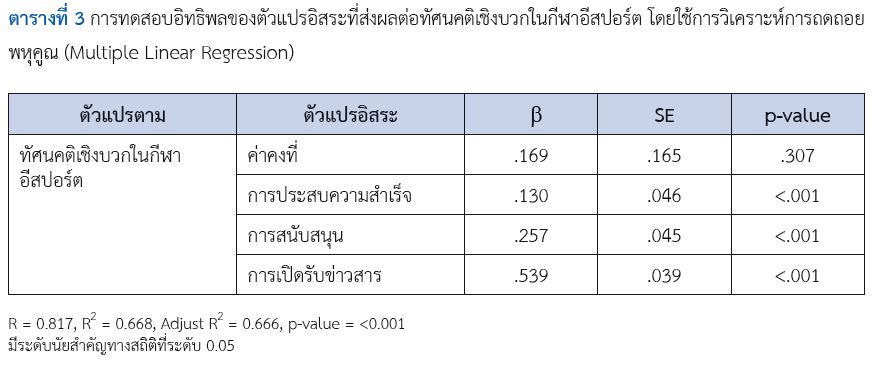
การศึกษาวิจัยในครั้งนี้ มีวัตถุประสงค์เพื่อนำเสนอเนื้อหาเกี่ยวกับอิทธิพลของตัวแปรการประสบความสำเร็จ การสนับสนุน การเปิดรับข่าวสาร และอิทธิพลเมื่อมีการคล้อยตามกลุ่มอ้างอิงซึ่งเป็นตัวแปรกำกับ ต่อทัศนคติเชิงบวกในกีฬาอีสปอร์ต การศึกษาในครั้งนี้เป็นวิจัยเชิงปริมาณความคิดปฏิฐานนิยม (Positivism) ใช้การสำรวจโดยมีการเก็บข้อมูลจากการตอบแบบสอบถามออนไลน์ของประชากรกลุ่มตัวอย่างคือบุคคลที่รู้จักกีฬา E-Sports ช่วงอายุระหว่าง 18-45 ปี จำนวน 385 ชุด แล้วนำไปวิเคราะห์แบบ Multiple Regression Analysis และ Moderator Analysis เพื่อหาข้อสรุปให้เกี่ยวเนื่องกับสมมติฐานที่ตั้งไว้
ผลการวิจัยพบว่าตัวแปรการประสบความสำเร็จ การสนับสนุน การเปิดรับข่าวสาร ส่งผลต่อทัศคติเชิงบวกในกีฬาอีสปอร์ตอย่างมีนัยสำคัญทางสถิติที่ระดับ 0.01 ซึ่งเป็นไปตามสมมติฐาน และยังพบว่าการคล้อยตามกลุ่มอ้างอิงมีอิทธิพลต่อตัวแปรการเปิดรับข่าวสารข้างต้นที่ทำให้ส่งผลต่อทัศนคติเชิงบวกในกีฬาอีสปอร์ตที่นัยสำคัญทางสถิติที่ระดับ 0.05 เพียงตัวแปรเดียว
การศึกษาวิจัยในครั้งนี้ได้เพิ่มพูนองค์ความรู้เกี่ยวกับทัศนคติในกีฬาอีสปอร์ต ทั้งในมุมมองทางวิชาการ และมุมมองทางความคิดของบุคคล เพื่อนำไปประยุกต์ใช้จริงในการออกแบบและดำเนินธุรกิจที่เกี่ยวข้องกับกีฬาอีสปอร์ต ตลอดจนการออกแบบเครื่องมือทางการตลาดต่อไป
เอกสารอ้างอิง
Ajzen, I. (1991). The theory of planned behavior. Organizational Behavior and Human Decision Processes, 50(2), 179-211. https://doi.org/10.1016/0749-5978(91)90020-T
Angkanaphorn Singto. (2021). Factors Predicting the Recognition of E-Sport Sponsors. [Master Thesis, Rangsit University]. Rungsit University Intellectual Repository. https://rsuir-library.rsu.ac.th/handle/123456789/1481
Atkin, C. K. (1973). New model for mass communication research. New York: Free Press.
Brooks, C. M. (1994). Sport marketing: competitive business strategies for sports. New Jersey: Prentice Hall
Charoenlarp, P. (2018). Value and economics value of eSport. [Master Thesis, Bangkok University]. DSpace at Bangkok University .http://dspace.bu.ac.th/handle/123456789/3001
Chontipa Aphirattananon and Chalermporn Yenyuak. (2022). Achievement Motivation for Professional Success of the Thai National Rugby Team. The Journal of Development Administration Research, 12(1), 83-94.
Cochran, W. G. (1977). Sampling techniques (3rd ed.). New York: John Wiley & Sons
Cornwell, T. B. (2019). Less "Sponsorship As Advertising" and More Sponsorship Linked Marketing As Authentic Engagement. Journal of Advertising, 48(5), 1- 12. https://doi.org/10.1080/00913367.2019.1588809
Farrelly, F., Quester, P., & Clulow, V. (2008). Exploring market orientation and satisfaction of partners in sponsorship relationship. Australian Marketing Journal, 16(2), 51-66. https://doi.org/10.1016/S1441-3582(08)70014-4
Francis, J. R. (2004). What do we know about audit quality?. The British accounting Review, 36(4), 345-368. https://doi.org/10.1016/j.bar.2004.09.003
Hamari, J. & Keronen, L. (2017). Why do people play games? A meta-analysis. International Journal of Information Management, 37(3), 125–141. https://doi.org/10.1016/j.ijinfomgt.2017.01.006
Hazari, S. (2018). Investigating social media consumption, sports enthusiasm, and gender on sponsorship outcomes in the context of Rio Olympics. International Journal of Sports Marketing and Sponsorship, 19(4), 396-414. https://doi.org/10.1108/IJSMS-01-2017-0007
Intira Chainarong, Wanpen Pinyopasakul, Sasima Kusuma Na Ayuthya, Saranya Koositamongkol. (2017). The Relationships among Attitude Toward Exercise, Subjective Norms, Perceived Behavioral Control and Walking Exercise Intention in Post Stroke Patients after Hospital Discharge. Journal of The Royal Thai Army Nurses, 18(2), 178-185
Kanchanat Udomsook. (2021). The communications for development Esports in Thailand. Dhurakij Pundit Communication Arts Journal 15(1), 128-160.
Lee, D., & Schoenstedt, L. J. (2011). Comparison of eSports and traditional sports consumption motives. The ICHPER-SD Journal of Research in Health, Physical Education, Recreation, Sport & Dance, 6(2), 39-44.
McCleland, D.C. (1953). The Achievement Motive. New York: Appleton - Century Croft, Inc. https://doi.org/10.1037/11144-000
Neus, F., Nimmermann, F., Wagner, K., & Schramm-Klein, H. (2020). Differences and similarities in motivation for offline and online eSports event consumption. In Event marketing in the context of higher education marketing and digital environments, 79-99. https://doi.org/10.1007/978-3-658-29262-1_6
Nittaya Sittisuea. (2010). The results of strengthening one's power according to the theory of the contact language program that corresponds to reality of students at the lower secondary school level, Ban Thap Chang School Nakhon Ratchasima Province. [Unpublished master’s thesis]. Nakhon Ratchasima Rajabhat University.
Prachachat. (August 11, 2022) E-sports market is growing, what are the high-paying gaming jobs, what are the professions-how much do you earn?. https://www.prachachat.net/sd-plus/sdplus-sustainability/news-1011780
Richard, L. I., Sutton, W. A., McCarthy, L. M, & Irwin, R. L. (2008). Sport promotion and sales management. New York: Human Kinetic.
Rogers, Everett M. &; Svenning, Lynne. (1969). Modernization among peasants: The impact of communication. New York: Holt, Rinehart and Winston, Inc.
Salayapa Nawarat. (2017). The expectations the exposure and the satisfaction of the e-sports broadcast. [Master Thesis, Thammasat University]. Thammasat University Digital Collections. https://digital.library.tu.ac.th/tu_dc/frontend/Info/item/dc:143954
Seitz, P. (2018, 02/13/2018 Feb 13). Esports Channel Twitch Draws More Viewers Than CNN. Investor's Business Daily. Retrieved on November 15, 2023, from https://search.proquest.com/docview/2001575864?accountid=42455
Snavely, T. L. (2014). History and Analysis of eSport system. Retrieved on November 15, 2023, from http://repositories.lib.utexas.edu/handle/2152/28652?show=full.
Tawanseth Sennan. (2006). Behavior and impact of the game-online addiction : case study of student. [Master Thesis, Chulalongkorn University]. Chulalongkorn University Intellectual Repository. https://cuir.car.chula.ac.th/handle/123456789/14830
Taylor, N. T. (2016). Now you’re playing with audience power: the work of watching games. Critical Studies in Media Communication, 33(4), 293-307. https://doi.org/10.1080/15295036.2016.1215481
Thairath Online. (17 April 2018). "E-sports"...sports-dream career Answering the question of overcoming children addicted to games. https://www.thairath.co.th/money/economics/thailand_econ/1257307
Thanabadee Kasitsit. (Mar 16, 2020). Esport: Influence of globalized culture that is creating problems for Thai society?.TrueID. https://intrend.trueid.net/post/58314
Trail, G. T., & McCullough, B. P. (2020). Marketing sustainability through sport: Testing the sport sustainability campaign evaluation model. European Sport Management Quarterly, 20(2), 109-129. https://doi.org/10.1080/16184742.2019.1580301
Wagner, M. G. (2006). On the Scientific Relevance of eSports. In International conference on internet computing, 437-442.
Wang, J., Liu, R. D., Ding, Y., Liu, Y., Xu, L., & Zhen, R. (2017). What influences Chinese adolescents’ choice intention between playing online games and learning? Application of theory of planned behavior with subjective norm manipulated as peer support and parental monitoring. Frontiers in Psychology, 8, 589. https://doi.org/10.3389/fpsyg.2017.00589
Waranthiya Chaiyala. (2007). A study of Mathematical Process Skills with different Achievement Motive and Learning Styles of Mathayomsuksa III students in the Educational Area I, Kanchanaburi Province. [Master thesis, Srinakharinwirot University]. Central Library Srinakharinwirot University. http://search.swu.ac.th/permalink/f/1912klb/ALEPH_MONO000107497
Xiao, M. (2020). Factors influencing eSports viewership: An approach based on the theory of reasoned action. Communication & Sport, 8(1), 92-122. https://doi.org/10.1177/2167479518819482
ดาวน์โหลด
เผยแพร่แล้ว
รูปแบบการอ้างอิง
ฉบับ
ประเภทบทความ
สัญญาอนุญาต
ลิขสิทธิ์ (c) 2024 คณะบริหารธุรกิจ สถาบันบัณฑิตพัฒนบริหารศาสตร์

อนุญาตภายใต้เงื่อนไข Creative Commons Attribution-NonCommercial-NoDerivatives 4.0 International License.