การประยุกต์ใช้ปัญญาประดิษฐ์เพื่อการพัฒนาประสบการณ์ของลูกค้าในธุรกิจบริการธนาคาร
คำสำคัญ:
ปัญญาประดิษฐ์, ประสบการณ์ลูกค้าบทคัดย่อ
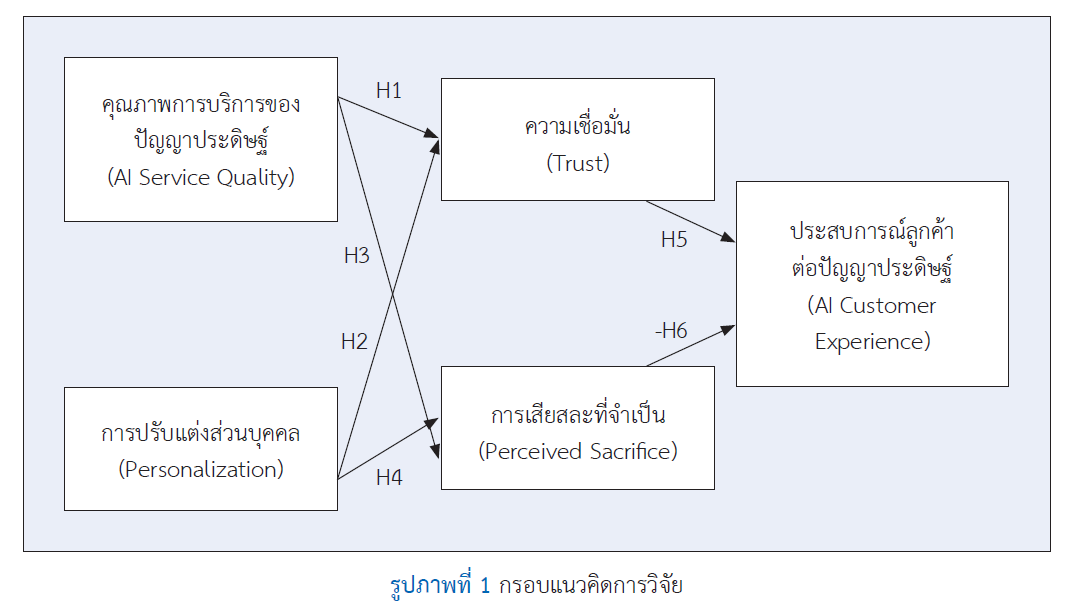
การศึกษานี้ได้ทำการศึกษาการประยุกต์ใช้เทคโนโลยีปัญญาประดิษฐ์เพื่อการพัฒนาประสบการณ์ลูกค้าในธุรกิจบริการธนาคาร โดยหลักการและแนวคิดในการศึกษานี้เป็นการวิเคราะห์แบบจำลองประสบการณ์การใช้งานเทคโนโลยีปัญญาประดิษฐ์ของลูกค้า ซึ่งมีวัตถุประสงค์เพื่อวิเคราะห์ปัจจัยที่เป็นองค์ประกอบของการประยุกต์ใช้เทคโนโลยีปัญญาประดิษฐ์และมีอิทธิพลต่อประสบการณ์ของลูกค้าในธุรกิจบริการ โดยเก็บรวบรวมข้อมูลด้วยแบบสอบถามจากกลุ่มตัวอย่างลูกค้าในธุรกิจบริการธนาคารจำนวน 400 คน ที่อาศัยอยู่ในกรุงเทพมหานครและปริมณฑล จากนั้นทำการวิเคราะห์ทางสถิติ ประกอบด้วย ค่าเฉลี่ย ส่วนเบี่ยงเบนมาตรฐาน ทดสอบสมมติฐานทางสถิติด้วยการวิเคราะห์โมเดลสมการโครงสร้าง (Structural Equation Modeling: SEM)
ผลการศึกษาพบว่าการใช้งานเทคโนโลยีปัญญาประดิษฐ์ในธุรกิจบริการธนาคารนั้นมีปัจจัยเรื่องของคุณภาพบริการ ความเชื่อมั่น และการปรับแต่งส่วนบุคคล ที่มีผลต่อการพัฒนาประสบการณ์ลูกค้า และปัจจัยที่ไม่มีผลต่อการพัฒนาประสบการณ์ลูกค้า คือ ความเสียสละที่จำเป็นของลูกค้าในการปรับตัวกับเทคโนโลยีปัญญาประดิษฐ์ งานวิจัยนี้สะท้อนให้เห็นว่าการนำปัญญาประดิษฐ์มาใช้ในธุรกิจบริการธนาคารมีบทบาทสำคัญในการพัฒนาประสบการณ์ลูกค้า ปัญญาประดิษฐ์ที่นำมาใช้เพื่อประสบการณ์ของลูกค้าต้องมีองค์ประกอบในเรื่องความไว้วางใจ ความสะดวก ความพึงพอใจต่อการพัฒนาความสามารถของปัญญาประดิษฐ์ควบคู่กับการปรับบริการให้เหมาะสมกับลูกค้าแต่ละราย จึงจะช่วยสร้างประสบการณ์ของลูกค้าอันนำไปสู่ความได้เปรียบทางการแข่งขันให้กับธุรกิจธนาคารในยุคดิจิทัล
เอกสารอ้างอิง
Ainur, A. K., Sayang, M. D., Jannoo, Z., & Yap, B. W. (2017). Sample size and non-normality effects on goodness of fit measures in structural equation models. Pertanika Journal of Science & Technology, 25(2), 575–586.
Al-Sabawi, R., & Al-Qudah, A. (2022). The moderating role of cost and convenience on the relationship in the UTAUT model to adopt e-payment services. International Journal of E-Payment Services, 32(1), Article 14.
Bendapudi, N., & Leone, R. P. (2003). Psychological implications of customer participation in co-production. Journal of Marketing, 67(1), 14–28. https://doi.org/10.1509/jmkg.67.1.14.18585
Bhalodia, G., Gediya, P., & Kher, V. (2024). Awareness and usage of digital payment modes among people of Rajkot city. In Digital Transformation and Consumer (Vol. 1, p. 4). https://doi.org/10.1201/9781003606185-154
Bienstock, C. C., Mentzer, J. T., & Bird, M. M. (1997). Measuring physical distribution service quality. Journal of the Academy of Marketing Science, 18(1), 31–44. https://doi.org/10.1007/BF02894507
Chang, V., Sivakulasingam, S., Wang, H., Wong, S. T., Ganatra, M. A., & Luo, J. (2024). Credit risk prediction using machine learning and deep learning: A study on credit card customers. Risks, 12, Article 174. https://doi.org/10.3390/risks12110174
Collier, J. E., & Bienstock, C. C. (2006). Measuring service quality in e-retailing. Journal of Service Research, 8(3), 260–275. https://doi.org/10.1177/1094670505278867
Comfere, C. L., Kascher, B., & Wiedenbeck, S. (2003). Trust and risk in e-commerce: A review. Information Systems Journal, 50(6), 737–758.
Corritore, C. L., Kracher, B., & Wiedenbeck, S. (2003). On-line trust: Concepts, evolving themes, a model. International Journal of Human-Computer Studies, 58(6), 737–758. https://doi.org/10.1016/S1071-5819(03)00041-7
Davis, F. D., Bagozzi, R. P., & Warshaw, P. R. (1989). User acceptance of computer technology: A comparison of two theoretical models. Management Science, 35(8), 982–1003. https://doi.org/10.1287/mnsc.35.8.982
De Winter, J., Dodou, D., & Eisma, Y. B. (2024). Personality and acceptance as predictors of ChatGPT use. Discover Psychology, 4, Article 57. https://doi.org/10.1007/s44202-024-00161-2
Guo, X., Zhang, X., & Sun, Y. (2016). The privacy–personalization paradox in mHealth services acceptance of different age groups. Information & Management, 53(2), 215–226. https://doi.org/10.1016/j.im.2015.09.010
Gupta, G., Bhatia, R., Singla, V., Joshi, M. C., & Rani, M. (2024). Study of chatbot in customer service at banking. In IEEE International Conference on Contemporary Computing and Informatics (Vol. 6, pp. 1–6). https://doi.org/10.1109/IC3I59117.2023.10397723
Kumar, N., Sharma, N. K., & Kumar, S. (2023). WSOmark: An adaptive dual-purpose color image watermarking using white shark optimizer and Levenberg–Marquardt BPNN. Expert Systems with Applications, 72, Article 120137. https://doi.org/10.1016/j.eswa.2023.120137
Lin, C.-H., Sher, P. J., & Shih, H.-Y. (2005). Past–present–future of ERP research: A review of the empirical literature. International Journal of Management Science, 16(4), 318–338. https://doi.org/10.1108/09564230510613988
Mick, D. G., & Fournier, S. (1998). Paradoxes of technology: Consumer cognizance, emotions, and coping strategies. Journal of Consumer Research, 25(2), 123–143. https://doi.org/10.1086/209531
Morgan, R. M., & Hunt, S. D. (1994). The commitment-trust theory of relationship marketing. Journal of Marketing, 58(3), 20–38. https://doi.org/10.1177/002224299405800302
Parasuraman, A., Zeithaml, V. A., & Berry, L. L. (1985). A conceptual model of service quality and its implications for future research. Journal of Marketing, 49(4), 41–50. https://doi.org/10.1177/002224298504900403
Preciado Martínez, P. M., Reier Forradellas, R. F., Garay Gallastegui, L. M., & Náñez Alonso, S. L. (2025). Comparative analysis of machine learning models for the detection of fraudulent banking transactions. Cogent Business & Management, 12(1). https://doi.org/10.1080/23311975.2025.2474209
Shrestha, N. (2021). Factor analysis as a tool for survey analysis. American Journal of Applied Mathematics and Statistics, 9(1), 4–11. https://doi.org/10.12691/ajams-9-1-2
Tarhini, A., Ameen, N., Rappel, A., & Anand, A. (2021). Customer experiences in the age of artificial intelligence. Computers in Human Behavior, 114, Article 106549. https://doi.org/10.1016/j.chb.2020.106548
Wind, J., & Rangaswamy, A. (2001). Customerization: The next revolution in mass customization. Harvard Business Review, 79(1), 13–32. https://doi.org/10.1002/1520-6653(200124)15:1<13::AID-DIR1001>3.0.CO;2-#
Yamane, T. (1967). Statistics: An introductory analysis (2nd ed.). Harper and Row.
Zeithaml, V. A. (1988). Consumer perceptions of price, quality, and value: A means-end model and synthesis of evidence. Journal of Marketing, 52(3), 2–22. https://doi.org/10.1177/002224298805200302
ดาวน์โหลด
เผยแพร่แล้ว
รูปแบบการอ้างอิง
ฉบับ
ประเภทบทความ
สัญญาอนุญาต
ลิขสิทธิ์ (c) 2026 คณะบริหารธุรกิจ สถาบันบัณฑิตพัฒนบริหารศาสตร์

อนุญาตภายใต้เงื่อนไข Creative Commons Attribution-NonCommercial-NoDerivatives 4.0 International License.