What does the end of legacy SWIFT code mean for cryptocurrency? Evidence from Ripple
Keywords:
Cryptocurrency, Event study, Abnormal return, Regulation, Market efficiency, Market reaction, ripple, price reaction, institutional, SWIFTAbstract
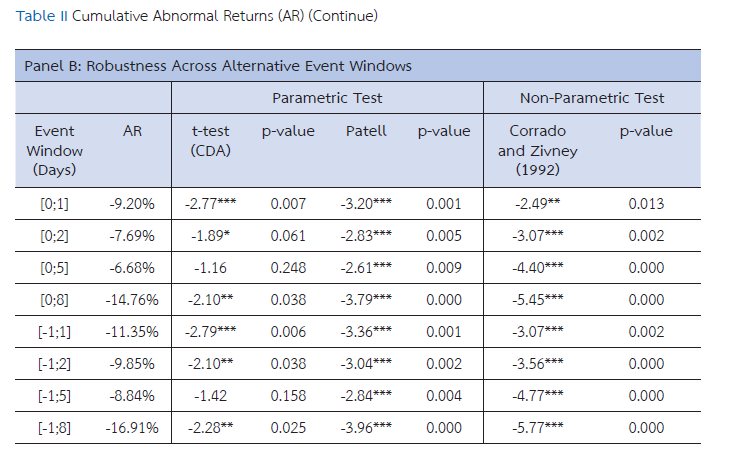
The public announcement to officially support ISO:20022 standard by Ripple, provides a unique setting to investigate the price effect following its announcement in the cryptocurrency market. This article is the first to explore the price reactions from the ISO standard adoption in cryptocurrency market context. Using an event-study methodology, the article shows the announcement of support for the ISO standard experienced a significant decrease in price a few days around the announcement, despite the nature of the announcement being good news. Such market anomalies are consistent with the stock price behaviors predicted by the concentrated-ownership theory commonly documented in stock market literature.
References
Algieri, B., Lawuobahsumo, K. K., Leccadito, A., & Zahid, I. (2025). Calendar effects on returns, volatility and higher moments: Evidence from crypto markets. The North American Journal of Economics and Finance, 79, Article 102441. https://doi.org/10.1016/j.najef.2025.102441
Antoniadis, I., Gkasis, C., & Kontsas, S. (2019). The Relationship of Insider Trading Announcements, Ownership Structure and Corporate Governance: An Event Study Analysis of Athens Stock Exchange Market Technology Firms. International Journal of Economics and Finance, 11(7), 13–27. https://doi.org/10.5539/ijef.v11n7p13
Bartos, J. (2015). Does Bitcoin follow the hypothesis of efficient market? International Journal of Economic Sciences, 4(2), 10–23. https://doi.org/10.20472/ES.2015.4.2.002
Bouoiyour, J., & Selmi, R. (2019). How do futures contracts affect Bitcoin prices? Economics Bulletin, 39(2), 1127–1134.
Brown, S. J., & Warner, J. B. (1980). Measuring security price performance. Journal of Financial Economics, 8(3), 205–258. https://doi.org/10.1016/0304-405X(80)90002-1
Brown, S. J., & Warner, J. B. (1985). Using daily stock returns. Journal of Financial Economics, 14(1), 3–31. https://doi.org/10.1016/0304-405X(85)90042-X
Byun, H.-Y., Hwang, L.-S., & Lee, W.-J. (2011). How does ownership concentration exacerbate information asymmetry among equity investors? Pacific-Basin Finance Journal, 19(5), 511–534. https://doi.org/10.1016/j.pacfin.2011.06.002
Carhart, M. M. (1997). On persistence in mutual fund performance. The Journal of Finance, 52(1), 57–82. https://doi.org/10.1111/j.1540-6261.1997.tb03808.x
Chen, H., Noronha, G., & Singal, V. (2004). The Price Response to S&P 500 Index Additions and Deletions: Evidence of Asymmetry and a New Explanation. The Journal of Finance, 59(4), 1901–1930. https://doi.org/10.1111/j.1540-6261.2004.00683.x
Chen, H.-L., Shiu, C.-Y., & Wei, H.-S. (2019). Price effect and investor awareness: Evidence from MSCI Standard Index reconstitutions. Journal of Empirical Finance, 50, 93–112. https://doi.org/10.1016/j.jempfin.2019.01.002
Chokor, A., & Alfieri, E. (2021). Long and short-term impacts of regulation in the cryptocurrency market. The Quarterly Review of Economics and Finance, 81, 157–173. https://doi.org/10.1016/j.qref.2021.05.005
Ciaian, P., Rajcaniova, M., & Kancs, d’Artis. (2016). The economics of Bitcoin price formation. Applied Economics, 48(19), 1799–1815. https://doi.org/10.1080/00036846.2015.1109038
Cipriani, M., Goldberg, L. S., & La Spada, G. (2023). Financial sanctions, SWIFT, and the architecture of the international payment system. Journal of Economic Perspectives, 37(1), 31–52. https://doi.org/10.1257/jep.37.1.31
CoinMarketCap. (2025, September 5). Today’s cryptocurrency prices by market cap. https://Coinmarketcap.com
Corrado, C. J. (1989). A nonparametric test for abnormal security-price performance in event studies. Journal of Financial Economics, 23(2), 385–395. https://doi.org/10.1016/0304-405X(89)90064-0
Corrado, C. J., & Zivney, T. L. (1992). The specification and power of the sign test in event study hypothesis tests using daily stock returns. The Journal of Financial and Quantitative Analysis, 27(3), 465. https://doi.org/10.2307/2331331
Cowan, A. R. (1992). Nonparametric event study tests. Review of Quantitative Finance and Accounting, 2(4), 343–358. https://doi.org/10.1007/BF00939016
Cowan, A. R., & Sergeant, A. M. A. (2001). Interacting biases, non-normal return distributions and the performance of tests for long-horizon event studies. Journal of Banking & Finance, 25(4), 741–765. https://doi.org/10.1016/S0378-4266(00)00094-7
Crane, A. D., Michenaud, S., & Weston, J. P. (2016). The effect of institutional ownership on payout policy: Evidence from index thresholds. Review of Financial Studies, 29(6), 1377–1408. https://doi.org/10.1093/rfs/hhw012
Dumrongwong, K. (2021). Calendar effects on cryptocurrencies: Not so straightforward. Southeast Asian Journal of Economics, 9(1), 1–26.
Dumrongwong, K. (2024). The exchange inclusion effect in the cryptocurrency market. The Journal of Investing, 33(3), 56–71. https://doi.org/10.3905/joi.2024.1.300
Fama, E. F., & French, K. R. (1993). Common risk factors in the returns on stocks and bonds. Journal of Financial Economics, 33(1), 3–56. https://doi.org/10.1016/0304-405X(93)90023-5
Fama, E. F., & French, K. R. (2015). A five-factor asset pricing model. Journal of Financial Economics, 116(1), 1–22. https://doi.org/10.1016/j.jfineco.2014.10.010
Gimenes, A. D., Colombo, J. A., & Yousaf, I. (2023). Store of value or speculative investment? Market reaction to corporate announcements of cryptocurrency acquisition. Financial Innovation, 9(1), 123. https://doi.org/10.1186/s40854-023-00539-6
Hrazdil, K. (2010). S&P 500 index inclusion announcements: Does the S&P committee tell us something new? Managerial Finance, 36(5), 368–393. https://doi.org/10.1108/03074351011039418
Huffman, E. (2025, September 5). ISO 20022 crypto: Top list of compliant coins in 2025. https://cryptonews.com/cryptocurrency/iso-20022-crypto
Jain, P. C. (1987). The effect on stock price of inclusion in or exclusion from the S&P 500. Financial Analysts Journal, 43(1), 58–65. https://doi.org/10.2469/faj.v43.n1.58
Jiang, H., Habib, A., & Hu, B. (2011). Ownership concentration, voluntary disclosures and information asymmetry in New Zealand. The British Accounting Review, 43(1), 39–53. https://doi.org/10.1016/j.bar.2010.10.005
Joo, M. H., Nishikawa, Y., & Dandapani, K. (2020). Announcement effects in the cryptocurrency market. Applied Economics, 52(44), 4794–4808. https://doi.org/10.1080/00036846.2020.1745747
Kamal, M. R., & Wahlstrøm, R. R. (2023). Cryptocurrencies and the threat versus the act event of geopolitical risk. Finance Research Letters, 57, Article 104224. https://doi.org/10.1016/j.frl.2023.104224
Kinateder, H., & Papavassiliou, V. G. (2021). Calendar effects in Bitcoin returns and volatility. Finance Research Letters, 38, Article 101420. https://doi.org/10.1016/j.frl.2019.101420
Kolari, J. W., & Pynnönen, S. (2010). Event study testing with cross-sectional correlation of abnormal returns. Review of Financial Studies, 23(11), 3996–4025. https://doi.org/10.1093/rfs/hhq072
Kolari, J. W., & Pynnönen, S. (2011). Nonparametric rank tests for event studies. Journal of Empirical Finance, 18(5), 953–971. https://doi.org/10.1016/j.jempfin.2011.08.003
Köppel, J. (2011). The SWIFT affair: Swiss banking secrecy and the fight against terrorist financing. Graduate Institute Publications. https://doi.org/10.4000/books.iheid.225
Li, S., Xiang, S., & Cui, X. (2025). The booster of long-termism or the tool for major shareholders’ entrenchment? Evidence from staggered boards in emerging markets. Journal of Accounting Literature. https://doi.org/10.1108/JAL-09-2024-0249
Liu, A., Jahanshahloo, H., Chen, J., & Eshraghi, A. (2023). Trading patterns in the Bitcoin market. The European Journal of Finance, 1–18. https://doi.org/10.1080/1351847X.2023.2241883
MacKinlay, A. C. (1997). Event studies in economics and finance. Journal of Economic Literature, 35(1), 13–39. https://www.jstor.org/stable/2729691
Madhavan, A. (2003). The Russell reconstitution effect. Financial Analysts Journal, 59(4), 51–64. https://doi.org/10.2469/faj.v59.n4.2545
Martin, J. (2020, May 6). Ripple joins ISO global standards body on cross-border payments. https://cointelegraph.com/news/ripple-joins-iso-global-standards-body-on-cross-border-payments
Patell, J. M. (1976). Corporate forecasts of earnings per share and stock price behavior: empirical test. Journal of Accounting Research, 14(2), 246–276. https://doi.org/10.2307/2490543
Pynnonen, S. (2022). Non-parametric statistic for testing cumulative abnormal stock returns. Journal of Risk and Financial Management, 15(4), 149. https://doi.org/10.3390/jrfm15040149
Qiu, T., Zhang, R., & Gao, Y. (2019). Ripple vs. SWIFT: Transforming cross border remittance using blockchain technology. Procedia Computer Science, 147, 428–434. https://doi.org/10.1016/j.procs.2019.01.260
Razali, N. M., & Wah, Y. B. (2011). Power comparisons of Shapiro-Wilk, Kolmogorov-Smirnov, Lilliefors and Anderson-Darling tests. Journal of Statistical Modeling and Analytics, 2(1), 21–33.
Ripple. (2020). Q2 2020 XRP markets report. Ripple Insights. https://ripple.com/insights/q2-2020-xrp-markets-report/
SWIFT. (2025a). Why ISO 20022? https://www.swift.com/standards/iso-20022/supercharge-your-payments-business/chapter-2
SWIFT. (2025b, September 5). Who we are. https://www.swift.com/about-us/who-we-are
Vidal-Tomás, D., & Ibañez, A. (2018). Semi-strong efficiency of Bitcoin. Finance Research Letters, 27, 259–265. https://doi.org/10.1016/j.frl.2018.03.013
Wilcoxon, F. (1945). Individual comparisons by ranking methods. Biometrics Bulletin, 1(6), 80–83. https://doi.org/10.2307/3001968
XRPScan. (2025, September 6). Top accounts by XRP balance. https://xrpscan.com/balances
Yaseen, H., & Trifan, R. (2019). The Impact of dividend events on stock returns: findings on companies listed on the Bucharest Stock Exchange. The Review of Finance and Banking, 11(2), 59–78.
Ye, W., & Li, Y. (2025). Ownership structure and firm profitability: Impact of major shareholder gender. Finance Research Letters, 84, 107221. https://doi.org/10.1016/j.frl.2025.107221
Yue, W., Zhang, S., & Zhang, Q. (2021). Asymmetric news effects on cryptocurrency liquidity: an event study perspective. Finance Research Letters, 41, Article 101799. https://doi.org/10.1016/j.frl.2020.101799
Zhou, F. (2025). Application of event study methodology in the analysis of cryptocurrency returns. Emerging Markets Finance and Trade, 61(4), 989–1009. https://doi.org/10.1080/1540496X.2024.2404173
Downloads
Published
How to Cite
Issue
Section
License
Copyright (c) 2026 NIDA Business School, National Institute of Development Administration

This work is licensed under a Creative Commons Attribution-NonCommercial-NoDerivatives 4.0 International License.