The Impact of Intellectual Capital on ESG Score: Empirical Evidence from Company Listed on the Stock Exchange of Thailand
Keywords:
MVAIC, Stock Exchange of Thailand, Intellectual Capital, Human Capital, ESG ScoreAbstract
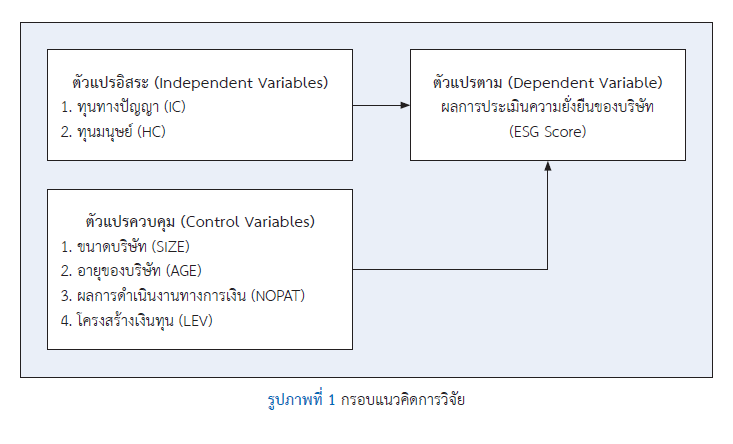
This study investigated the relationship between intellectual capital and the business sustainability assessment as measured by Environmental, Social, and Governance scores (ESG Score) of companies listed on the Stock Exchange of Thailand (SET). The research focused on analyzing the roles of Intellectual Capital (IC) and Human Capital (HC) in influencing ESG scores. Data was obtained from the London Stock Exchange Group (LSEG) database. The sample comprises 212 firm-year observations from 75 listed companies in the resources, property and construction, and technology sectors during the period 2022–2024. Multiple regression analysis was conducted using a Fixed Effects Model.
The empirical results revealed that both Intellectual Capital and Human Capital were positively and significantly associated with ESG Score, indicating that companies capable of efficiently managing and leveraging their intellectual capital and human capital tend to achieve higher sustainability ratings. Furthermore, leverage ratio, measured by the debt-to-equity ratio, is also found to have a significant positive relationship with the ESG Score. In contrast, firm size, firm age, and profitability, did not show any significant statistical association with ESG Score.
References
Al Amosh, H., Khatib, S. F., & Ananzeh, H. (2023). Environmental, social and governance impact on financial performance: Evidence from the Levant Countries. Corporate Governance: The International Journal of Business in Society, 23(3), 493-513.
Alves, C. F., & Meneses, L. L. (2024). ESG scores and debt costs: Exploring indebtedness, agency costs, and financial system impact. International Review of Financial Analysis, 94, 103240. https://doi.org/10.1016/j.irfa.2024.103240
Amitrano, C. C., Gheith, M. H., Troise, C., & Cappa, F. (2026). Individual and organizational intellectual capital, ESG dimensions and competitive advantage: A focus on Italian SMEs. Journal of Intellectual Capital, 27(1), 89-109. https://doi.org/10.1108/JIC-12-2024-0411
Asmawanti-S, D., & Wijayanti, I. O. (2017). Intellectual capital and corporate social responsibility in banking industries in Indonesia. Journal of Economics, Business, and Accountancy Ventura, 20(2), 191-200. https://doi.org/10.14414/jebav.v20i2.787
Bakry, A. E. A. (2022). Does intellectual capital efficiency improve the corporate social responsibility of Egyptian firms? Journal of Financial Reporting and Accounting, 20(3-4), 693-711. https://doi.org/10.1108/JFRA-09-2020-0269
Barney, J. (1991). Firm resources and sustained competitive advantage. Journal of Management, 17(1), 99-120. https://doi.org/10.1177/014920639101700108
Bodhanwala, S., & Bodhanwala, R. (2022). Exploring relationship between sustainability and firm performance in travel and tourism industry: A global evidence. Social Responsibility Journal, 18(7), 1251-1269.
Broadstock, D. C., Chan, K., Cheng, L. T. W., & Wang, X. (2021). The role of ESG performance during times of financial crisis: Evidence from COVID-19 in China. Finance Research Letters, 38, Article 101716. https://doi.org/10.1016/j.frl.2020.101716
Chantabutr, P., & Wuttichindanon, S. (2020). Definition, classification, measurement, and reporting of intellectual capital: A literature review. Journal of Management Sciences, Prince of Songkla University, 37(2), 165-194.
Chih, H.-L., Shen, C.-H., & Kang, F.-C. (2008). Corporate social responsibility, investor protection, and earnings management: Some international evidence. Journal of Business Ethics, 79(1-2), 179-198. https://doi.org/10.1007/s10551-007-9383-7
Eccles, R. G., Ioannou, I., & Serafeim, G. (2014). The impact of corporate sustainability on organizational processes and performance. Management Science, 60(11), 2835-2857. https://doi.org/10.1287/mnsc.2014.1984
Edvinsson, L. (1997). Developing intellectual capital at Skandia. Long Range Planning, 30(3), 366-373. https://doi.org/10.1016/S0024-6301(97)00016-2
Han, H., & Kim, Y. (2020). The impact of firm age on corporate social responsibility. In Proceedings of the 49th European Marketing Academy Conference (EMAC 2020) (Article A2020-62801). European Marketing Academy. https://proceedings.emac-online.org/pdfs/A2020-62801.pdf
Higgins, R. C. (1977). How Much Growth Can a Firm Afford? Financial Management, 6, 7-16. https://doi.org/10.2307/3665251
Kaplan, R. S., & Norton, D. P. (1992). The balanced scorecard--measures that drive performance. Harvard Business Review, 70(1), 71-79.
Kartadjumena, E., Djajadikerta, H. G., & Ng, C. (2011). The relationship of profit and corporate social responsibility disclosure: Survey on manufacture industry in Indonesia. In Proceedings of the 2nd International Conference on Business and Economic Research (2nd ICBER 2011) (pp. 662-674). Global Research Agency.
Kranraweekultana, W., Poungsangsuk, S., Maisak, R., & Kankomon, N. (2024). Environmental Social Governance (ESG) Responsibility and Intellectual Capital affect the Profitability of Companies Listed on the Stock Exchange of Thailand. SSRU Journal of Public Administration, 7(1), 67-81.
Kuzmin, E., Vlasov, M., Strielkowski, W., Faminskaya, M., & Kharchenko, K. (2024). Digitalization of the energy sector in its transition towards renewable energy: A role of ICT and human capital. Energy Strategy Reviews, 53, Article 101418. https://doi.org/10.1016/j.esr.2024.101418
LSEG. (2024). Environmental, Social, and Governance (ESG) Scores from LSEG. https://www.lseg.com/content/dam/dataanalytics/en_us/documents/methodology/lseg-esg-scores-methodology.pdf
Malik, M. (2015). Value-Enhancing Capabilities of CSR: A Brief Review of Contemporary Literature. Journal of Business Ethics, 127, 419-438. https://doi.org/10.1007/s10551-014-2051-9
Musibah, A. S., & Alfattani, W. S. B. W. Y. (2013). Impact of intellectual capital on corporate social responsibility: Evidence from Islamic banking sector in GCC. International Journal of Finance and Accounting, 2(6), 307-311. https://doi.org/10.5923/j.ijfa.20130206.01
Naeem, N., Cankaya, S., & Bildik, R. (2022). Does ESG performance affect the financial performance of environmentally sensitive industries? A comparison between emerging and developed markets. Borsa Istanbul Review, 22; S128-S140. https://doi.org/10.1016/j.bir.2022.11.014
Nimtrakoon, S. (2015). The relationship between intellectual capital, firms’ market value and financial performance Empirical evidence from the ASEAN. Journal of Intellectual Capital, 16(3), 587-618. https://doi.org/10.1108/JIC-09-2014-0104
Nurhayadi, W., Fitriani, H., Putri, R. A., Jamaludin, N., & Sucihati, S. (2025). The effect of social risk, intellectual capital, and HR policies on ESG performance of financial technology companies in West Java. West Science Social and Humanities Studies, 3(7), 1073-1087. https://doi.org/10.58812/wsshs.v3i07.2102
Obeidat, B.Y., Abdallah, A.B., Aqqad, N.O., Akhoershiedah, A.H.O.M., & Maqableh, M. (2016). The effect of intellectual capital on organizational performance: The mediating role of knowledge sharing. Communications and Network, 9(1), 1-27.
Ordóñez de Pablos, P. (2004). Human resource management systems and their role in the development of strategic resources: Empirical evidence. Journal of European Industrial Training, 28(6), 474-489. https://doi.org/10.1108/03090590410542701
Phondet, P., Waenkaeo, K., Bangmek, R., & Sumritsakun, C. (2021). Comparison of industry types on intellectual capital of Thai Listed Companies. Journal of Management Science Udon Thani Rajabhat University, 3(2), 21-32.
Porter, D. C., & Gujarati, D. N. (2009). Basic Econometrics. McGraw-Hill Education.
Promlao, K. (2021). What is ESG and why it is popular among investors today. TRIS Corporation Limited. https://www.tris.co.th/wp-content/uploads/2021/05/2564_Article_250564.pdf
Pulic, A. (2000). VAICTM – An accounting tool for IC management. International Journal of Technology Management, 20(5-8), 702-714. https://doi.org/10.1504/IJTM.2000.002891
Razafindrambinina, D., & Kariodimedjo, D. (2011). Is company intellectual capital linked to corporate social responsibility disclosure? Findings from Indonesia. Communications of the IBIMA, 2011, Article 511442. https://doi.org/10.5171/2011.511442
Sim-im, P. (2019). The relationship between intellectual capital and sustainable growth of companies listed on the Stock Exchange of Thailand. Ratchaphruek Journal, 17(1), 216-227.
Ståhle, P., Stahle, S. and S. Aho. (2011). Value added intellectual coefficient (VAIC): A critical Analysis. Journal of Intellectual Capital, 12(4), 247-268. https://doi.org/10.1108/14691931111181715
Stewart, T. A. (1997). Intellectual Capital. QFinance, 1, 1-4. https://www.scribd.com/document/446654031/Intellectual-Capital-pdf
Sumiati, & Isnaini, A. (2024). The power of green intellectual capital: Driving sustainability and profitability through ESG practice. Jurnal Aplikasi Manajemen, 22(4), 1135-1153. https://doi.org/10.21776/ub.jam.2024.022.04.14
Sunalai, P. (2022). The relationship between corporate governance and financial distress risk through intellectual capital of companies listed on the Stock Exchange of Thailand. [Unpublished independent study]. Thammasat University.
Sveiby, K. E. 1997. The New Organisational Wealth: Managing and Measuring Knowledge Based Assets. Berrett-Koehler.
The Stock Exchange of Thailand. (2025). Business Sustainability Trends: One Report. SET Sustainability. https://setsustainability.com/libraries/1038/item/-one-report-
Thongsaichon, N. (2022). ESG: Investing in the New Era. SET Investnow. https://www.setinvestnow.com/th/knowledge/article/165-tsi-invest-in-esg-stocks-in-new-investment-era
Ulum, I. (2014). Intellectual Capital Performance of Indonesian Banking Sector: A Modified VAIC (M-VAIC) Perspective. Asian Journal of Finance & Accounting, 6(2), 103-123. http://dx.doi.org/10.5296/ajfa.v6i2.5246
Vilalai, P., & Thaneerananon, A. (2025). Firm growth, cash holdings, and financial performance influencing the sustainability assessment of companies listed on the Stock Exchange of Thailand: Sustainable stocks group. Journal of Social Science and Culture, 9(6), 25-36.
Wang, C. (2024). The relationship between ESG performance and corporate performance–Based on stakeholder theory. SHS Web of Conferences, 190, 03022. https://doi.org/10.1051/shsconf/202419003022
Wimonanupong, K. (2021). The relationship between intellectual capital, growth opportunities, and firm performance of companies listed on the Stock Exchange of Thailand [Master’s thesis, Thammasat University].
Wisesight. (2025). What is ESG Score? A New Metric for Sustainable Organizations. https://wisesight.com/th/insights-hub/what-is-esg-score/
Wooldridge, J. M. (2016). Introductory Econometrics: A Modern Approach (6th ed.). Cengage Learning.
World Economic Forum. (2022). Fostering Effective Energy Transition 2022. World Economic Forum.
Xu, J., & Wang, B. (2018). Intellectual capital, financial performance and companies’ sustainable growth: Evidence from the Korean manufacturing industry. Sustainability, 10(12), Article 4651. https://doi.org/10.3390/su10124651
Downloads
Published
How to Cite
Issue
Section
License
Copyright (c) 2026 NIDA Business School, National Institute of Development Administration

This work is licensed under a Creative Commons Attribution-NonCommercial-NoDerivatives 4.0 International License.