A Systematic Literature Review and Framework Development: Integrating Literacy for Financial Well-being in the Digital Era
Keywords:
Integrating Literacy, Systematic Literature Review (SLR), Financial Well-being, Digital AgeAbstract
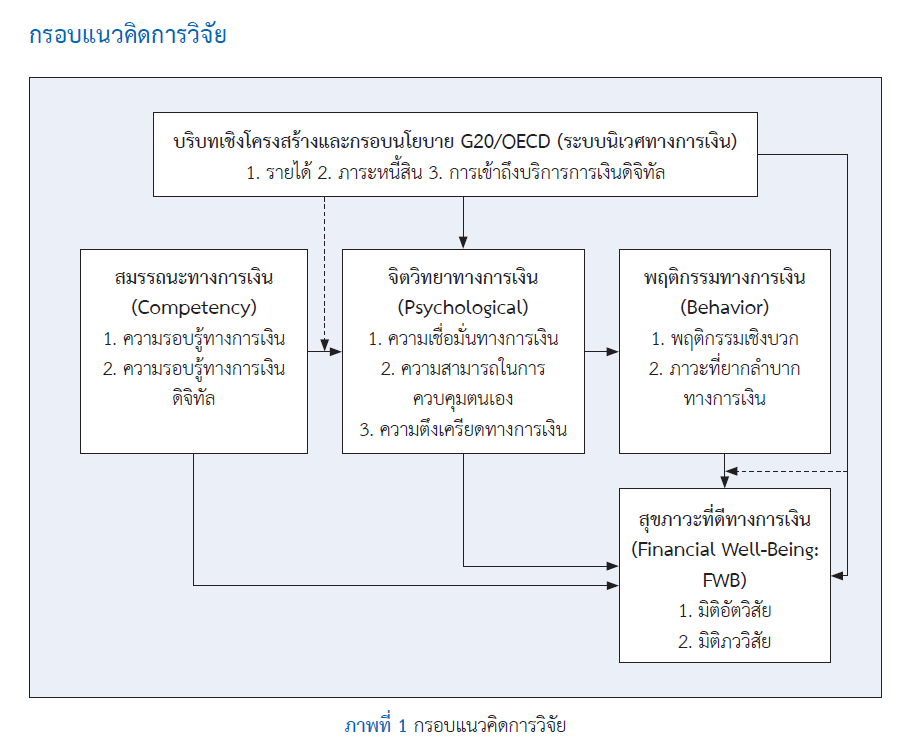
Financial Well-being (FWB) serves as a pivotal metric for economic stability and individual quality of life. Thailand currently faces a significant structural challenge with household debt reaching 85–90% of GDP, compounded by the rapid expansion of digital financial technology, which escalates decision-making risks. This article aims to synthesize the determinants of financial well-being and develop an integrated conceptual framework interconnecting financial competence, financial psychological, financial behaviors, and structural context and policy framework. The study employs a Systematic Literature Review (SLR) of 20 empirical articles published between 2020 and 2025 from standardized databases. Thematic synthesis was utilized to analyze the patterns of relationship between variables. The findings categorize financial well-being determinants into four primary themes: 1) financial competence, 2) financial psychological, 3) financial behavior, and 4) structural context and policy framework. A critical finding reveals that positive financial behavior and self-control act as essential mediators, transforming financial literacy into financial well-being outcomes across both subjective and objective dimensions. The developed integrated framework aligns with the international guidelines of the G20/OECD. Enhancing the financial well-being of the Thai populace requires a paradigm shift beyond mere literacy to emphasize behavioral modification alongside structural reforms and digital consumer protection. This framework provides a robust foundation for designing public policies to address financial vulnerability sustainably.
References
Almeida, F., Silva, P., & Domingos, C. (2025). Digital financial literacy: A systematic review. Acta Universitatis Danubius. Œconomica, 21(5), 132–147.
Anghel, M., & Pochea, M. M. (2025). Financial literacy and financial well-being: Empirical evidence from Romania. Borsa Istanbul Review, 1-7. https://doi.org/10.1016/j.bir.2025.100776
Anjani, D. D., & Wulandari, S. (2024). The influence of income level, financial behavior and financial management on financial well being in the sandwich generation (study in Sukaragam village, Serang Baru district). Dinasti International Journal of Economics, Finance & Accounting, 5(3), 970–977. https://doi.org/10.38035/dijefa.v5i3
Bank of Thailand. (2024). Financial stability report 2024. https://www.bot.or.th/content/dam/bot/documents/en/research-andpublications/reports/financial-stability-report/FSR2024e.pdf
Brüggen, E. C., Hogreve, J., Holmlund, M., Kabadayi, S., & Löfgren, M. (2017). Financial well-being: A conceptualization and research agenda. Journal of Business Research, 79, 228–237. https://doi.org/10.1016/j.jbusres.2017.03.013
Budiyanto, A., Mujib, A., Al Arif, M. N. R., & Prasetyowati, R. A. (2024). Factors affecting financial well-being: The mediating role of financial behavior towards religiosity and anti-consumption lifestyle – evidence from Indonesia. Investment Management and Financial Innovations, 21(3), 187–198.
Bushra & Mir, M. A. (2024). Digital financial literacy and financial well-being. In G. Malik, R. Bansal, S. Gupta, & Y. Ansari (Eds.). Emerging perspectives on financial well-being (pp.57–73). IGI Global Scientific Publishing. https://doi.org/10.4018/979-8-3693-1750-1.ch003.
Castro González, S., Fernández López, S., Rey Ares, L., & Rodeiro Pazos, D. (2020). The influence of attitude to money on individuals’ financial well being. Social Indicators Research, 148, 747–764. https://doi.org/10.1007/s11205-019-02219-4
Consumer Financial Protection Bureau. (2015). Financial well-being: The goal of financial education. https://files.consumerfinance.gov/f/201501_cfpb_report_financial-well-being.pdf
Dare, S. E., van Dijk, W. W., van Dijk, E., van Dillen, L. F., Gallucci, M., & Simonse, O. (2023). How executive functioning and financial self efficacy predict subjective financial well being via positive financial behaviors. Journal of Family and Economic, 44, 232–248. https://doi.org/10.1007/s10834-022-09845-0
Firza, S. U., Agustina, A., Halim, F., & Mie, M. (2025). Factors influencing financial well being among gen z in the digital era. Journal of Economics, Finance and Management Studies, 8(12), 7765–7774. https://doi.org/10.47191/jefms/v8-i12-20
Gumbo, L. (2025). Digital financial literacy: A systematic review. Acta Universitatis Danubius. Œconomica, 21(5), 132–147. https://dj.univ-danubius.ro/index.php/AUDOE/article/view/3497
G20/OECD. (2024). G20 policy note on financial well-being. https://www.oecd.org/en/publications/2024/11/g20-policy-note-on-financial-well-being_5eade0bc.html
Hernandez Perez, J., & Cruz Rambaud, S. (2025). Uncovering the factors of financial well being: The role of self control, self efficacy and financial hardship. Future Business Journal, 11(70). https://doi.org/10.1186/s43093-025-00498-7
International Monetary Fund. (2025). Thailand can ease household debt burden by using a coordinated approach. https://www.imf.org/en/News/Articles/2025/04/09/cf-thailand-can-ease-household-debt-burden-by-using-coordinated-approach
Joo, S. (2008). Personal financial wellness. I: J. J. Xiao (Eds.). Handbook of consumer finance research (pp. 21-33). Springer. https://doi.org/10.1007/978-0-387-75734-6_2
Krungsri Research. (2025). Thai household assets and debt post COVID-19: Warning signs of financial vulnerability. https://www.krungsri.com/en/research/research-intelligence/household-wealth-2025
Kumar, P., Ahlawat, P., Deveshwar, A., & Yadav, M. (2025). Do villagers’ financial socialization, financial literacy, financial attitude and financial behavior predict their financial well being? evidence from an emerging India. Journal of Family and Economic Issues, 46, 802–820. https://doi.org/10.1007/s10834-024-09976-6
Lambert, M. J. C. M., Jusoh, Z. M., Abd Rahim, H., & Zainudin, N. (2023). Factors affecting financial well-being of millennials: A systematic review. Information Management and Business Review, 15(2(I)SI), 98-108. https://doi.org/10.22610/imbr.v15i2(I)SI.3424
Lusardi, A., & Mitchell, O. S. (2014). The economic importance of financial literacy: Theory and evidence. Journal of Economic Literature, 52(1), 5–44. https://doi.org/10.1257/jel.52.1.5
Morgan, P. J., Huang, B., & Trinh, L. Q. (2019). The need to promote digital financial literacy for the digital age. Asian Development Bank Institute, 40-43. https://www.adb.org/sites/default/files/publication/503706/adbi-realizing-education-all-digital-age.pdf#page=56
Netemeyer, R. G., Warmath, D., Fernandes, D., & Lynch, J. G. (2018). How Am I Doing? perceived financial well-being, its potential antecedents, and its relation to overall well‑being. Journal of Consumer Research, 45(1), 68–89. https://doi.org/10.1093/jcr/ucx109
OECD. (2021). Digital financial literacy: Toolkit for measurement. https://www.oecd.org/finance/financial-education/digital-financial-literacy-toolkit.htm
OECD. (2024). OECD/INFE survey instrument to measure digital financial literacy. https://www.oecd.org/en/publications/oecd-infe-survey- instrument-to-measure-digital-financial-literacy_548de821-en.html
Santini, F. O., Mette, F., Carvalho, B. P., Ladeira, W. J., & Sampaio, C. H. (2025). Drivers and outcomes of financial well-being. RAM – Revista de Administração Mackenzie, 26(4), eRAMR250094. https://doi.org/10.1590/1678-6971/eRAMR250094
Singh, S., Jaiswal, A., Rai, A. K., & Kumar, A. (2024). Moderating role of fintech adoption on relationship between financial literacy and financial well-being. Educational Administration: Theory and Practice, 30(4), 7597–7607. https://doi.org/10.53555/kuey.v30i4.1351
Subaida, I. (2024). The influence of financial behavior on financial well-being through financial satisfaction. Jurnal Ekonomi Pembangunan, 22(01), 30–39. https://doi.org/10.22219/jep.v22i01.29654
Suprapto, Y. (2020). Analysis of factors affecting financial well-being millennial generation in Batam. Journal of Global Business and Management Review, 2(1), 33–40.
Utami, N. M., Pradana, M., & Hidayat, A. M. (2025). Financial literacy and fintech use’s effects on Indonesian young adults’ financial well-being: Financial behavior as a mediation variable. Journal of Ecohumanism, 4(1), 1288–1298. https://doi.org/10.62754/joe.v4i1.5943
Uttarin & Nittayakamolphun. (2023). Factors influencing financial well-being among workers in Buriram municipality. Economics and Business Administration Journal Thaksin University, 16(13), 97-112. https://doi.org/10.55164/ecbajournal.v16i3.267020 (in Thai)
Weerasinghe H. A., Samarakoon S.M.A.K., & Malalage G. S. (2025). Factors affecting personal financial well-being of young working adults in Colombo district, Sri Lanka. Journal of Business and Technology, 9(1), 66-84. https://jbt.sljol.info/articles/10.4038/jbt.v9i1.139
Yadav, M., & Banerji, P. (2024). Systematic literature review on digital financial literacy. SN Bus Econ, 4(142), 1-25. https://doi.org/10.1007/s43546-024-00738-y
Yadav, R. A., & Venugopal, M. (2025). Exploring the nexus between mobile payments, digital financial literacy and financial well-being: A systematic literature review. Journal of Marketing & Social Research, 2(4), 320–330.
Downloads
Published
How to Cite
Issue
Section
License
Copyright (c) 2026 NIDA Business School, National Institute of Development Administration

This work is licensed under a Creative Commons Attribution-NonCommercial-NoDerivatives 4.0 International License.