The Interactive Mechanism Between Social Embeddedness and Resource Orchestration: A Case Study of Logistic Company in Thailand
Keywords:
Social embeddedness, Resource orchestration, Dual-engine drive, Emerging marketsAbstract
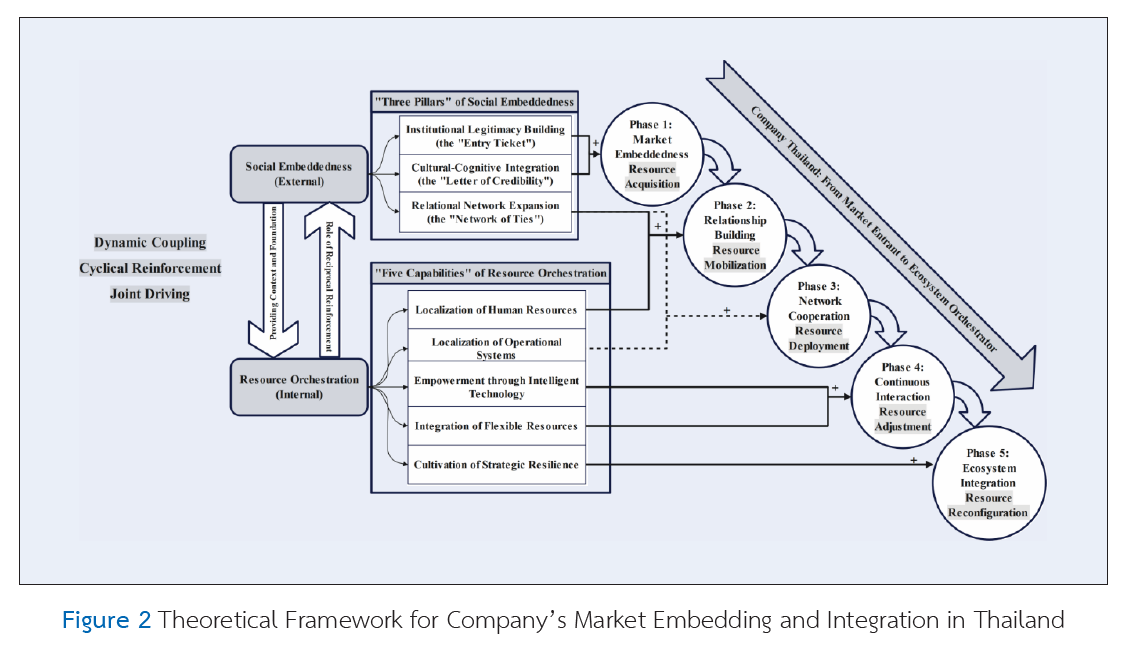
This paper examines the outsider disadvantage faced by cross-border logistics enterprises in emerging markets against the backdrop of global value chain restructuring and digital trade development. Through a case study of logistic company in the Thai market employing grounded theory methodology, it reveals how enterprises achieve sustainable growth through the interplay of social embedding and resource orchestration. The research proposes a ‘dual-drive mechanism for cross-market embedding and integration’: social embedding provides the legitimacy foundation and initial capital for resource orchestration, while effective resource orchestration, through value creation, reinforces and deepens social embedding. Together, these two drivers propel the enterprise from market entry to strategic leapfrogging into ecosystem leadership. The primary contribution lies in integrating social embeddedness and resource orchestration theories, revealing their synergistic dynamics. This offers a dynamic, integrated analytical framework for understanding complex corporate adaptation in emerging markets, providing systematic insights for practice.
References
Eisenhardt, K. M., & Schoonhoven, C. B. (1996). Resource-based view of strategic alliance formation: Strategic and social effects in entrepreneurial firms. Organization Science, 7(2), 136–150. https://doi.org/10.1287/orsc.7.2.136
Granovetter, M. (1985). Economic action and social structure: The problem of embeddedness. American Journal of Sociology, 91(3), 481–510. https://doi.org/10.1086/228311
Gulati, R. (1998). Alliances and networks. Strategic Management Journal, 19(4), 293–317. https://sms.onlinelibrary.wiley.com/doi/10.1002/(SICI)1097-0266(199804)19:4%3C293::AID-SMJ982%3E3.0.CO;2-M
Huang, S., Liu, W., & Lin, Y. (2025). 新兴市场跨国公司获取国际化多重合法性的机理及策略研究 [Mechanisms and strategies for emerging-market multinationals to obtain multiple legitimacies in internationalization]. 研究与发展管理, 37(2), 176–189. https://doi.org/10.13581/j.cnki.rdm.20241117
Kostova, T., & Zaheer, S. (1999). Organizational legitimacy under conditions of complexity: The case of the multinational enterprise. Academy of Management Review, 24(1), 64–81. https://doi.org/10.2307/259037
Lee, R. (2017). Entrepreneurial newcomers: Resources and social embeddedness. In The social capital of entrepreneurial newcomers. Palgrave Macmillan. https://doi.org/10.1057/978-1-137-59820-2_2
Li, L. (2024). 极兔的本地化策略及对中国快递企业“出海”的经验借鉴 [J&T’s localization strategy and lessons for Chinese express delivery firms’ overseas expansion]. 邮政研究, 40(5), 79–84. https://doi.org/10.13955/j.yzyj.2024.05.13.06
Shane, S., & Venkataraman, S. (2000). The promise of entrepreneurship as a field of research. Academy of Management Review, 25(1), 217–226. https://doi.org/10.2307/259271
Sirmon, D. G., Hitt, M. A., & Ireland, R. D. (2007). Managing firm resources in dynamic environments to create value: Looking inside the black box. Academy of Management Review, 32(1), 273–292. https://doi.org/10.5465/amr.2007.23466005
Sirmon, D. G., Hitt, M. A., Ireland, R. D., & Gilbert, B. A. (2011). Resource orchestration to create competitive advantage: Breadth, depth, and life cycle effects. Journal of Management, 37(5), 1390–1412. https://doi.org/10.1177/0149206310385695
Suchman, M. C. (1995). Managing legitimacy: Strategic and institutional approaches. Academy of Management Review, 20(3), 571–610. https://doi.org/10.5465/amr.1995.9508080331
Swedberg, R. (1991). Major traditions of economic sociology. Annual Review of Sociology, 17(1), 251–276. https://doi.org/10.1146/annurev.so.17.080191.001343
Teece, D. J., Pisano, G., & Shuen, A. (1997). Dynamic capabilities and strategic management. Strategic Management Journal, 18(7), 509–533. https://doi.org/10.1016/B978-0-7506-7088-3.50009-7
Tian, L. (2025). 泰国快递物流产业:效率提升与价格竞争在平衡木上“共舞” [Thailand’s express logistics industry: Efficiency improvement and price competition “dancing” on a balance beam]. 中国对外贸易, (04), 64–65.
Vestrum, I., & Rasmussen, E. (2013). How community ventures mobilise resources: Developing resource dependence and embeddedness. International Journal of Entrepreneurial Behavior & Research, 19(3), 283–302. https://doi.org/10.1108/13552551311330183
Zaheer, S. (1995). Overcoming the liability of foreignness. Academy of Management Journal, 38(2), 341–363. https://doi.org/10.2307/256683
Zhang, Q., & Hua, Z. (2020). 资源编排理论及其研究进展述评 [Resource orchestration theory and its research progress: A review]. 经济管理, 42(9), 193–208. https://doi.org/10.19616/j.cnki.bmj.2020.09.012
Zhao, Y., & Cheng, Q. (2022). 创新生态系统中核心企业如何实现跨界资源整合? [How do core firms in innovation ecosystems achieve cross-boundary resource integration?]. 科学学与科学技术管理, 43(5), 100–116. https://doi.org/10.20201/j.cnki.ssstm.2022.05.007
Downloads
Published
How to Cite
Issue
Section
License
Copyright (c) 2026 NIDA Business School, National Institute of Development Administration

This work is licensed under a Creative Commons Attribution-NonCommercial-NoDerivatives 4.0 International License.