Factors Influencing the Effective Use of Information Literacy in Pre-service Teachers in Thailand: The Mediating Role of Information Technology Usage
DOI:
https://doi.org/10.60101/jimc2026.2801คำสำคัญ:
IT Management , Teaching Skills, Use of Information Technology, Information Literacy, SEMบทคัดย่อ
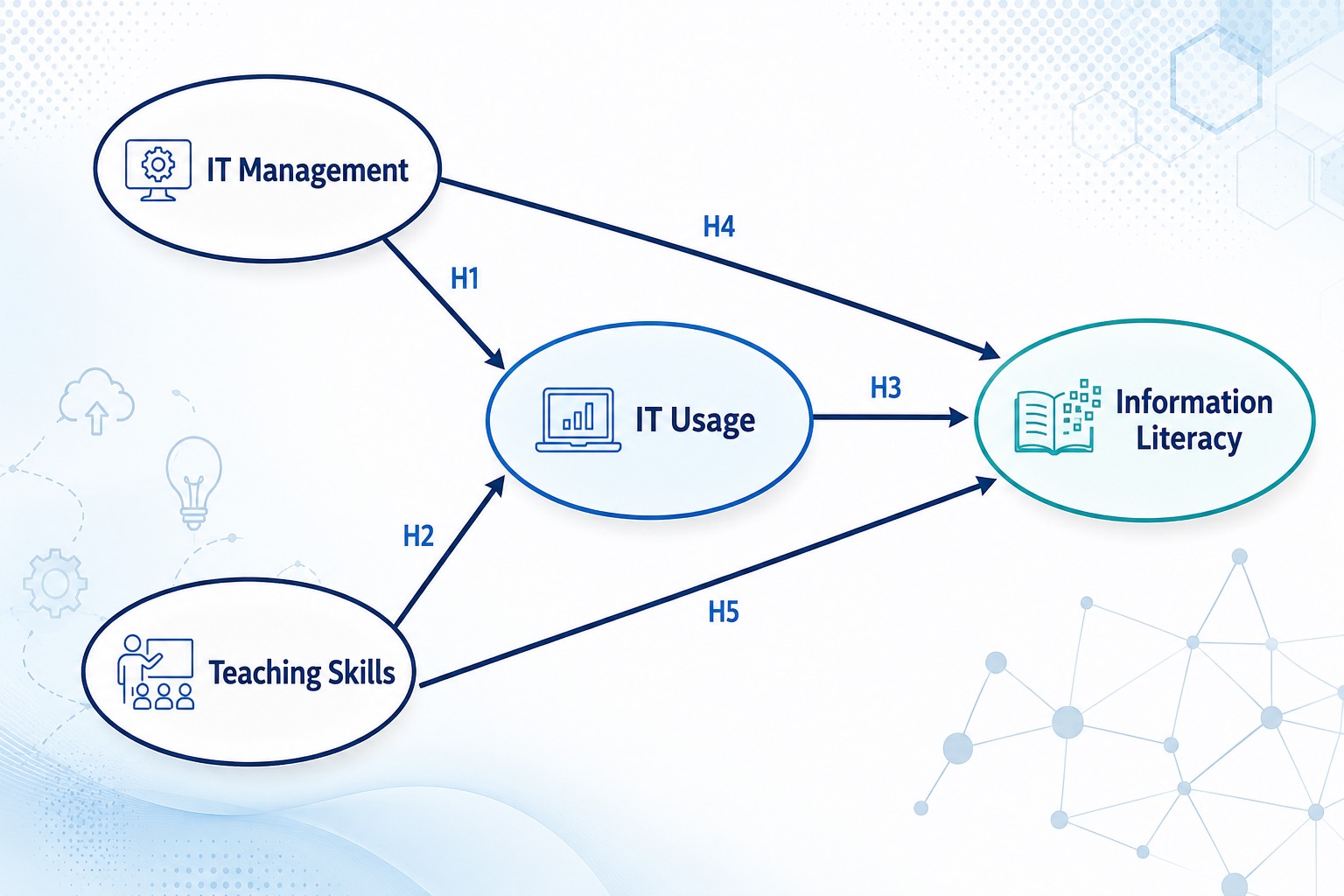
This research aimed to investigate the impact factors that influence the Information Literacy (IL) of Thailand’s pre-service teachers; and the roles of learning outcomes, including the causal relationship between Information Technology (IT) management, Teaching Skills (TS), and IT usage that affect the manipulation of the IL. The research employed a stratified random sampling approach, recruiting a total of 618 verified participants from five universities located in five regions of Thailand, and using a questionnaire survey method. The reliability of the research instrument accuracy was 0.8, based on structure equation modeling, while the GFI, CFI, AGFI, RMSEA, and SRMR values were 0.95, 1.00, 0.92, 0.045, and 0.02, respectively. Testing for the influence of the mediator variable indicated that the direct influence of IT management and TS on IL was 0.05 and 0.25, respectively, while the indirect influence of IT management and TS on IL through the mediator variable of the IT usage was 0.147 and 0.39, respectively. Thus, this study revealed that the mediator variable of the IT usage affected IL.
เอกสารอ้างอิง
Adams, C., et al. (2016). A collaborative approach to integrating information and academic literacy into the curricula of research methods courses. The Journal of Academic Librarianship, 42(3), 222–231.
Altbach, P. G. (2007). The underlying realities of higher education in the 21st century. In P. G. Altbach & P. M. Peterson (Eds.), Higher education in the new century: Global challenges and innovative ideas (pp. 17–24). Sense.
American Institute for Research. (2004). Evaluation of the school technology leadership initiative: External evaluation report #1. University of Minnesota.
American Library Association. (2020). Pandemic preparedness. http://www.ala.org/tools/atoz/pandemic-preparedness
Amornsiriphong, W. (2018). Information literacy of Nakhon Pathom Rajabhat University undergraduate students. Journal of Information Science, 36(3), 42–66.
Anderson, J. C., & Gerbing, D. C. (1988). Structural equation modeling in practice: A review and recommended two-step approach. Psychological Bulletin, 103(3), 411–423.
Argote, L. (2017). Organizational learning and management of technology. Production and Operations Management, 26(4), 579–590.
Association of College and Research Libraries. (2000). Information literacy competency standards for higher education. http://www.ala.org/ala/acrl/acrlstandards/informationliteracycompetency.cfm
Association of College and Research Libraries. (2016). Framework for information literacy for higher education. http://www.ala.org/acrl/sites/ala.org.acrl/files/content/issues/infolit/framework1.pdf
Association of College and Research Libraries. (2017). Global perspectives on information literacy:
Fostering a dialogue for international understanding. https://www.ala.org/sites/default/ files/acrl/content/ publications/whitepapers/GlobalPerspectives_InfoLit.pdf
Association of College and Research Libraries. (2020). Pandemic resources for academic libraries. https://acrl.libguides.com/pandemic
Ata, R., & Yildirim, K. (2019). Exploring Turkish pre-service teachers’ perceptions and views of digital literacy. Education Sciences, 9(1), Article 40. https://doi.org/10.3390/educsci9010040
Baggia, A., et al. (2016). Factors influencing the information literacy of students: Preliminary analysis.
BLED 2016 Proceedings 2 (pp. 617-631). Association for Information Systems.
Bagozzi, R., & Yi, Y. (1988). On the evaluation of structural equation models. Journal of the Academy of Marketing Sciences, 16, 74–94.
Bailey, K. M. (1998). Learning about language assessment: Dilemmas, decisions, and directions. Heinle & Heinle.
Belay, M., et al. (2021). Investigate knowledge management technology implementation for supporting decision making in Ethiopian health sectors. BMC Medical Informatics and Decision Making, 21, Article 146. https://doi.org/10.1186/s12911-021-01507-9
Benson, D. A. (2002). The use of technology in the digital workplace: A framework for human resource development. Advances in Developing Human Resources, 4(4), 392–404.
Bereiter, C., & Scardamalia, M. (2006). Education for the knowledge age. In P. A. Alexander & P. H. Winne (Eds.), Handbook of educational psychology (2nd ed., pp. 695–713). Lawrence Erlbaum.
Berphan, C. (2012). Information literacy behavior of Chulalongkorn University students. Library Science Journal, 32(2), 25–38.
Bidabadi, N. S., et al. (2016). Effective teaching methods in higher education: Requirements and barriers. Journal of Advances in Medical Education & Professionalism, 4(4), 170-178.
Brown, M. W., & Cudeck, R. (1993). Alternative ways of assessing model fit. In K. A. Bollen & J. S. Long (Eds.), Testing structural equation models (pp. 136–162). Sage.
Burbules, N. (2018). Watch IT: The risks and promises of information technologies for education. Routledge. https://doi.org/10.4324/9780429503153
Chau, P. Y., & Hu, P. J. H. (2001). Information technology acceptance by individual professionals:
A model comparison approach. Decision Sciences, 32(4), 699–719.
Chen, Y. H., & Chengalur-Smith, I. (2015). Factors influencing students' use of a library web portal: Applying course-integrated information literacy instruction as an intervention. The Internet and Higher Education, 26, 42–55.
Chotijirawattana, S. (2019). Assessment of the needs for information and communication technology to support health literacy in the learning center for the elderly in Bangkok Metropolis and its vicinities. The Journal of Library and Information Science Srinakharinwirot University, 12(2), 71–85.
CILIP. (2020). CILIP coronavirus information service. https://www.cilip.org.uk/news/493378/CILIP-Coronavirus-Information-Service.htm
Cordell, R. M. (2013). Information literacy and digital literacy: Competing or complementary? Communications in Information Literacy, 7(2), 177–183.
Demirel, M., & Akkoyunlu, B. (2017). Prospective teachers lifelong learning tendencies and information literacy self-efficacy. Educational Research and Reviews, 12(6), 329–337.
Drossel, K., et al. (2017). Predictors of teachers’ use of ICT in school–the relevance of school characteristics, teachers’ attitudes and teacher collaboration. Education and Information Technologies, 22(2), 551–573. https://doi.org/10.1007/s10639-016-9476-y
Dubicki, E. (2019). Mapping curriculum learning outcomes to ACRL's framework threshold concepts: A syllabus study. The Journal of Academic Librarianship, 45, 288–298.
Durodolu, O. O. (2016). Technology acceptance model as a predictor of using information system to acquire information literacy skills. Library Philosophy and Practice.
Earle, R. (2002). The integration of instructional technology into public education: Promises and challenges. Educational Technology, 42(1), 5–13.
Falloon, G. (2020). From digital literacy to digital competence: The teacher digital competency (TDC) framework. Educational Technology Research and Development, 68(5), 2449–2472.
https://doi.org/10.1007/s11423-020-09767-4
Fedorov, A., & Mikhaleva, G. (2020). Current trends in media and information literacy in research and scientific publications of the early 21st century. International Journal of Media and
Information Literacy, 5(2), 153–163. https://doi.org/10.13187/ijmil.2020.2.153
Flierl, M., et al. (2017). IMPACT lessons: Strategically embedding media and information literacy through teacher development in higher education. In Media and information literacy in higher education (pp. 119–133). Chandos Publishing.
Foo, S., et al. (2013). Information literacy skills of humanities, arts, and social science tertiary students in Singapore. Reference and User Services Quarterly, 53, 40–50.
Fox, R., & Henri, J. (2005). Understanding teacher mindsets: IT and change in Hong Kong schools. Educational Technology & Society, 8(2), 161–169.
George, C. A., et al. (2006). Scholarly use of information: Graduate students' information seeking behaviour. Information Research, 11(4), Article 273.
Gilman, N. V., et al. (2017). A faculty–librarian collaboration success story: Implementing a teach-the-teacher library and information literacy instruction model in a first-year agricultural science course. Library Trends, 65(3), 339–358. https://doi.org/10.1353/lib.2017.0005
Godbey, S. (2018). Testing future teachers: A quantitative exploration of factors impacting the information literacy of teacher education students. College and Research Libraries, 79(5),
–623. http://dx.doi.org/10.5860/crl.79.5.611
Gounaris, S., & Dimitriadis, S. (2003). Assessing service quality on the web: Evidence from business-
to-consumer portals. Journal of Services Marketing, 17(5), 529–548.
Govindasamy, T. (2002). Successful implementation of e-learning: Pedagogical considerations. The
Internet and Higher Education, 4(3–4), 287–299.
Goyal, E., et al. (2010). Factors that affect information and communication technology usage: A case study in management education. Journal of Information Technology Management, 21(4), 38–57.
Greenhow, C., Robelia, B., & Hughes, J. E. (2009). Web 2.0 and classroom research: What path should we take now? Educational Researcher, 38(4), 246–259.
Guo, J., & Huang, J. (2021). Information literacy education during the pandemic: The cases of academic libraries in Chinese top universities. The Journal of Academic Librarianship, 47(4), 102363. https://doi.org/10.1016/j.acalib.2021.102363
Hair, J. F., et al. (2006). Multivariate data analysis (6th ed.). Prentice Hall.
Hair, J. F., et al. (2010). Multivariate data analysis (7th ed.). Prentice Hall.
Hammons, J. (2020). Teaching the teachers to teach information literacy: A literature review. The Journal of Academic Librarianship, 46(5), 102196. https://doi.org/10.1016/j.acalib.2020.102196
Harris, B. R. (2013). Subversive infusions: Strategies for the integration of information literacy across
the curriculum. The Journal of Academic Librarianship, 39(2), 175–180.
Hatlevik, O. E., et al. (2018). Students’ ICT self-efficacy and computer and information literacy: Determinants and relationships. Computers & Education, 118, 107–119.
Hee, O. C., et al. (2019). Exploring lifelong learning outcomes among adult learners via goal orientation and information literacy self-efficacy. International Journal of Evaluation and Research in Education, 8(4), 616–623.
Hiangrat, P., Sacchanand, C., & Choemprayong, S. (2018). Information literacy of undergraduate students of Rajabhat universities. TLA Research Journal, 11(1), 33–47.
Hu, L. T., & Bentler, P. M. (1999). Cutoff criteria for fit indexes in covariance structure analysis: Conventional criteria versus new alternatives. Structural Equation Modeling, 6(1), 1–55.
Hughes, C. (2010). People as technology conceptual model: Toward a new value creation paradigm for strategic human resource development. Human Resource Development Review, 9(1), 48–71.
Humrickhouse, E. (2021). Flipped classroom pedagogy in an online learning environment: A self- regulated introduction to information literacy threshold concepts. The Journal of Academic Librarianship, 47(2), Article 102327. https://doi.org/10.1016/j.acalib.2021.102327
IFLA. (2020). How to spot fake news – COVID-19 edition. https://www.ifla.org/publications/node/93015/
Information Literacy Group. (2020). COVID-19 and information literacy: A selective list of useful resources. https://infolit.org.uk/further-reading/covid-19-and-il/
Information Literacy Spaces. (2020). PISA’s warning: Teachers need to teach information literacy explicitly if we are to reverse the decline. https://informationliteracyspaces.wordpress. com/2020/02/24/pisas-warning-teachers-need-to-teach-information-literacy-explicitly-if-we-are-to-reverse-the-decline/
Inglehart, R. (2018). Culture shift in advanced industrial society. Princeton University Press.
Jackman, L. W., & Weiner, S. A. (2017). The rescinding of the ACRL 2000 information literacy competency standards for higher education—Really?? College & Undergraduate Libraries, 24(1), 117–119.
Jameson, J., & Walsh, M. E. (2017). Tools for evidence-based vascular nursing practice: Achieving information literacy for lifelong learning. Journal of Vascular Nursing, 35(4), 201–210. https://doi.org/10.1016/j.jvn.2017.07.003
Jang, M., et al. (2021). The impact of literacy on intention to use digital technology for learning: A comparative study of Korea and Finland. Telecommunications Policy, 45(7), Article 102154.
Jinchi, Z., & Jie, H. (2021). Information literacy education during the pandemic: The cases of academic libraries in Chinese top universities. The Journal of Academic Librarianship, 47(4), Article 102363. https://doi.org/10.1016/j.acalib.2021.102363
Johnson, H. A., & Barrett, L. (2017). Your teaching strategy matters: How engagement impacts application in health information literacy instruction. Journal of the Medical Library Association, 105(1),
–48. https://doi.org/10.5195/jmla.2017.8
Jonassen, D., Howland, J., Marra, R., & Crismond, D. (2008). Meaningful learning with technology (3rd ed.). Pearson.
Jones, C., & Pimdee, P. (2017). Innovative ideas: Thailand 4.0 and the fourth industrial revolution. Asian International Journal of Social Sciences, 17(1), 4–35.
Karpati, A. (2011). Digital literacy in education. UNESCO Institute for Information Technologies in Education.
Kemp, S. (2025). Digital 2025: Thailand. https://datareportal.com/reports/digital-2025-thailand
Khailova, L. (2021). Using curriculum mapping to scaffold and equitably distribute information literacy instruction for graduate professional studies programs. The Journal of Academic Librarianship, 47(1), Article 102281. https://doi.org/10.1016/j.acalib.2020.102281
Khammanee, T. (2012). Science of teaching: Knowledge for effective learning process management (16th ed.). Chulalongkorn University Press. (in Thai)
Khan, B. (2005). E-learning quick checklist. Information Science Publishing.
Kingsawat, K., et al. (2015). Components and factors in integrating information literacy instruction in elementary education using a virtual learning environment. LIBRES, 25(1), 50–77.
Kirschner, P. A. (2015). Do we need teachers as designers of technology-enhanced learning? Instructional Science, 43(2), 309–322.
Kline, P. (1994). An easy guide to factor analysis. Routledge.
Kongchawan, S. (2013). Development of personnel potential in IT system usage within the Subdistrict Administrative Organization of Kuansri, Baan Nasarn, Surat Thani. Veridian E-Journal, 6(3), 228–247.
Kozikoglu, I., & Onur, Z. (2019). Predictors of lifelong learning: Information literacy and academic self-efficacy. Cypriot Journal of Educational Sciences, 14(4), 492–506.
Kraisuth, D., & Panjakajornsak, V. (2017). Thai engineer ASEAN readiness: A structural equation model analysis. Asia-Pacific Social Science Review, 16(3), 64-85.
Kuglitsch, R. (2015). Teaching for transfer: Reconciling the framework with disciplinary information literacy portal. Portal: Libraries and the Academy, 15(3), 457–470.
Lai, P. C. (2017). The literature review of technology adoption models and theories for the novelty technology. Journal of Information Systems and Technology Management, 14(1), 21–38.
Lau, M. M. (2006). The brand loyalty of sportswear in Hong Kong. Journal of Textile and Apparel, Technology and Management, 5(1), 1–13.
Law, N., et al. (2018). A global framework of reference on digital literacy skills for indicator 4.4.2. UNESCO Institute for Statistics. https://unesdoc.unesco.org/ark:/48223/pf0000265403
Leahy, D., & Dolan, D. (2010, September). Digital literacy: A vital competence for 2010? In IFIP international conference on key competencies in the knowledge society (pp. 210–221). Springer.
Lokse, M., et al. (2017). Teaching information literacy in higher education: Effective teaching and active learning. Chandos Publishing.
Lorenz, R., et al. (2019). Predictors of fostering students’ computer and information literacy–analysis based on a representative sample of secondary school teachers in Germany. Education and Information Technologies, 24(1), 911–928. https://doi.org/10.1007/s10639-018-9809-0
Malik, S., Chetty, M., & Chadhar, M. A. (2018). Information technology and organizational learning interplay: A survey. Australasian Conference on Information Systems (pp. 1-10). https://storage.googleapis.com/rua-utsepress/files/books/41/ba857e79-78f2-4fd1-935d-6285 5443b761.pdf
Mamak, C. (2010). Business information literacy of undergraduate students in the faculty of
business administration of the private universities in Bangkok metropolitan area [Master’s thesis]. Srinakharinwirot University.
Marsh, H. W., & Hocevar, D. (1985). Application of confirmatory factor analysis to the study of self-
concept: First-and higher order factor models and their invariance across groups. Psychological Bulletin, 97(3), 562–582.
Maybee, C. (2005). Undergraduate women’s conceptions of information use [Master’s thesis, San Jose State University]. ProQuest Dissertations and Theses Global.
McKeever, C., et al. (2017). School library staff perspectives on teacher information literacy and collaboration. Journal of Information Literacy, 11(2), 51–68.
Misirli, Z. A., & Akbulut, Y. (2013). Development of a scale to explore technology literacy skills of Turkish 8th graders. Contemporary Educational Technology, 4(4), 249–262.
Moreno-Morilla, C., et al. (2021). Digital and information literacy inside and outside Spanish primary education schools. Learning, Culture and Social Interaction, 28, Article 100455. https://doi.org/10.1016/j.lcsi.2020.100455
Moto, S., et al. (2018). A Thai junior high school students' 21st century information literacy, media literacy, and ICT literacy skills factor analysis. International Journal of Emerging Technologies in Learning, 13(9), 87–106. https://doi.org/10.3991/ijet.v13i09.8355
Mukherjee, N. (2011). Non-replicated dynamic fragment allocation in distributed database systems. In: Meghanathan, N., Kaushik, B.K., Nagamalai, D. (eds) Advances in Computer Science and Information Technology. CCSIT 2011. Communications in Computer and Information Science, Vol. 131. https://doi.org/10.1007/978-3-642-17857-3_55
National School Boards Association. (2007). Creating & connecting: Research and guidelines on online social - and educational - networking. https://cdn-files.nsba.org/s3fs-public/reports/ CREATING-CONNECTING-Research-and-Guidelines-on-Online-Social-and-Educational-Networking.pdf
Nilsuk, P. (2008). Management of information technology: Thailand’s development tool. Journal of Information and Learning, 19(3), 34-46.
Pheeraphan, N. (2013). Enhancement of the 21st century skills for Thai higher education by integration of ICT in classroom. Procedia-Social and Behavioral Sciences, 103, 365–373. https://doi.org/10.1016/j.sbspro.2013.10.346
Phiwohang, J. (2021). Leadership in the digital era which affects the use of information technology
and communications in the management of school administrators affiliated to the area district office of Nakhon Phanom primary education. Rajapark Journal, 15(39), 96–108.
Phuworawan, Y., & Namprasert, P. (2003). ICT for Thai education. Se-Ed Education Press.
Picatoste, J., et al. (2018). A new educational pattern in response to new technologies and sustainable development: Enlightening ICT skills for youth employability in the European Union. Telematics and Informatics, 35(4), 1031–1038.
Pinheiro, P. (2017). Ecology of knowledge’s and internet: Rethinking research about teaching and learning. Journal of Historical and Anthropological Sciences, 1(2), Article 00053.
Pinto, M., et al. (2019). Gender perspective on information literacy: An interdisciplinary and multidimensional analysis within higher education settings. Library & Information Science Research, 41(4), Article 100979.
Ratheeswari, K. (2018). Information communication technology in education. Journal of Applied and Advanced Research, 3(Suppl.1), S45–S47.
Reddy, P., Sharma, B. N., & Chaudhary, K. C. (2020). Measuring the digital competency of freshmen
at a higher education institute. PACIS 2020 Proceedings. http://repository.usp.ac.fj/id/eprint/ 12254
Sample, A. (2020). Historical development of definitions of information literacy: A literature review
of selected resources. The Journal of Academic Librarianship, 46(2), Article 102116. https://doi.org/10.1016/j.acalib.2020.102116
Sarkar, S. (2012). The role of information and communication technology (ICT) in higher education
for the 21st century. The Science Probe, 1(1), 30–40.
Sashi, C. M. (2012). Customer engagement, buyer-seller relationships, and social media. Management Decision, 50(2), 253–272.
Shannon, T. R. (2018). An introduction to the world-system perspective. Routledge.
Shaw, T. (2018). The technology integration model (TIM): Predicting continued use of technology.
Computers in Human Behavior, 83, 204–214.
Sirawong, N. (2018). Information literacy skills in preservice teachers at Srinakharinwirot University.
Journal of Humanities and Social Sciences Thonburi University, 12(29), 96–105.
Skeldon, R. (2018). Of migration, great cities, and markets: Global systems of development. In Global history and migrations. Routledge.
Solmaz, D. Y. (2017). Relationship between lifelong learning levels and information literacy skills in
teacher candidates. Universal Journal of Educational Research, 5(6), 939–946.
Šorgo, A., et al. (2017). Attributes of digital natives as predictors of information literacy in higher education. British Journal of Educational Technology, 48(3), 749–767.
Suarez-Alvarez, J. (2021). Are 15-year-olds prepared to deal with fake news and misinformation?
PISA in Focus, 113. OECD Publishing. https://doi.org/10.1787/6ad5395e-en
Suryani, A. (2010). ICT in education: Its benefits, difficulties, and organizational development
issues. JSH Jurnal Sosial Humaniora, 3(1), 106–123.
Suwanroj, T., et al. (2019). Confirmatory factor analysis of the essential digital competencies for undergraduate students in Thai higher education institutions. Journal of Technology and Science Education, 9(3), 340–356. https://doi.org/10.3926/jotse.645
Tan, J. (2016). Improving digital infrastructure for a better-connected Thailand. Huawei Technologies. http://tinyurl.com/jen5wl5
Thammasaeng, P., et al. (2016). Needs assessment of information and communication technology literacy (ICT literacy) of students in secondary educational service area. International Journal of Emerging Technologies in Learning, 11(12), 9–13.
Thomas, N. P., et al. (2020). Information literacy and information skills instruction: New directions for school libraries. ABC-CLIO.
Tondeur, J., et al. (2011). ICT as cultural capital: The relationship between socioeconomic status and the computer-use profile of young people. New Media & Society, 13(1), 151–168.
UNESCO. (2005). Why a summit on the information society? World Summit on the Information
Society. http://www.itu.int/wsis/basic/why_print.html
UNESCO. (2020a). Information sharing & countering disinformation. United Nations Educational, Scientific and Cultural Organization. https://en.unesco.org/covid19/communication information response
UNESCO. (2020b). Media and information literacy education in Asia: Exploration of policies and practices in Japan, Thailand, Indonesia, Malaysia, and the Philippines. United Nations Educational, Scientific and Cultural Organization. https://unesdoc.unesco.org/ark:/ 48223/pf0000374575
UNICEF. (2019). Digital literacy for children: Exploring definitions and frameworks. In United Nations
Children’s Fund. https://www.unicef.org/globalinsight/media/1271/file/%20UNICEF-Global-Insight-digital-literacy-scoping-paper-2020.pdf
UNICEF. (2021). Digital literacy in education systems across ASEAN – Key insights and opinions of young people. https://www.unicef.org/eap/media/7766/file/Digital%20Literacy%20in%20 Education%20Systems%20Across%20ASEAN%20Cover.pdf
Van Deursen, A., & Van Dijk, J. (2011). Internet skills and the digital divide. New Media & Society,
(6), 893–911. https://doi.org/10.1177/1461444810386774
Vanslambrouck, S., et al. (2018). Students’ motivation and subjective task value of participating in online and blended learning environments. The Internet and Higher Education, 36, 33–40.
Venkatesh, V., et al. (2014). Understanding e-government portal use in rural India: Role of demographic and personality characteristics. Information Systems Journal, 24, 249–269.
Vuorikari, R., et al. (2016). DigComp 2.0: The digital competence framework for citizens. Update phase 1: The conceptual reference model (No. JRC101254). https://doi.org/10.2791/607218
Wang, L. (2013). An IL integration model and its application in curriculum integration and staff development in higher education. In S. Kurbanoğlu, E. Grassian, D. Mizrachi, R. Catts, & S. Špiranec (Eds) Worldwide Commonalities and Challenges in Information Literacy Research and Practice. ECIL 2013. Communications in Computer and Information Science, Vol 397. https://doi.org/10.1007/978-3-319-03919-0_12
Weber, D. M., & Kauffman, R. J. (2011). What drives global ICT adoption? Analysis and research
directions. Electronic Commerce Research and Applications, 10(6), 683–701.
Whittaker, B. (1999). What went wrong? Unsuccessful information technology projects. Information
Management & Computer Security, 7(1), 23–29.
World Economic Forum & Boston Consulting Group. (2018). Eight futures of work: Scenarios and their implications. https://www3.weforum.org/docs/WEF_FOW_Eight_Futures.pdf
Xu, A., & Chen, G. (2016). A study on the effects of teachers’ information literacy on information
technology integrated instruction and teaching effectiveness. Eurasia Journal of Mathematics, Science and Technology Education, 12(2), 335–346.
Yu, T. K., et al. (2017). Understanding factors influencing information communication technology adoption behavior: The moderators of information literacy and digital skills. Computers in Human Behavior, 71, 196–208. https://doi.org/10.1016/j.chb.2017.02.005